February 24, 2026
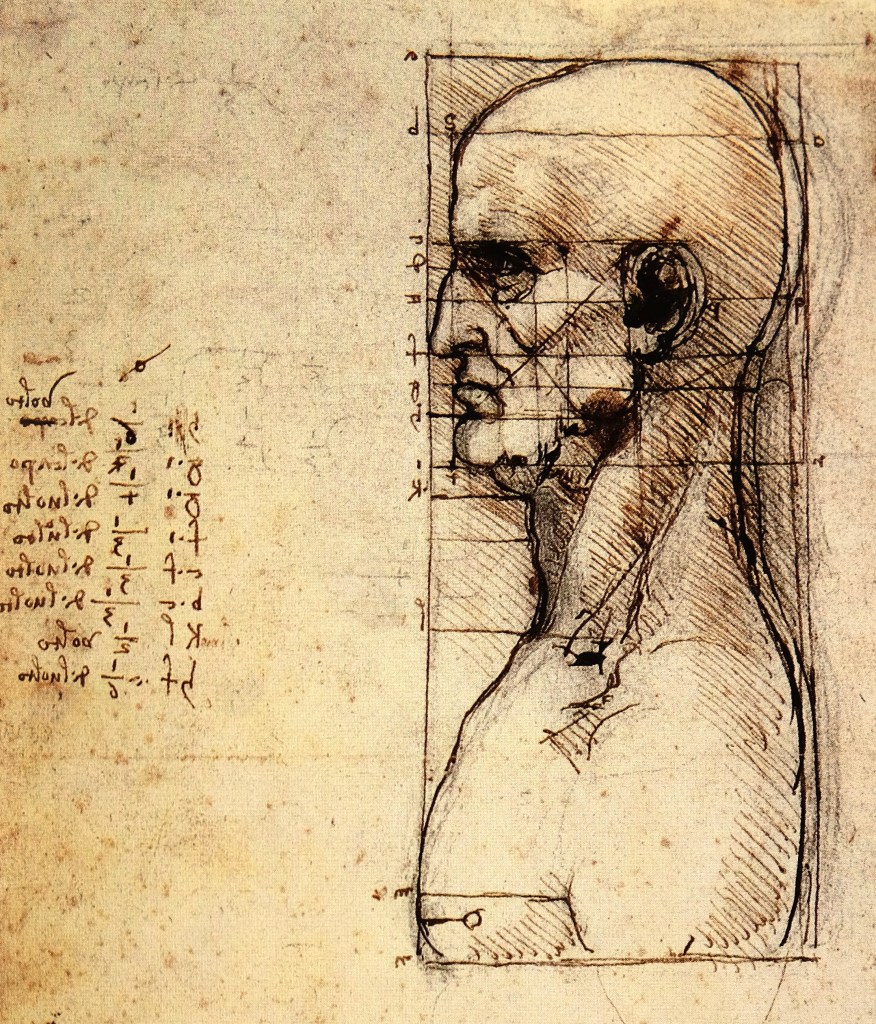
Okay, if we’re going to understand Parky’s, we need to get inside our heads. Way inside our heads. We’re talking “Journey-to-the-Center-of-the-Earth” inside.
Like DaVinci might have.
Yep, deep inside that 3 lb. ugly gray/pink walnut shell mound of worms, that marvel of evolutionary development that supposedly sets us apart from the rest of the animal world…I have my doubts… is where things go haywire with those of us in the Parky’s Club.
Fun fact. I learned this from my brother. Did you know your brain runs on about 12 watts of power; the same as a dim lightbulb. (Some of us dimmer than others.)
Think about that. I mean think about… thinking about that.
Right now, sitting at your kitchen counter, smelling your coffee, lifting your cup, squinting at your iPad, reading and…hopefully… comprehending this nonsense, listening to the faucet drip, and feeling the warmth of your flannel jammies and L.L. Bean fur lined slippers, your brain is doing the work of 18 million laptops.
That’s right. Eighteen MILLION.
Running on only 12 watts, your brain is doing what an AI center would require 2.7 gigawatts to do. “Giga?” That means “billions.” We’re talking infrastructure the size of a large power plant. Enough juice to power 130 homes a year, running so hot that it needs, just to cool it, the same amount of water as 4200 Americans use on a daily basis.
Cool, huh?
Now, you can look at the brain in a few ways. You might look at it as it would appear if you opened your skull and took it out. Gross, right? I know. So, let’s use a model.
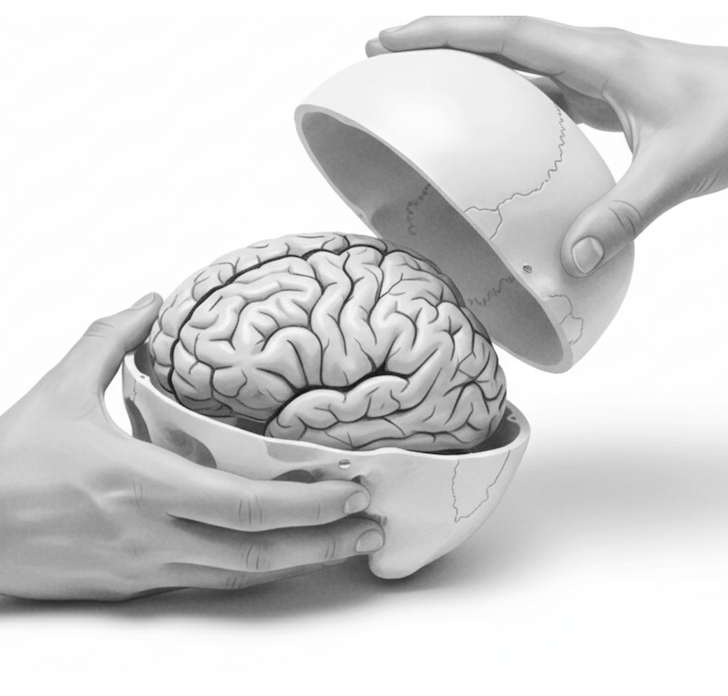
But what about inside?
Okay, let’s take a look under the hood.
Imagine you sliced a brain open to look inside. You could do that three ways. These are what your anatomical wizards call “sectional planes.”
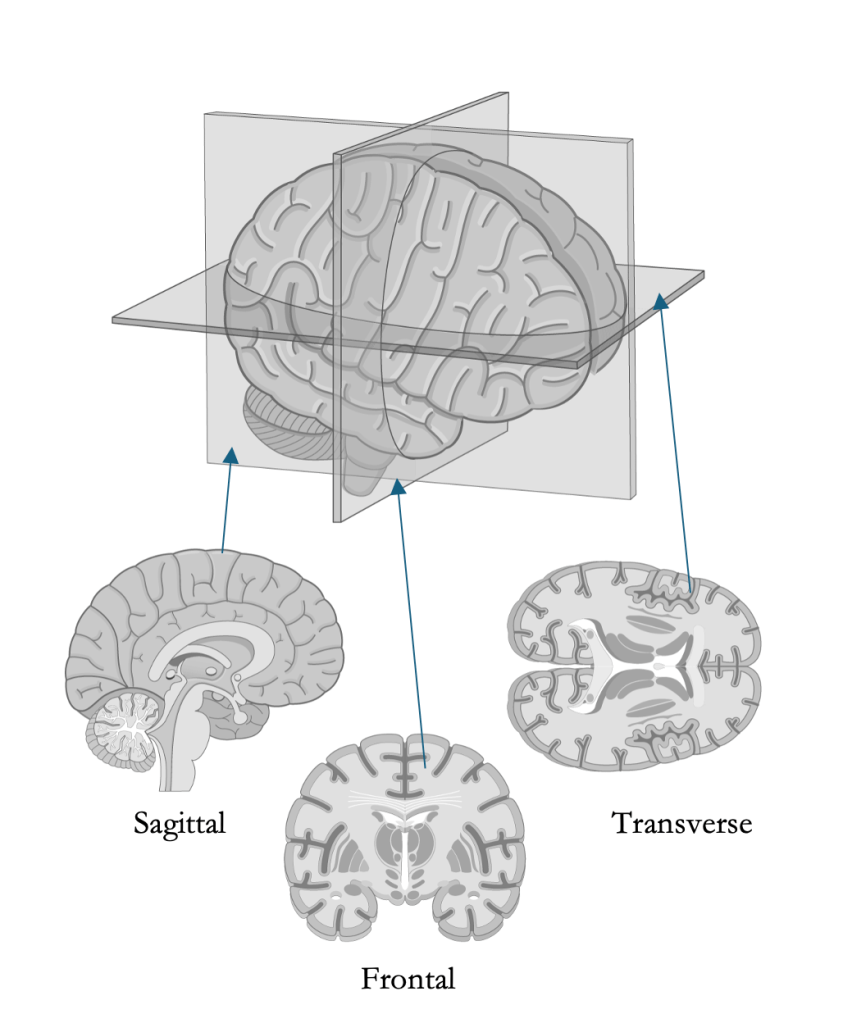
You could cut it to separate top and bottom; this slice is called a transverse section. Or cut it to separate left and right; this slice is called a sagittal section. Or you could cut it to separate front and back; this is called a frontal or coronal section.
With me? Good.
Now, every day we are finding out that a lot of what we thought yesterday about the brain is probably wrong today. The spooky little blob talks to itself in ways we don’t yet understand. Kinda like trees. That said, we’re pretty sure the ol’ noggin separates brain business into compartments. I think of them as departments. Your scientist types call them lobes.
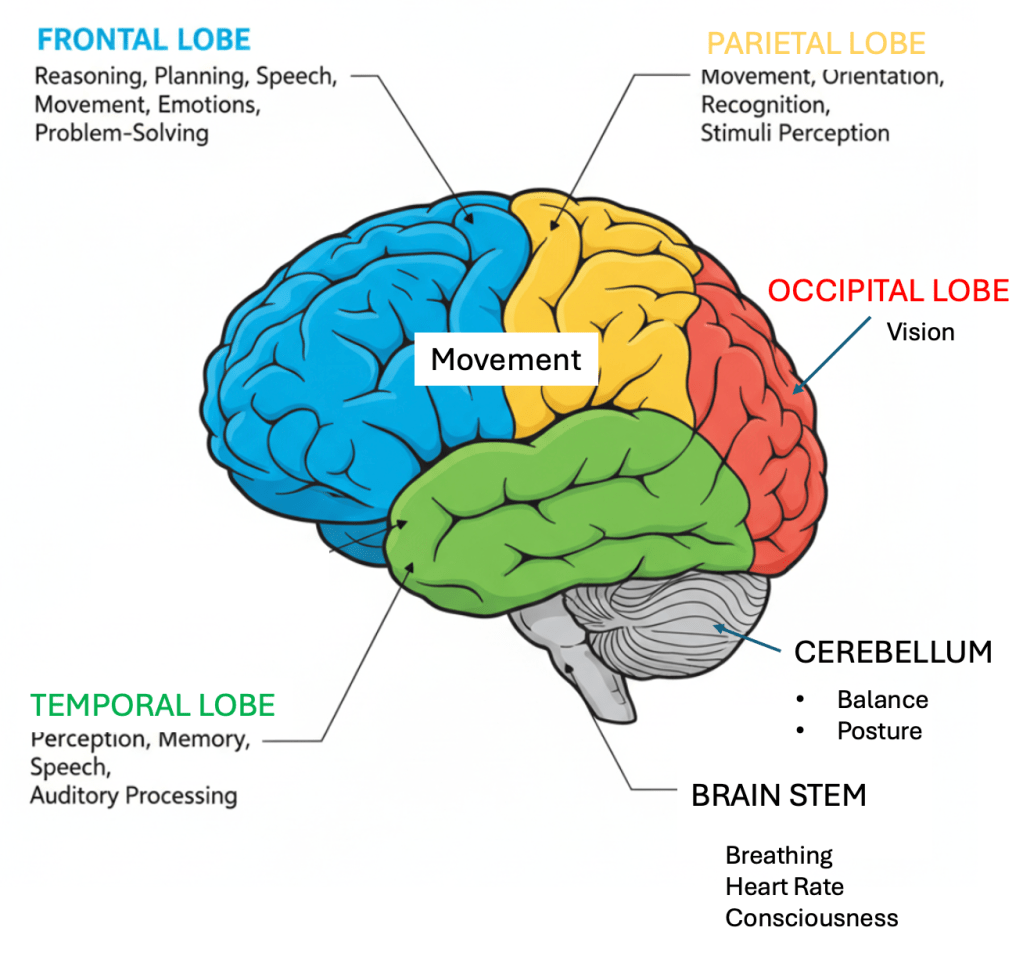
Just think of it. You’ve got your frontal lobe to work the Sunday Times crossword puzzle and plan the day and wrestle with your morning crankiness. Your parietal lobe to smell the coffee and feel your butt on the chair. Your occipital lobe to see the puzzle. The cerebellum to remain upright on your chair. The brain stem which keeps you breathing and your heart beating. And the temporal lobe which enables you to store and access information (i.e. memory) to answer 5 Down …hmmm… “A four-letter word for the brain that starts with an “M”.
Sorry… “Moron” has five letters. Keep at it.
All of that…and so much more…is happening at the same time. We’re talking multitasking-a-go-go.
The one function you may not think about…because you’re thinking about that four-letter word… is movement. Our brains control how we move.The control room for movement in the brain is the basal ganglia. It is the size of a gum ball. You have two of them. The right basal ganglia controls the left side of your body; the left basal ganglia controls the right side of your body. (Don’t ask; makes no sense to me either.) Both are located deep in the brain.
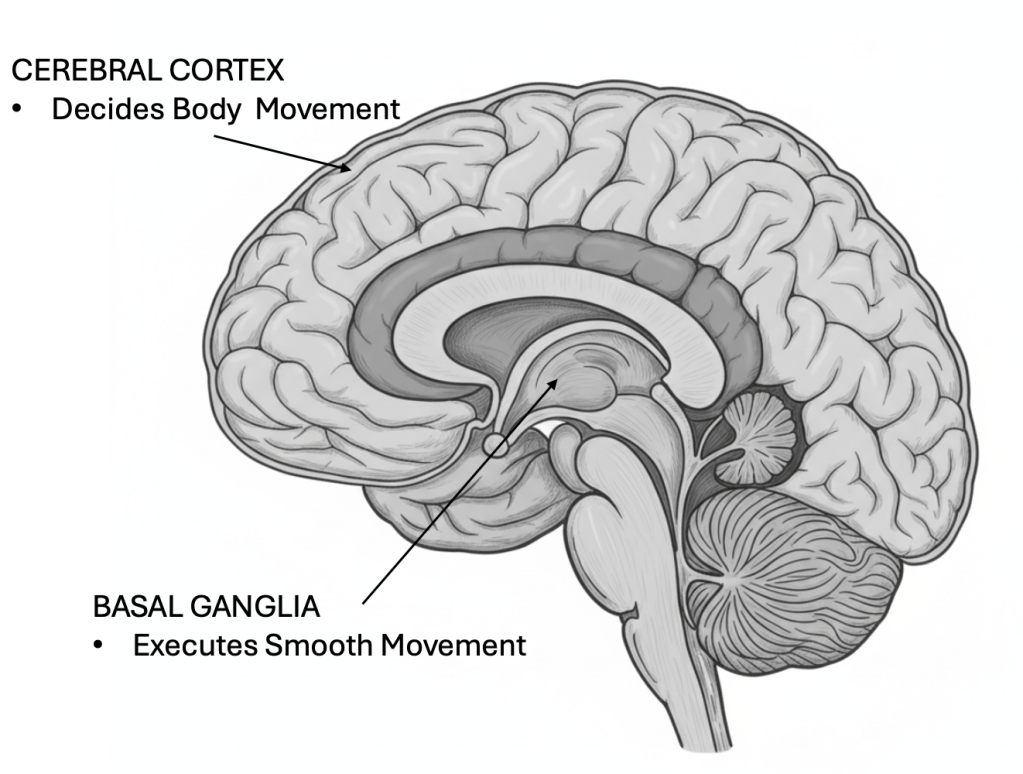
Here’s the basal ganglia in a front cross section:
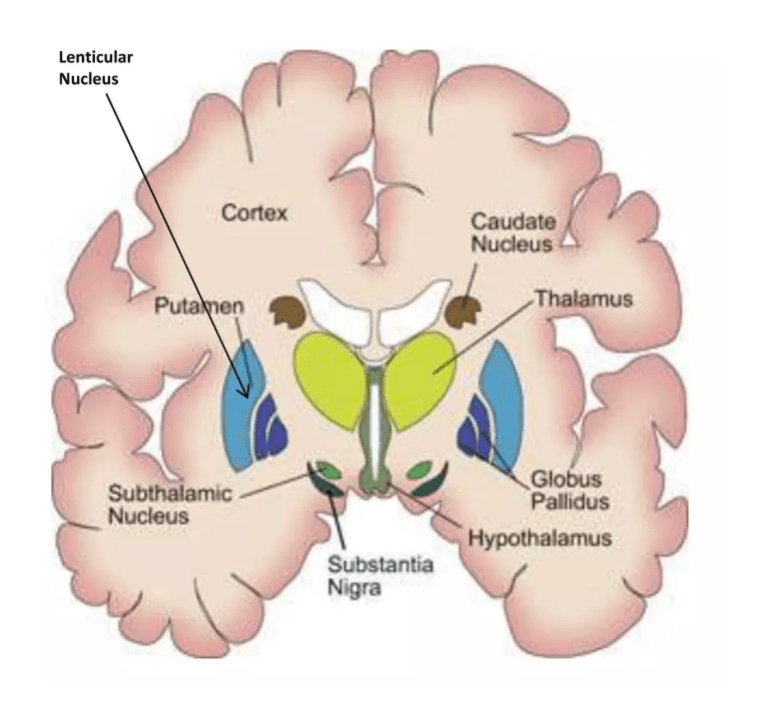
Here it is a sagittal cross section.
Now, movement is more than what you might think.
Let’s imagine it dawns on you that a four-letter word for brain is “MIND.” You decide to reach with your arm and grasp with your fingers that Ticonderoga No. 2 pencil you see on the countertop to fill in the squares. Seems simple enough. Right?
Wrong.
To do this, you form the intent in your cerebral cortex to move your hand. That fires off a signal to the basal ganglia (i.e. “I want that pencil; let’s grip it.”) Since you are right-handed, this takes place in the basal ganglia on the left side of the brain. It converts the decision into action.
The action is a complex and choreographed subconscious combination of muscle contractions and extensions in the large muscles in your core, shoulder and upper arm to provide stability, several muscles in your forearm to bend and straighten your wrist and fingers, and several small muscles in your hand to provide the learned movement pattern by which you exercise the fine motor control to grasp the pencil.
We haven’t even got to spelling, printing, etc.
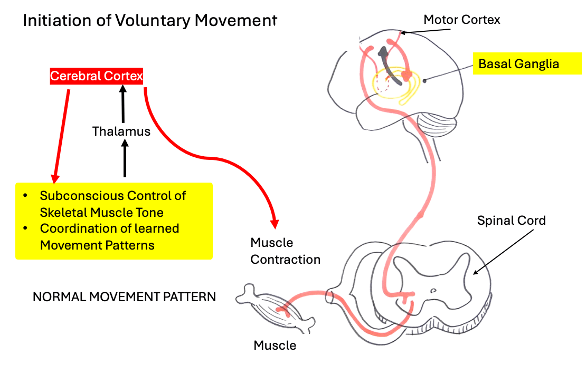
The basal ganglia directs all those muscles at once to do different things. But, for our purposes, let’s focus on just one. Let’s say, the branches of the extensor digitorum in your right hand.
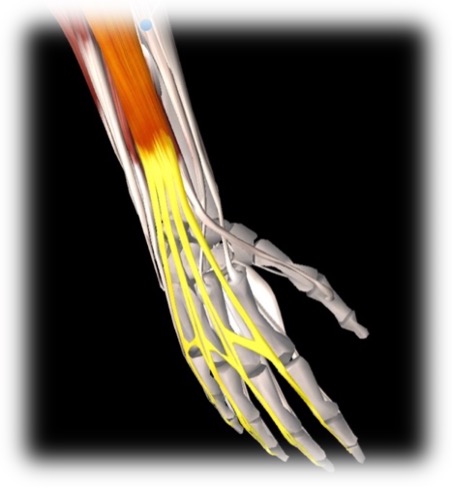
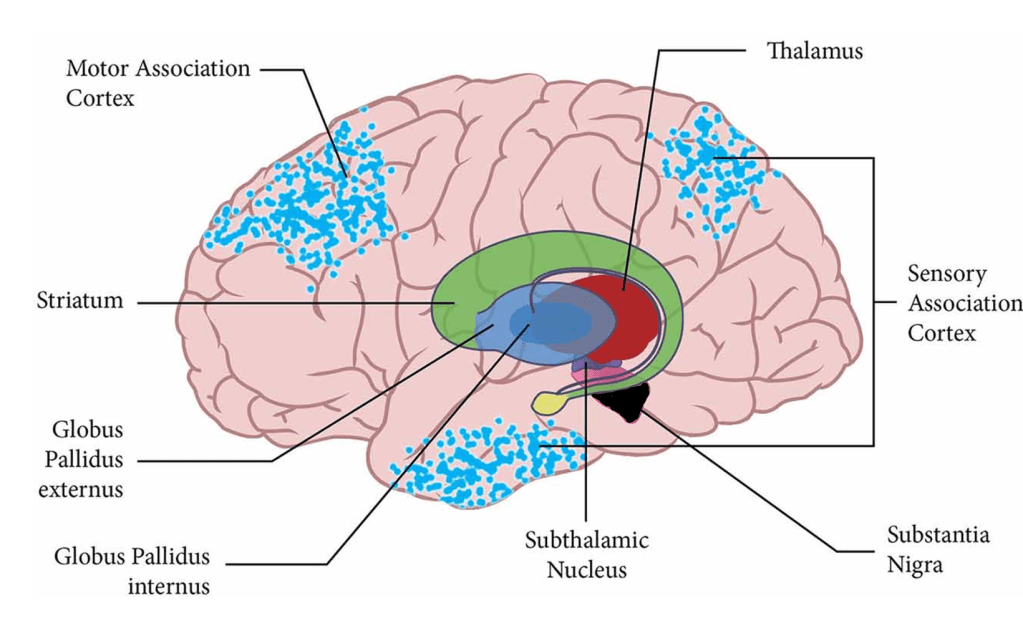
This is where it gets tricky. We need to know the parts of the basal ganglia. Here they are:
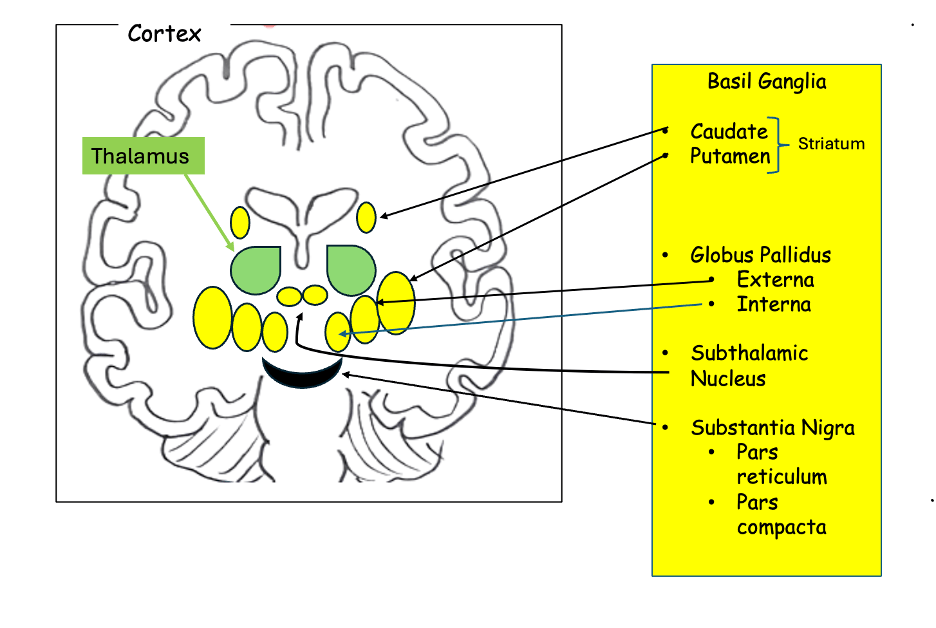
Now, I won’t get too far into the weeds, but let me take a stab at explaining how these parts of the Basil Ganglia convert an idea into smooth muscle movement.
If everything is working right, a smooth muscle movement is the result of a combination of a “direct pathway” and an “indirect pathway.” Think of the direct pathway as an “on” switch promoting movement and the indirect pathway as an “off” switch inhibiting/terminating movement.
All roads, direct and indirect, start from the Striatum and lead to the Thalamus. The direct pathway signal goes from the Cortex to the Striatum to the Globas Pallidus Interna to the Thalamus and back to the cortex. The indirect pathway signal goes from the Cortex to the Striatum to the Globus Pallidus Externa to the Subthalmic Nucleus to the Globus Pallidus to the Thalamus and back to the Cortex.
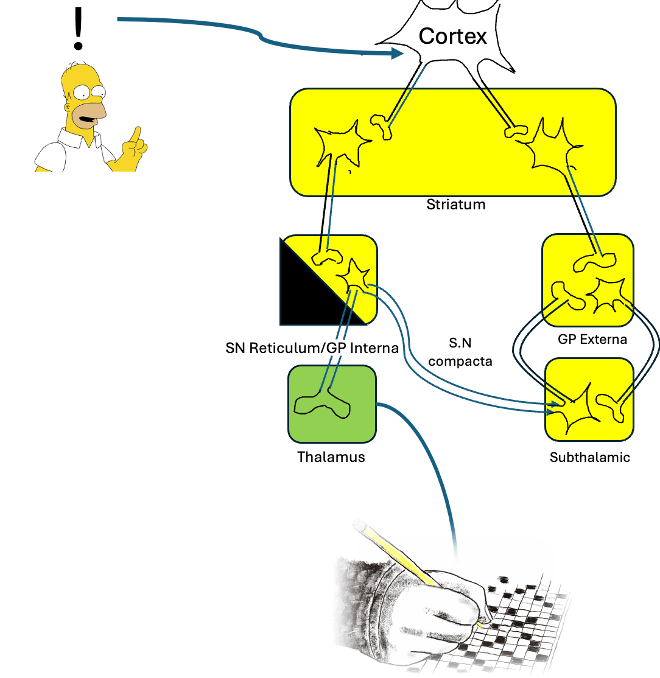
I know. Just trust me. Think of it like booking a flight from SFO to Rome. You can fly nonstop or by way of Frankfurt. They both get there but one is fast and the other slows you down.
One more thing…
Both paths rely on Dopamine. What is Dopamine? Well, here it is:
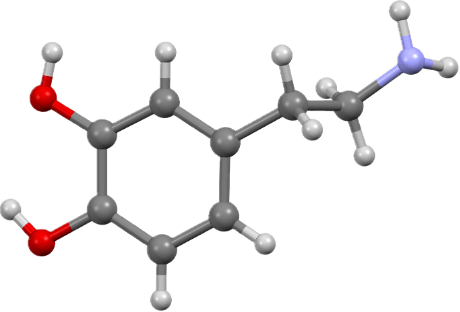
Sorry you asked? I know. That’s why I never took Organic Chem.
Dopamine is an organic chemical, C8H11NO2 that acts as a neurotransmitter, a chemical released by nerve cells to send signals to other nerve cells.
It’s often referred to as the “pleasure chemical” because it is released during sex (some…I’m not saying who…actually find their Parky symptoms ease after a little of the ol’ “doing the nasty”; I myself have volunteered for clinical trials but, thus far, my heroic self-sacrifice to aid science has been politely declined).
Dopamine is so much more than the byproduct of good sex. It regulates your mood, helps you deal with emotions, enables you to pay attention. All sorts of things.
Bur for our purposes, let’s focus on “motor control.”
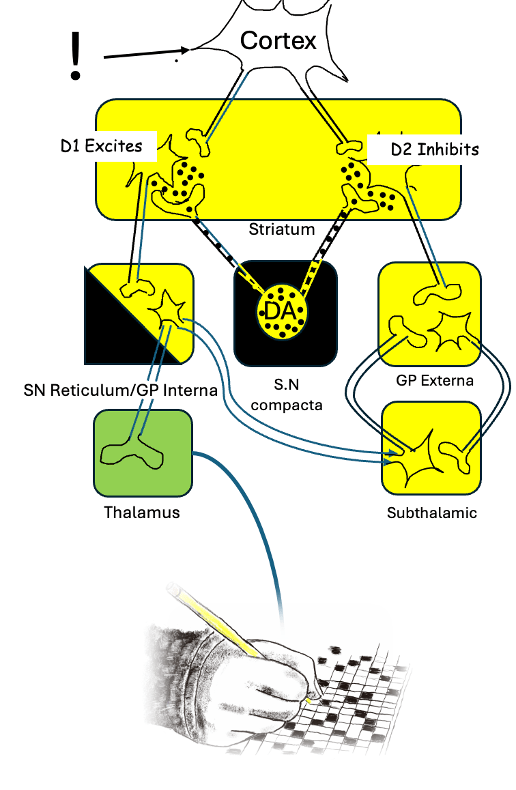
Dopamine is produced in the substantia nigra and released into the striatum and can bind on two types of receptors: D1 receptors which fire up the direct pathway, and D2 receptors which fire up the indirect pathway. So long as there is Dopamine, both pathways do what they should; the Direct excites and the Indirect inhibits.
But if there is no dopamine or reduced dopamine, things don’t work. The excite doesn’t excite and the inhibit over inhibits. The poor little Thalamus doesn’t know what to do with itself. It needs direction. And, without it, turns into a Whirling Dervish.
The net result are the classic signs of Parkinson’s. Our hands tremble. We are stiff and slow. We have a hard time getting up from a chair. We freeze in place when we walk.
In short, we run into…maybe that’s not the right expression…we stumble into the dreaded “…ia’s”
- akinesia (no movement);
- bradykinesia (struggle to initiate movement);
- hypomimia (expressionless face),
- dysphagia (difficulty swallowing),
- hypophonia (soft voice),
- anosmia (can’t smell)
And if embarrassment hadn’t already been maxed out, we dribble from where we shouldn’t dribble. We’re not talking Steph Curry dribbling.
The “nigra” in “substantia nigra” means “black” in Latin. It is black because of a pigment called neuromelanin which is a byproduct of dopamine metabolism. You want black substantia nigra because that means you’re breaking down dopamine. That’s good. If you’re substantia nigra are not black, that’s bad. That means you’re not breaking down dopamine and that’s because dopamine is missing.
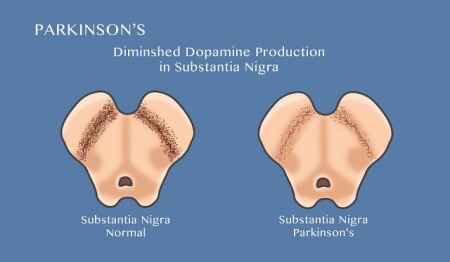
So where did my damn dopamine get up and go to?
Turns out, the neurons which produce our dopamine in those of us with Parky’s have died. In fact, they began to die a long time ago, long before we noticed any symptoms. We just didn’t get the memo. You don’t see symptoms until 80% of your dopamine producing neurons have died. When you finally notice, almost all of them are kaput.
Why did they die? Scientists are still working on that. It might be an accumulation of a protein called “alpha-synuclein”, otherwise known as Lewy bodies. (Those little suckers may have something to do with Alzheimer’s too.)
The pisser for we…the proud, the few…who suffer from Parky’s is that we are degenerates. That is to say Parkinsons is degenerative. Not only are our dead dopamine-producing-neurons muy finito, the few we have left are not long for the world. The damn disease just gets worse and worse… and worse. Drugs can ease the symptoms, but they don’t stop the process and don’t reverse the damage.
So, if my dopamine got up and left, can’t we just put more back in? Is there a dopamine pill?
Kinda.
The go-to drug of choice is Sinemet aka Carbidopa/Levodopa or what I call “Yabba-dabba-doo” It has been around since 1975.
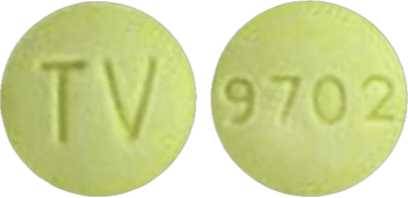
They make it in a time release variation as well. A little blue pill. (Not that Blue Pill,)
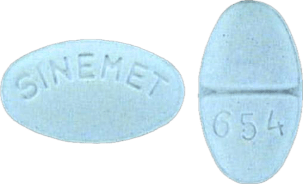
The Levodopa part increases dopamine. The Carbidopa part prevents nausea. Each dose begins working in about ten minutes to two hours depending on the formulation, with a duration of effect of about five hours.
So far, so good, right?
Not exactly.
With prolonged usage over time, Sinemet can lead to the dreaded “on/off” phenomenon. “On” periods are times when the medication is working well, and tremors, stiffness, and slowness are well-controlled. “Off” periods occur when the damn stuff wears off and the symptoms return with a vengeance, sometimes worse. We call this the “wearing-off” time before the next scheduled dose.
I could go on and on, but I suspect I am reaching terminal TMI. So, I will rely on the judgment part of my brain…which was suspect long before my dopamine dried up…and leave you with the immortal melody, if slightly modified lyrics of Cole Porter…
“

You say on . . . I say off.
I say off . . . you say on.
Dribble . . . Drabble.
Nigra . . .Niagara.
Let’s call the whole thing off.



















 Can't Hold Still