I learned…or I thought I learned… the lesson of “false summits” when I was a boy.
It’s a simple one.
Whether on foot or on a bike, never assume the hill on which you find yourself is the last. Never meet that open horizon ahead thinking, no matter how blue and cloudless the sky surrounding it, you have reached the top, the end of your struggle.
You haven’t. More climb awaits you. You just don’t yet see it.
The lesson of the false summit goes like this:
Always expect the ascent is endless and any descent is a tease on the way to a higher climb.
A true summit is a realization only after the fact.
I foolishly thought the activation of the gizmo would be the summit. For months…through many doctor’s visits, tests, CT scans and MRI’s, sleepless nights, two brain surgeries, and weeks of very difficult anticipation… I thought, with the flip of a switch, my struggle would ease, and peace would return.
It has not.
Dr. Nandipati tells me this is not unusual. That my brain is still swollen (Cathy could have told her that), that it takes weeks, sometime months, to adjust the amplitude on the gizmo to match my tapering reliance on yabba dabba so as to allow me to fire off Malaguena on my silent guitar.
I hope this is true.
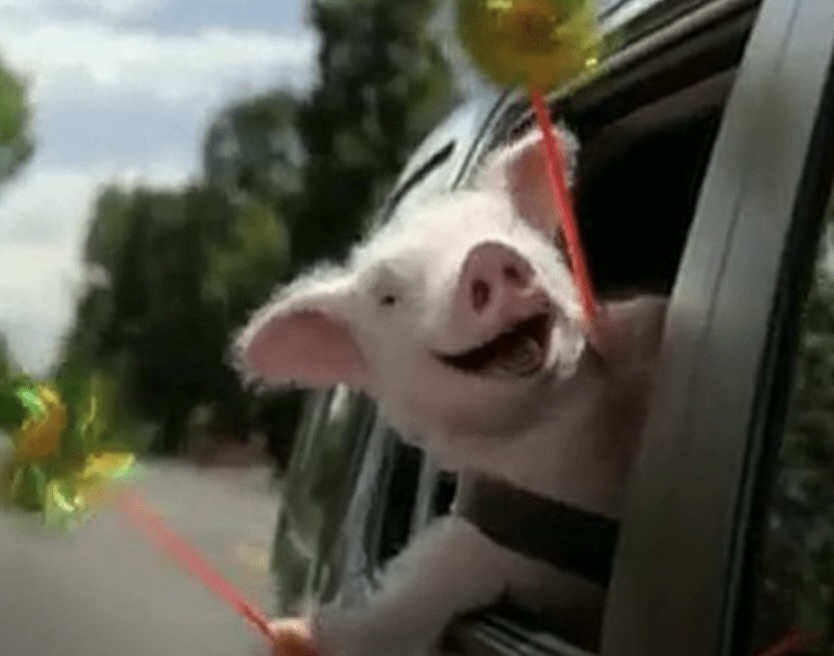
I had hoped to ride home from the gizmo activation like the little pig in the GEICO commercial.
That day may yet come.
In the meanwhile, I take comfort in my grandkids who look past my difficulty in remaining upright and encourage me that my hair grows fast, a new recliner which offers a glimpse of the sleep I once enjoyed, and the well wishes of you all. (including Cathy’s cousin Kerry who sent me the furry admonition to “BE HEALED” which I have displayed on my desk and brings me a smile each time I see it.).
My little flnger on my right hand…the pinky I’ve come to rely on to delete bad ideas…is not cooperating. It has a mind of its own. If I had a whole mind, I have half a mind to let it run with this and make my half minded point without me.
et’s tru// ///////////////. The quick brown fox jume=p over the zayx.’
you get the idea/
We are two weeks post the second DBS surgery, a week before the second suture removal, and a week and a half before activation of the gizmo…and I have taken a half an hour to type what used to take me two minutes to type.
This is not at all where I expected to be.
There are a number of competing explanations. The damn Parkinson’s didn’t get the memo and has decided to accelerate during this “time off.” My body has taken the impact of two invasive brain surgeries to heart…the last under prolonged sedation…and is slow to rebound. You are 70 years old Rob and …well… you’re 70 years old.
Whatever the cause, my balance is shot, my fingers are not finding the keys, the drugs don’t seem to work as they once did, and focusing is a big challenge.
And sleep?
If only…
If I stand to do a jig saw puzzle, my legs won’t act up. If I think they are quiet, I lie down. That lasts two minutes and I’m up again.
Repeat. Rinse, Restart.
In the good news department, my buddy Mike Cale came in second in each event he entered in the World Championships in Korea. Some damn Pole got in the way of world domination.
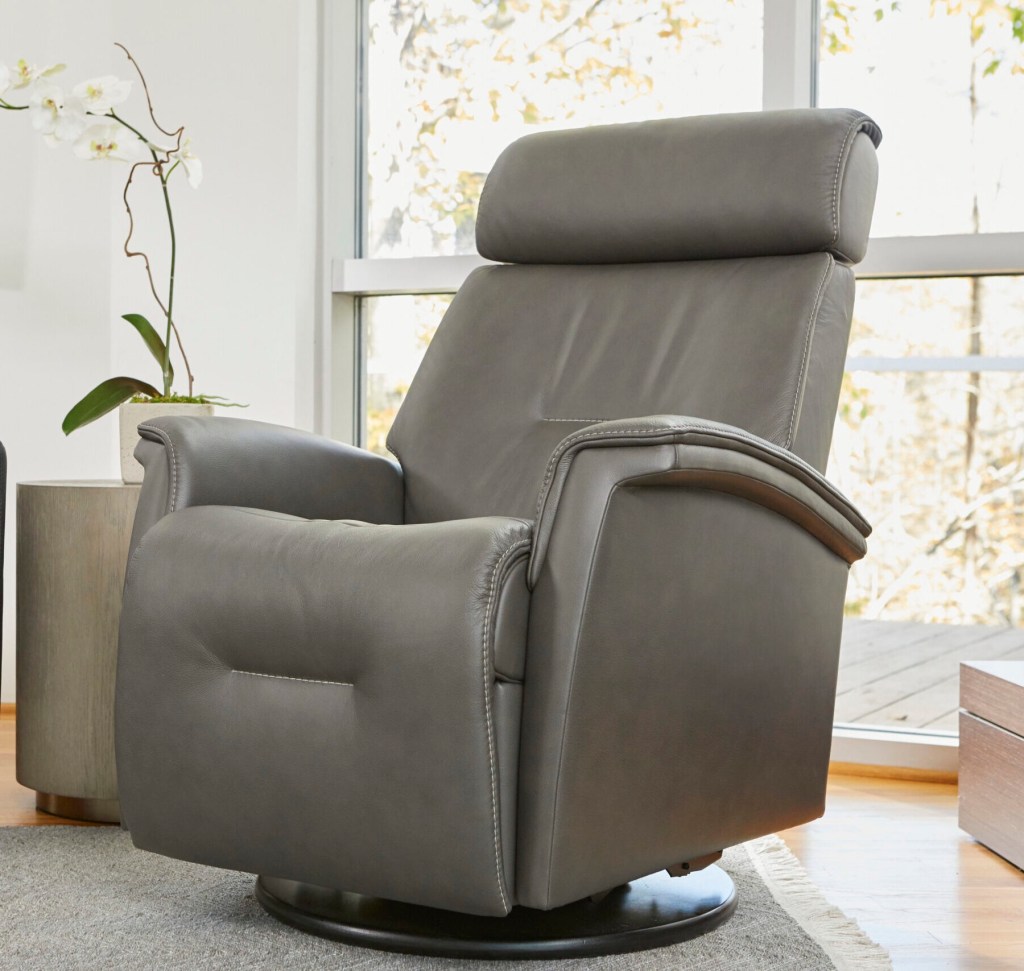
My wonderful wife Cathy has found the perfect chair to answer my woes.The Fjord Rome model rocks, swivels, and will enable me to sleep in a variety of upright positions.
And my kids Kate and Sam keep me laughing:
And I have you. You folks foolish enough to follow along.
Thanks for checking in. Let’s hope this gizmo works.
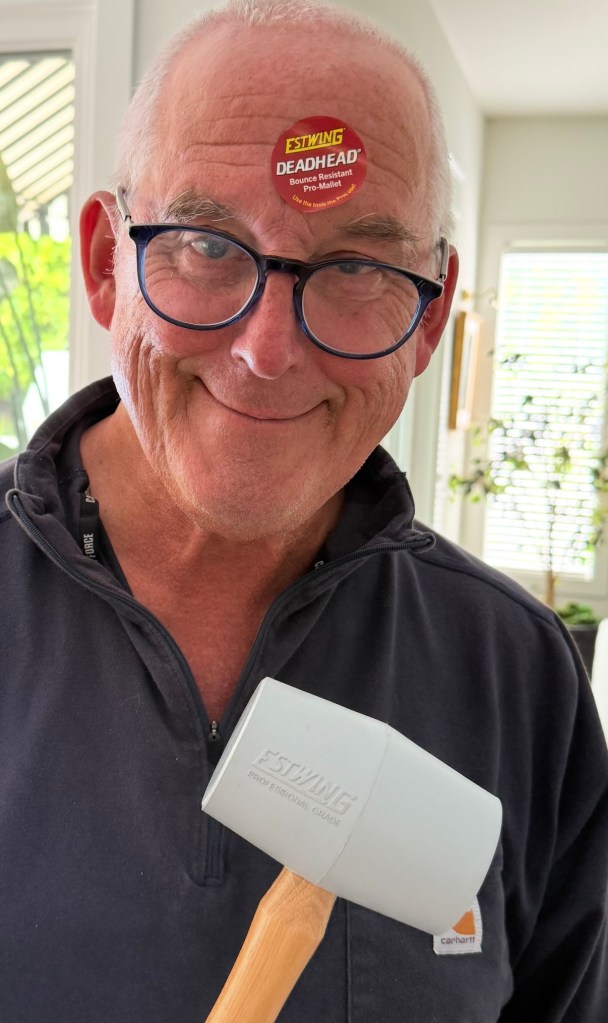
That’s what Cathy calls it. She says it was described as a “must have” in the instructions to a nifty new gardening shed she is building on the side of the house but, judging from what little help I’ve been of late anywhere around the house, I wouldn’t blame her if she starts to think of other “home improvement” projects that might require “bounce resistance” technology.
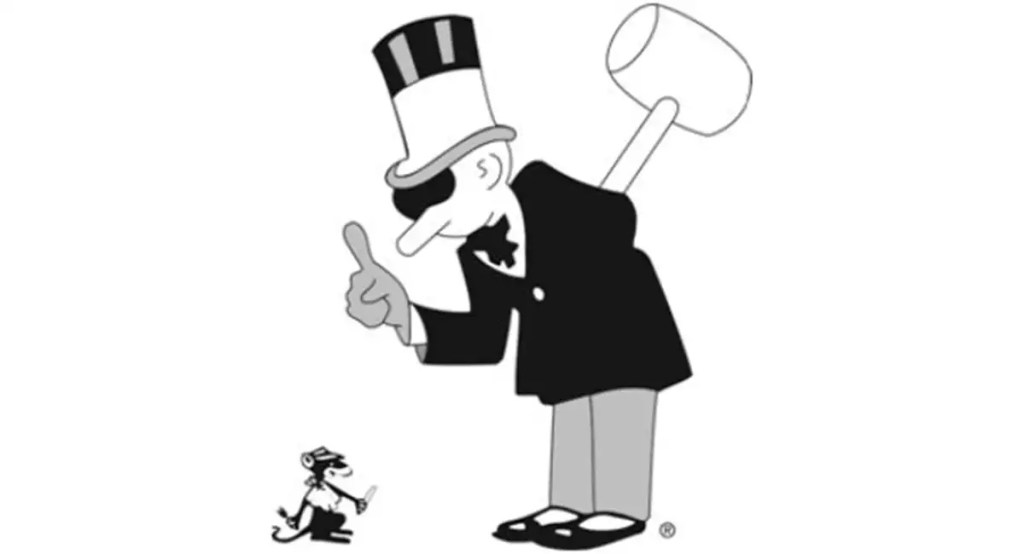
“Bang, Bang Maxwell Silver’s hammer came down upon his head…
My wife…
To say Cathy is a saint is to give too high of praise to saints. Let me give you some quick examples of why I say that:
She slept one eye open on a poor excuse for a window seat in the ICU in Redwood City the entire night after my first surgery just to keep that same watchful eye on me. Throughout the night, she pleasantly reminded me to take deep breaths when the damn alarms on the respiration rate and blood oxygen meters…apparently unfamiliar with the O2 output of my slow beating Secretariat size heart…kept going off.
She made not one, but two…count em…two… two his and her… couch beds in the family room, with clean sheets and pillow cases each night, so I needn’t negotiate the stairs to the bedroom and so no intrepid germ might find its way from my pillow case to my sutures in the first two weeks after the surgery.
For days, like Lilly Tomlin working overtime, she’s fielded texts, e-mails and phone calls answering kind inquiries from family and friends keeping them up to date so they needn’t worry and I might sleep.
Since I’m restricted from driving, she’s ferried me about like Ms. Daisy driving for Morgan Freeman. First to Petaluma Kaiser to have my stitches removed; then to pick me up from my friend Mike’s house out in the boonies, and whenever necessary to get me out and about when my cabin fever starts to reach Ted Kaczynski level.
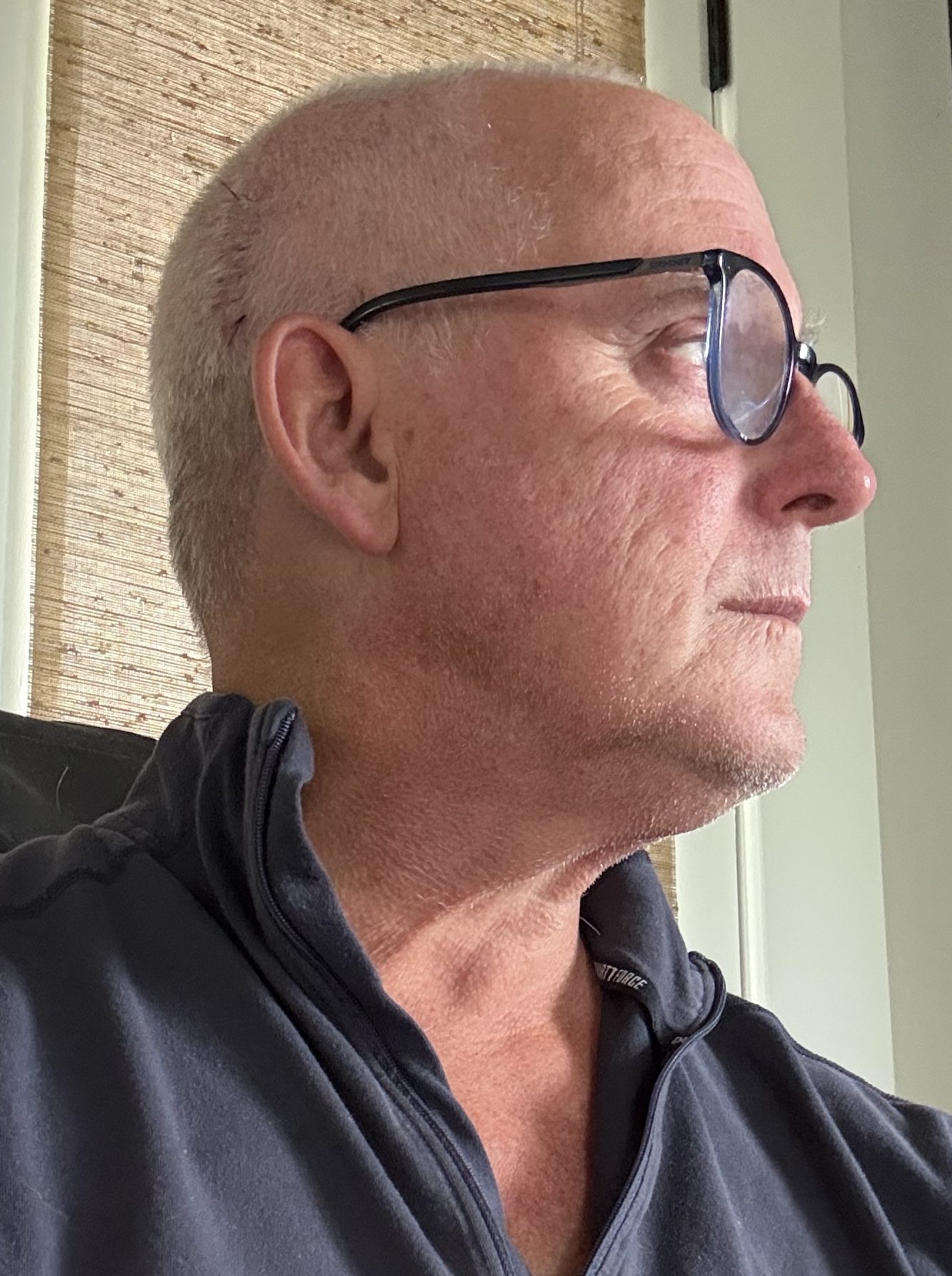
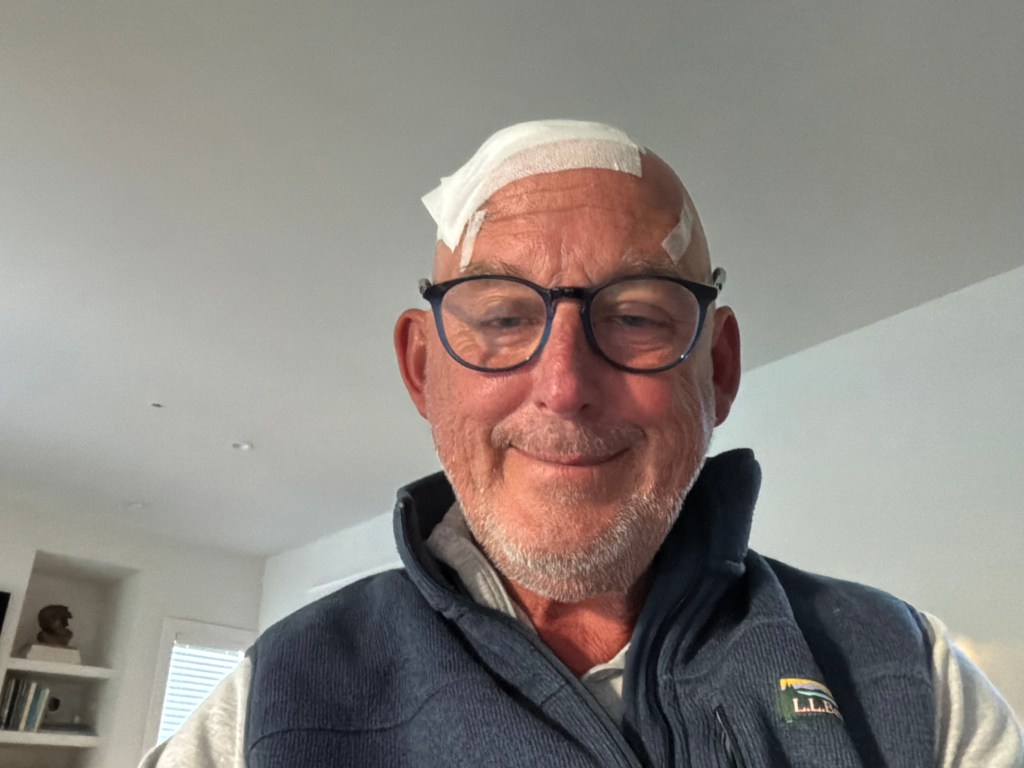
And when I catch a glimpse of myself in the mirror, wince, and complain that I can’t decide whether I more resemble Danny Devito, Dr. Evil, Mahatma Gandhi, or that guy in The Princess Bride who runs around screaming “THAT’S INCONCEIVABLE”, she reassures me that, when I wear my glasses and she catches me in the right light, I’m a dead ringer for a gay Stanley Tucci in The Devil Wears Prada.
So, I’ve got that going for me.
In short, she’s an angel.
Mind you, I say that with caution.
Why?
Not the “angel” part…the “short” part.
I normally try to avoid the word “short” in the same sentence…hell, the same paragraph…oh, who’re we kidding… in the same hemisphere… when discussing my wife.
That is…ever since the unfortunate incident at the tail end of 7thgrade when my inscription in her yearbook…something like “Have a great summer, Shorty”…a lip-pursed-7th-grader-hoping-for-a-kiss term of endearment that apparently sailed right over her innocent head…failed to capture the reaction I thought sure it would engender…and prompted her not to speak to me for what?
Almost 50 years.
So, let’s just keep it sh…I mean…let’s just say, I don’t deserve her.
***
I’ve been wrestling with the right metaphor to describe this damn holding pattern between my two surgeries.
Think Rob, think. You’re a wordsmith. Work your magic.
Hmmmm…?
I could go with a sports analogy. You know…half time. Something like “It’s half time and the right brain is trailing the left brain by six.
Nah. Overused. Cliche.
How about a film reference? I could play with the word “intermission,” but the last time there was an intermission in a movie was either in Dr. Zhivago or Lawrence of Arabia…maybe The Sound of Music… and since no one goes to the movie theater anymore, I thought the metaphor might be doomed before half time.
Whoops. Sorry. Mixed metaphor. My bad.
So, then I thought, how about something meteorological.
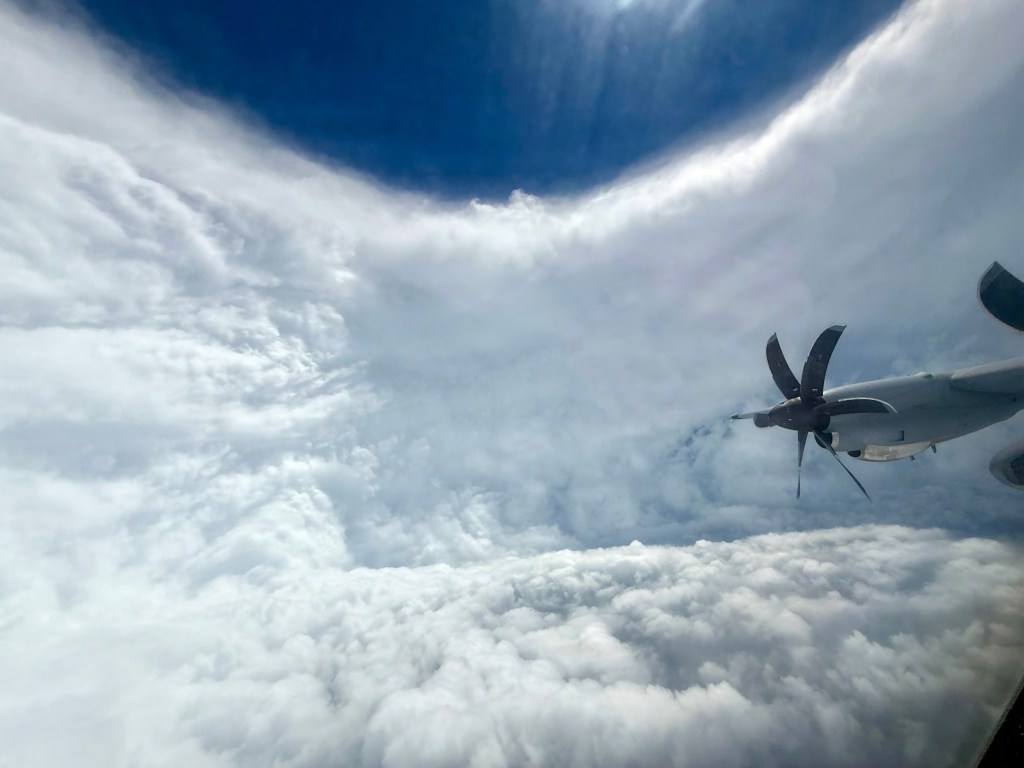
I remember as a kid being so impressed by those pilots who fly into a hurricane. The way they described the eye of the storm. How quiet and peaceful it is.
That might work, Rob.
Here you are, knocked around in 100+ MPH winds. It’s dark. Raining so hard your wipers can’t keep up. Lightning flashing all around. You’re diving and climbing, pitching, yawing, bouncing between updrafts and downdrafts, when, just about the time you think your wings will fall off, the winds cease, the rain stops, and the sun shines down from above.
You’re in the eye of the storm.
A beautiful sunny day, except you’re surrounded by a swirling mess of all-hell-breaking-loose.
It must be such a relief. The peace. The quiet.
But then you have to fly out… through the spin cycle.
I always wondered what it must be like leaving the “eye.” I get the “getting in” part. The “getting out” part I don’t get.
But then I don’t get a lot of things.
When the time comes to leave the eye and plow through the wall back through bedlam to get home, there must be a certain “Do we have to?” You know…a kind of “Can’t we just stay here, ride along, and wait for things to calm down?”
“Let’s just circle here for a while.”
***
Ten days.
Ten days left in the eye.
Then the second surgery. Another buzz cut. Another core sample. This time a matching hole on the left side, a new wire plant to tie into the first one so we can go stereo, a tiny fire-proof junction box above the right ear for the wire nuts, and the main line running down the right side of my neck to the wizzywig battery pack they plan to plant in my right chest.
The good news is, this time, they intend to put me out altogether. Full sedation. No audience participation required. I get to fly back into the storm with instruments on autopilot.
Just knock me out, doc. If you need help, I know a gal with a mallet.
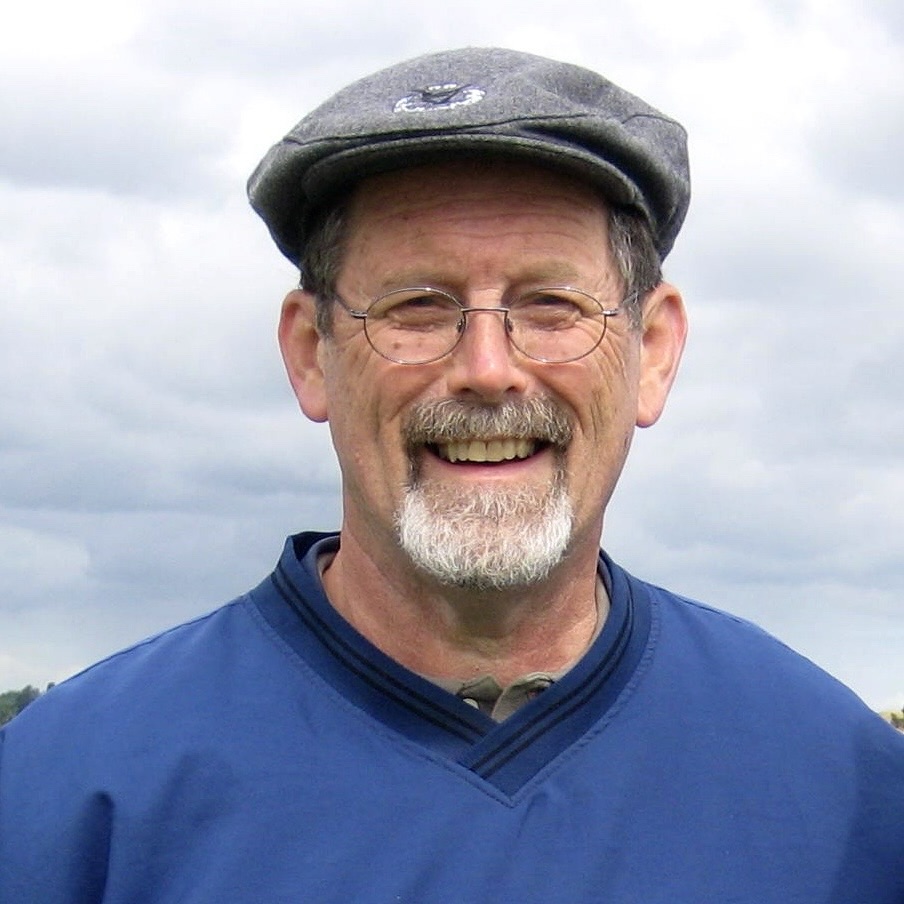
If, like me, you find yourself, from time to time, in need of inspiration, I know a guy.
This guy.
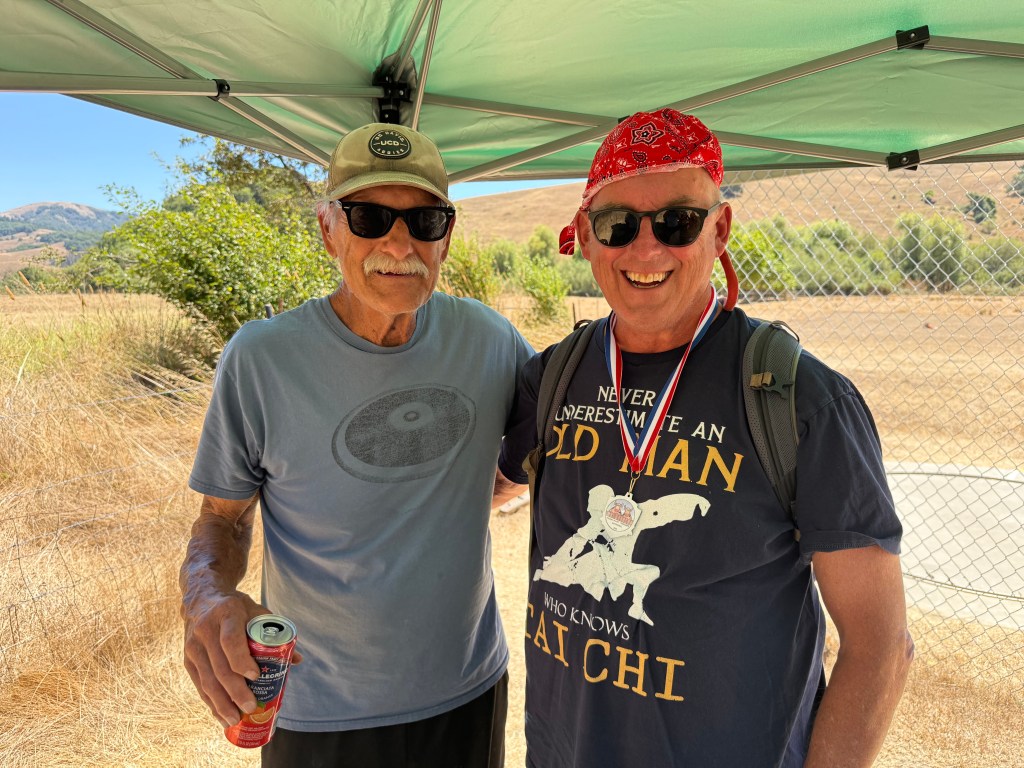
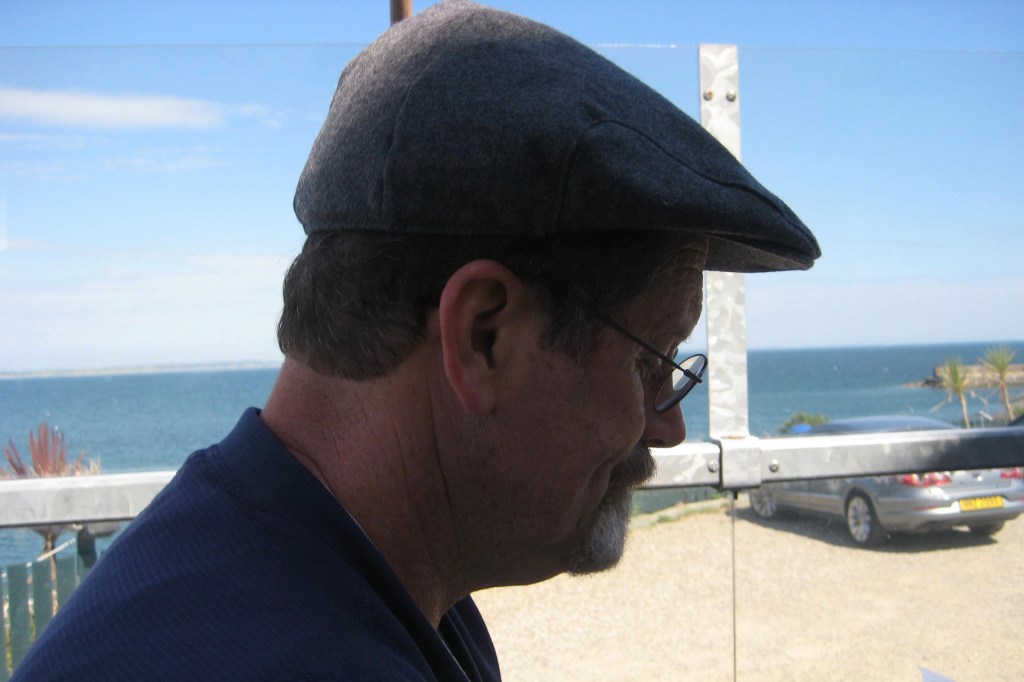
His name is Mike Gale.
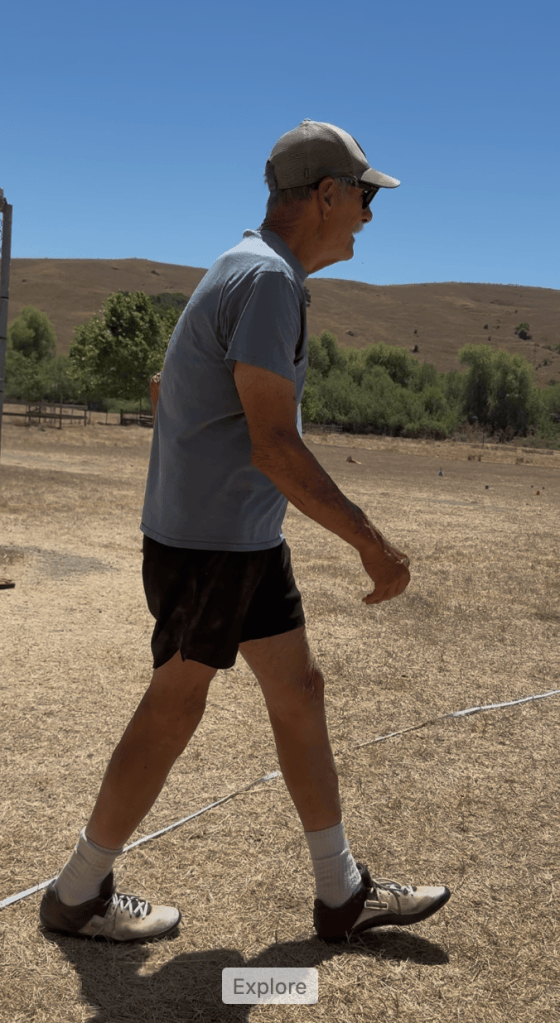
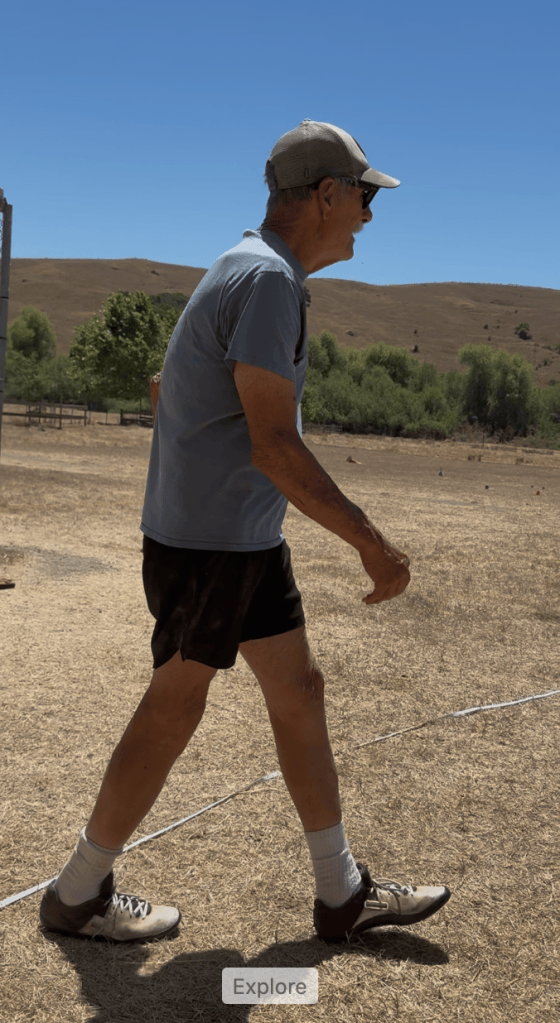
“Okay,” you say. “Looks like a nice fella, Rob. Hard to tell from a still photograph, but looks like he might be getting on in years, maybe has a hitch in his gitty-up.”
To which I would say, “What the hell do you expect from an 85-year-old guy who still runs a working cattle ranch?”
This cattle ranch.
If you drive west from Petaluma toward the coast on Chileno Valley Road, you will pass through the ranch. You might not notice it, save for the stately Victorian that Mike’s wife Sally’s great-great-grandather bought from Henry Halleck who left California to become chief of staff to Abraham Lincoln.
Here’s Sally with Mike. They met when both answered John Kennedy’s call and served in the Peace Corp in the sixties.
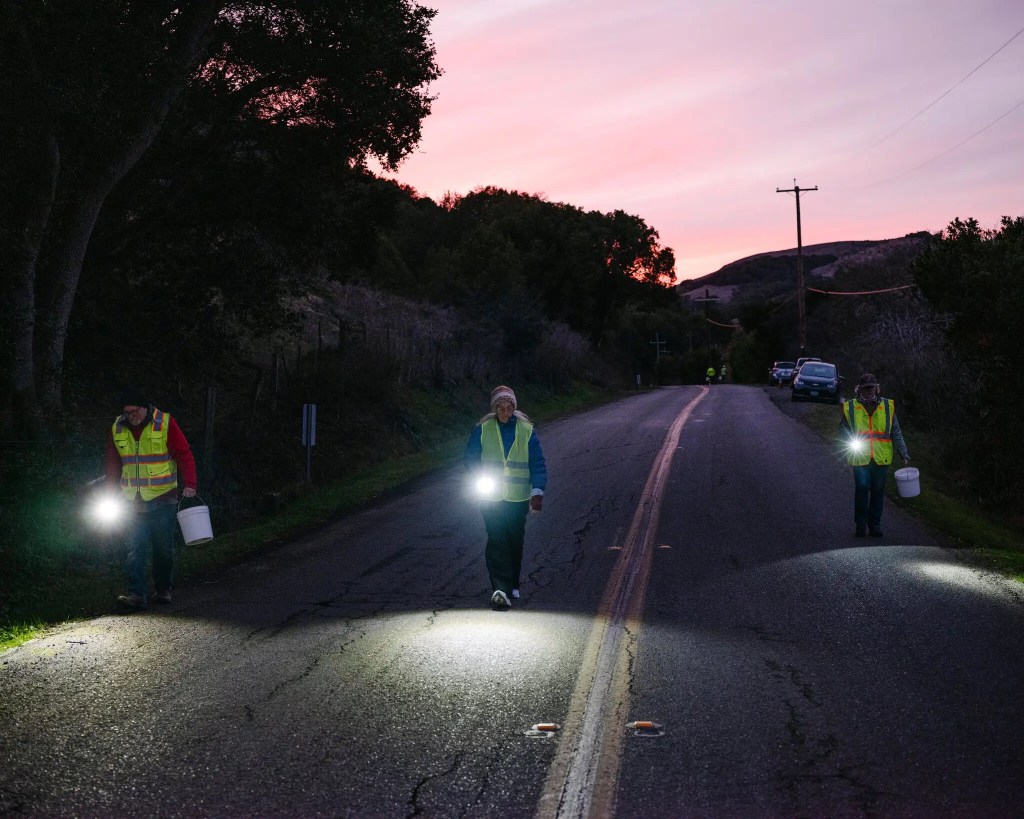
You might have heard about Mike and Sally. Two years ago they were written up in the New York Times for their efforts to save newts.
Yes, newts.
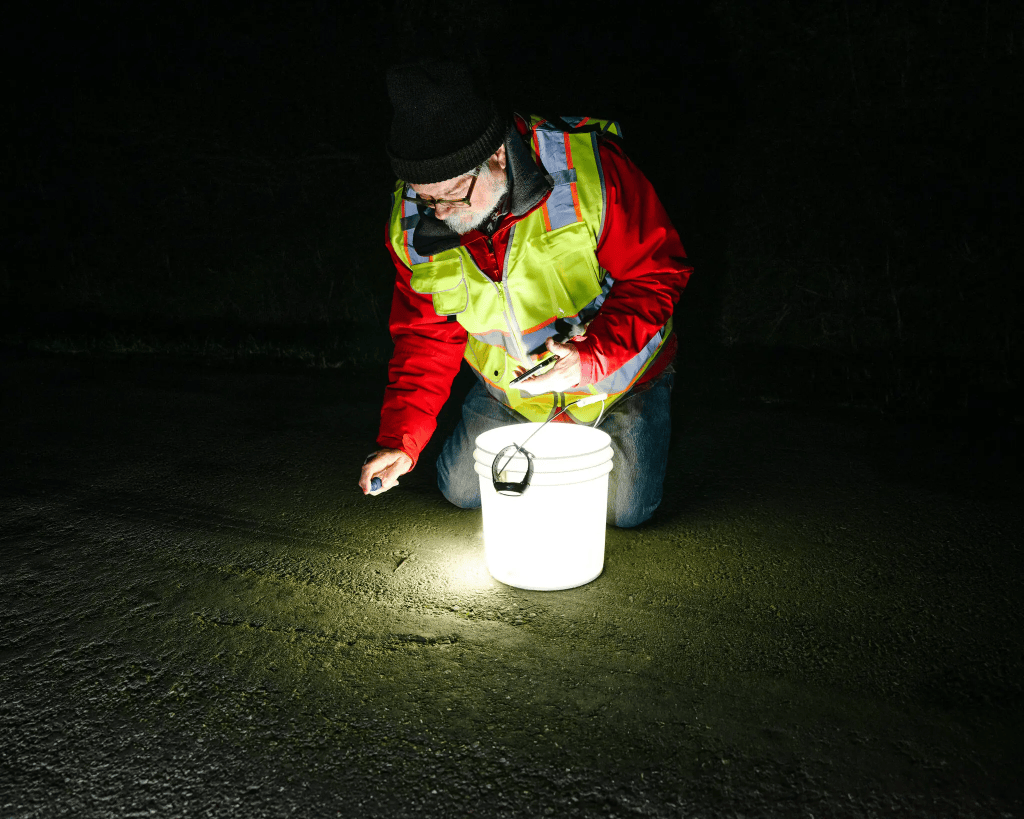
“For the past four years, volunteers have spent their winter nights shepherding newts across a one-mile stretch of Chileno Valley Road, a winding country road in the hills of Petaluma. They call themselves the Chileno Valley Newt Brigade, and their founder, Sally Gale, says they will keep showing up until the newts no longer need them.”
NY Times 1/24/23
“Four years ago, Ms. Gale, who runs a cattle ranch in the area, was driving home from dinner with her husband when she spotted several newts trying to cross the road. Concerned for their safety, Ms. Gale got out of the car and started moving them out of harm’s way. As she walked, she noticed the flattened bodies of dozens of newts that had been run over. The experience inspired her to start the newt brigade, which has since amassed dozens of dedicated members.”
NY Times 1/14/23
But enough about newts, let’s get back to the photo of the old fella with the hitch in his giddy-up.
Look again.
Look closely.
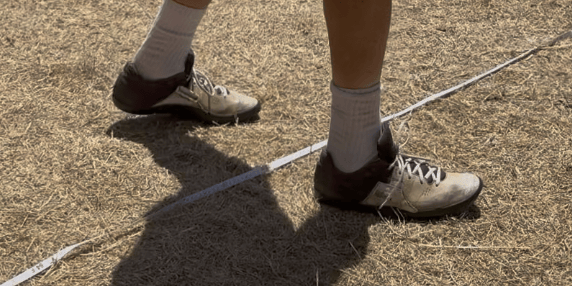
Look at his shoes.
Do you know what kind of shoes those are? The shoes on the 85-year-old guy?
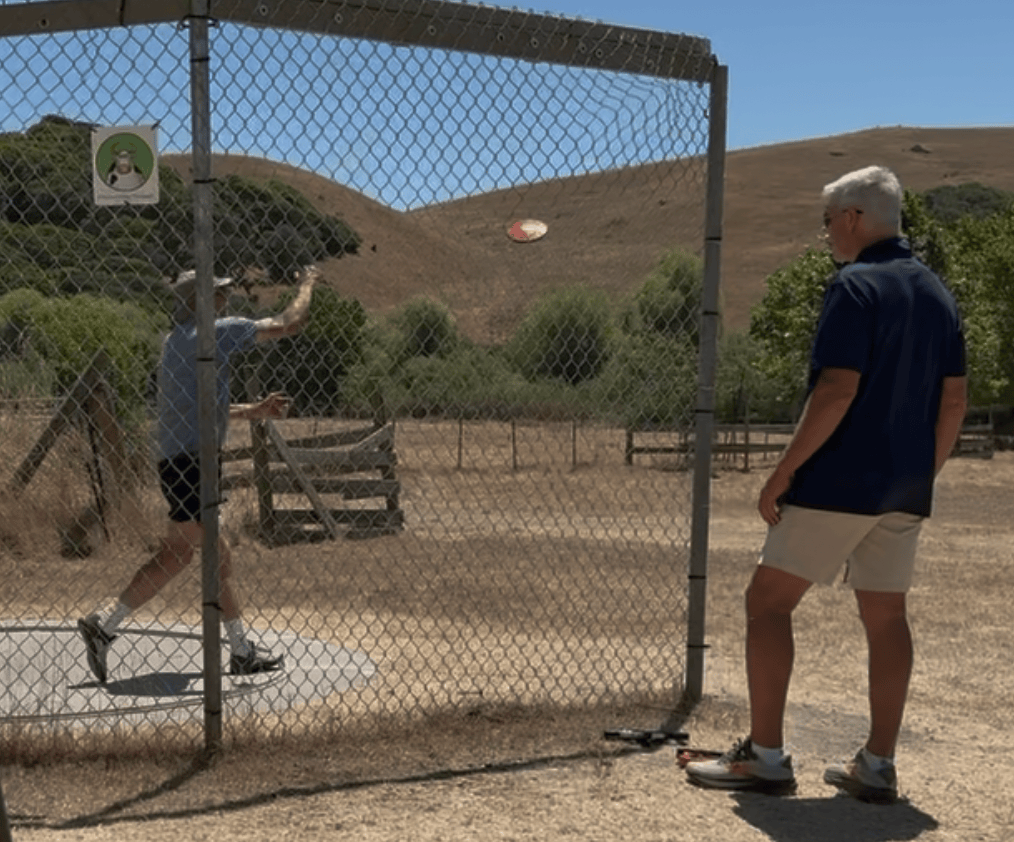
Those are called ‘throwing shoes.” You wear them to throws things …things most 85 year olds don’t throw. Things like…oh I don’t know…a discus or a javelin or a hammer.
Like this…
Or when you want to shot put or… to put it more properly… when you want to put a shot. Like this…
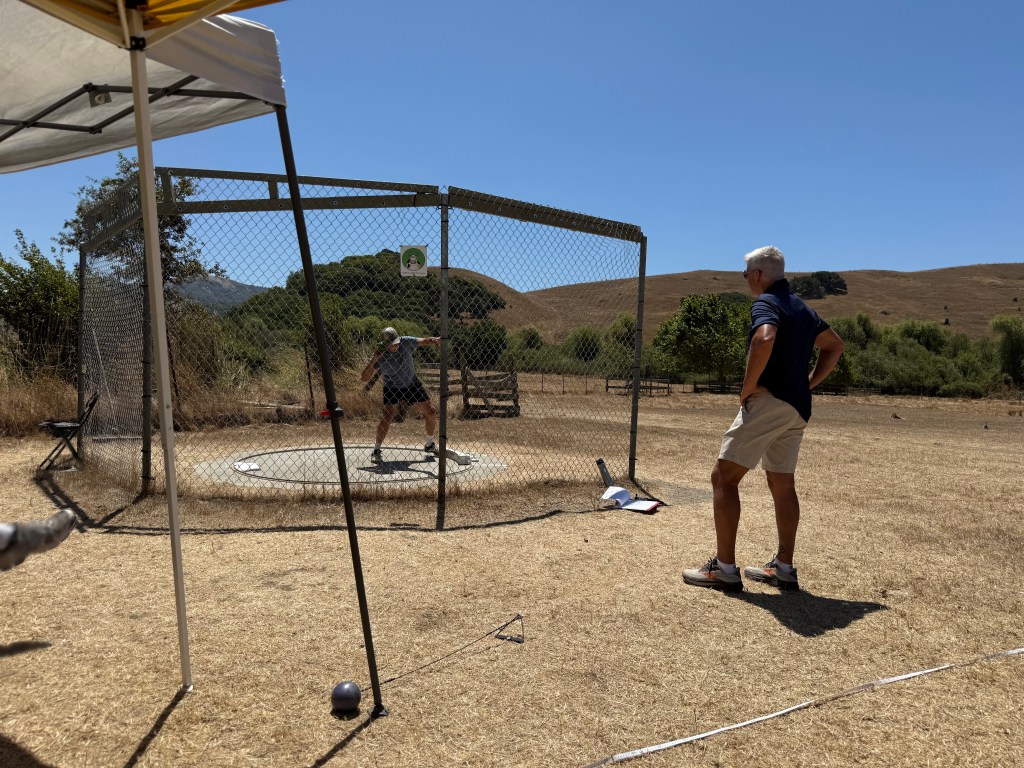
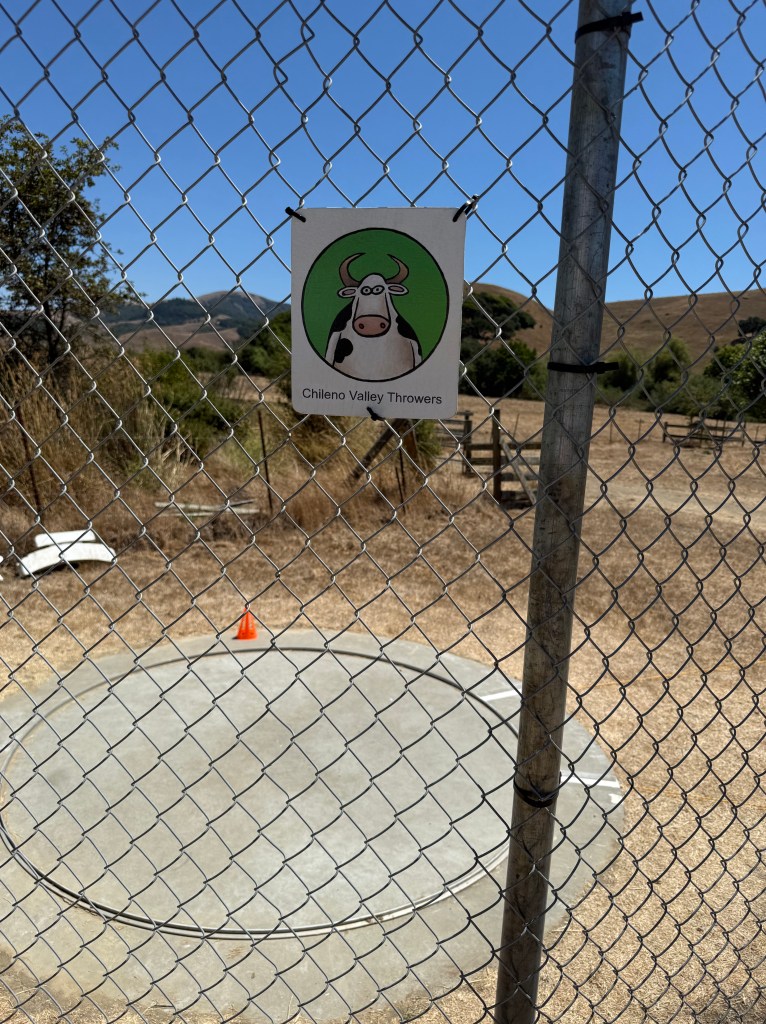
If you stop at the Chileno Valley Ranch, walk to the left of the barn, past the grove of fruit trees, through a cattle gate, you’ll see in a corner of the ranch specifically chosen to test your skill in the prevailing breeze that blows in from the Pacific just a few miles away, a throwing ring Mike has built to Olympic specs
There, Mike and his friends, practice.
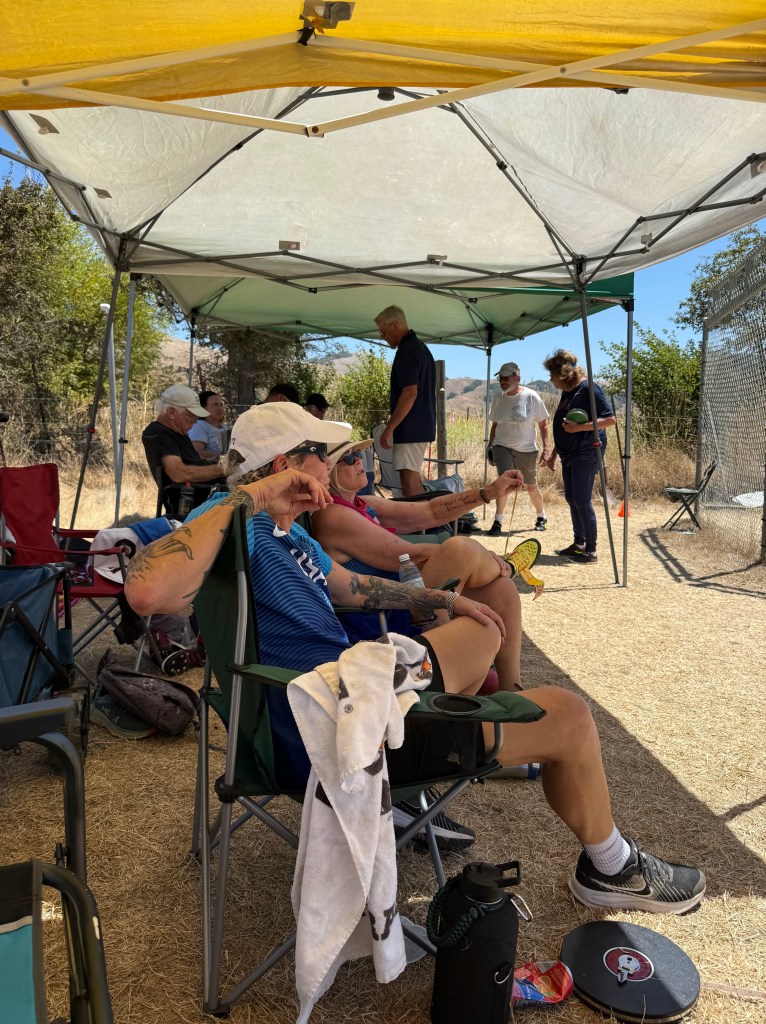
These are Mike’s friends. They are serious about their throwing.
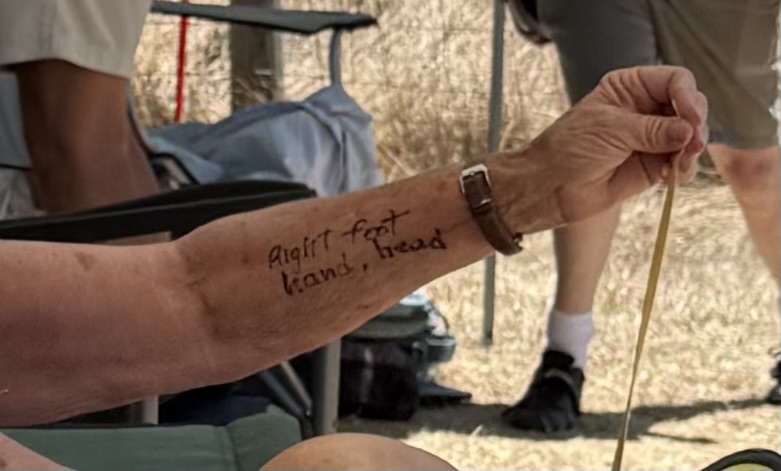
Wanna know how you can tell? See the woman with the outstretched arm pulling on a show lace on her throwing shoes? Zoom in on her left forearm.
“Right foot, hand, head”
I’m not sure what it means, but I’m pretty sure it isn’t a dance step.
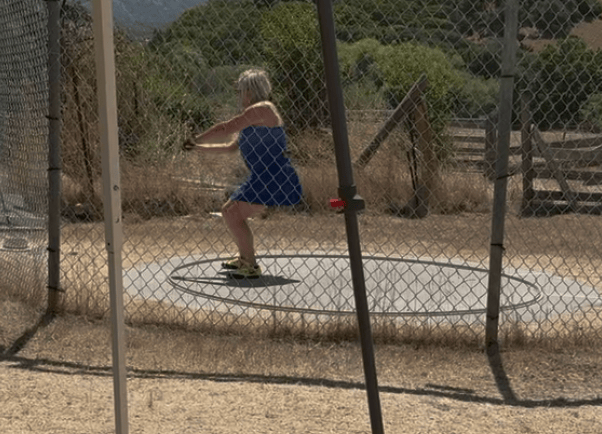
Here she is going into her wind-up with the hammer.
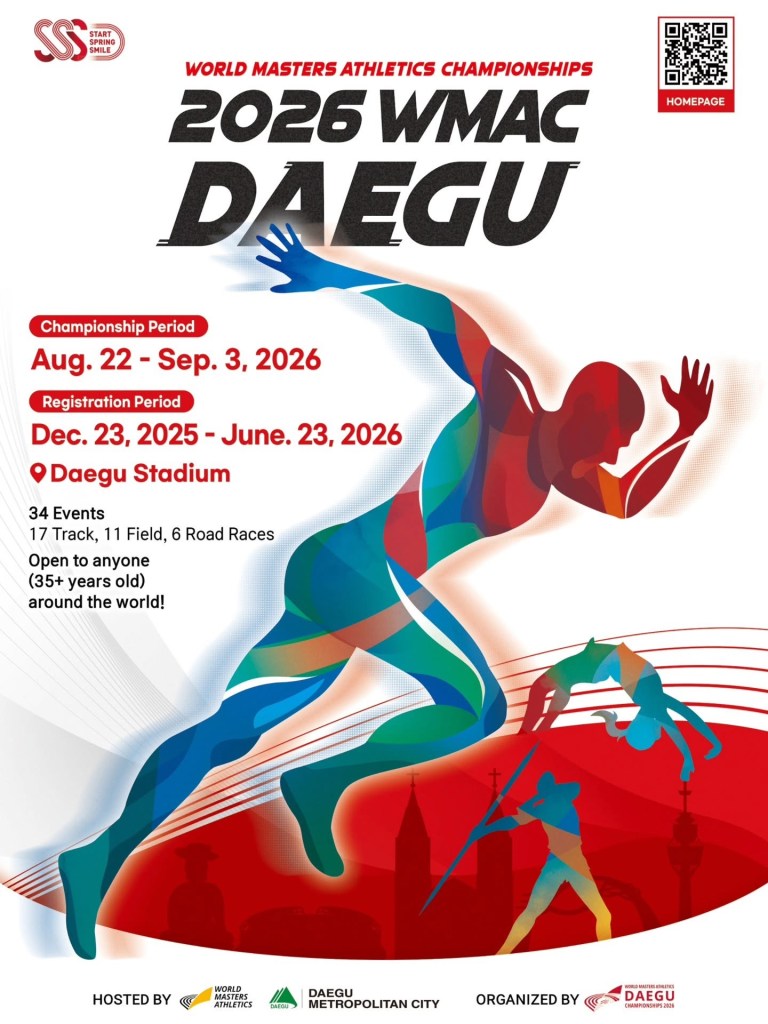
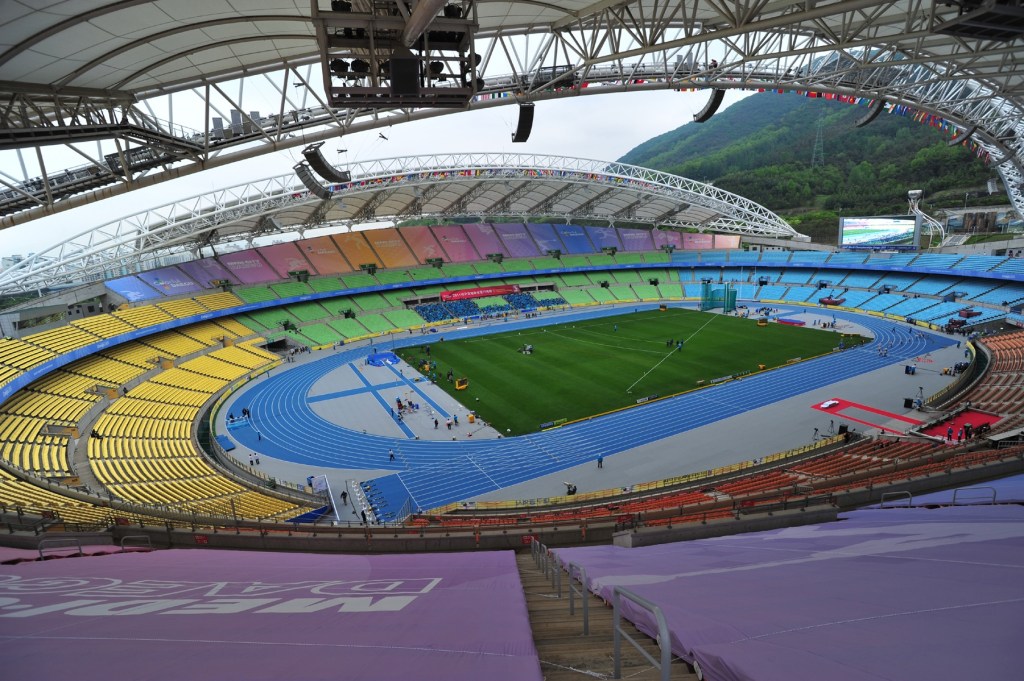
Three weeks from now, Mike and some of his friends will compete for a gold medal in the World Masters Track and Field Championship in Daegu, South Korea.
Mike will be entered in the Throws Pentathlon where he will compete in five events in one day:
Discus
Hammer
Shot Put
Javelin
The Weight
He also plans to compete in the individual discus.
Six throws in each event. Maybe more if he qualifies. That’s 30+ throws in one day.
Not to go all-Ag on you, but I don’t think Mike would take offense if I said he is no spring chicken. He was born on June 29, 1941. By virtue of his birthday, he will compete in the 85 and older age bracket. Right now, Mike is ranked in the top ten in the world for his age group. But that could change.
How, you ask?
Well, first off Mike is improving. At an age in which most recede, he strives to exceed. Because of his hard work and practice, he is gaining on the field.
Second…how to put this delicately…at age 85 and older, the number of contestants in your age bracket …let’s just say… is not static. The ranks tend to dwindle rather than grow with time. “No shows” though rare, are presumed more likely the result of heart failure than a change of heart.
Longevity.
In throwing, as in life, it’s pretty simple.
There are no style points. Nothing for artistic interpretation. Sure, there are rules for what you can do in the ring, but it’s really all about how far you can stretch the tape.
Some, like Mike, stretch the tape a long way.
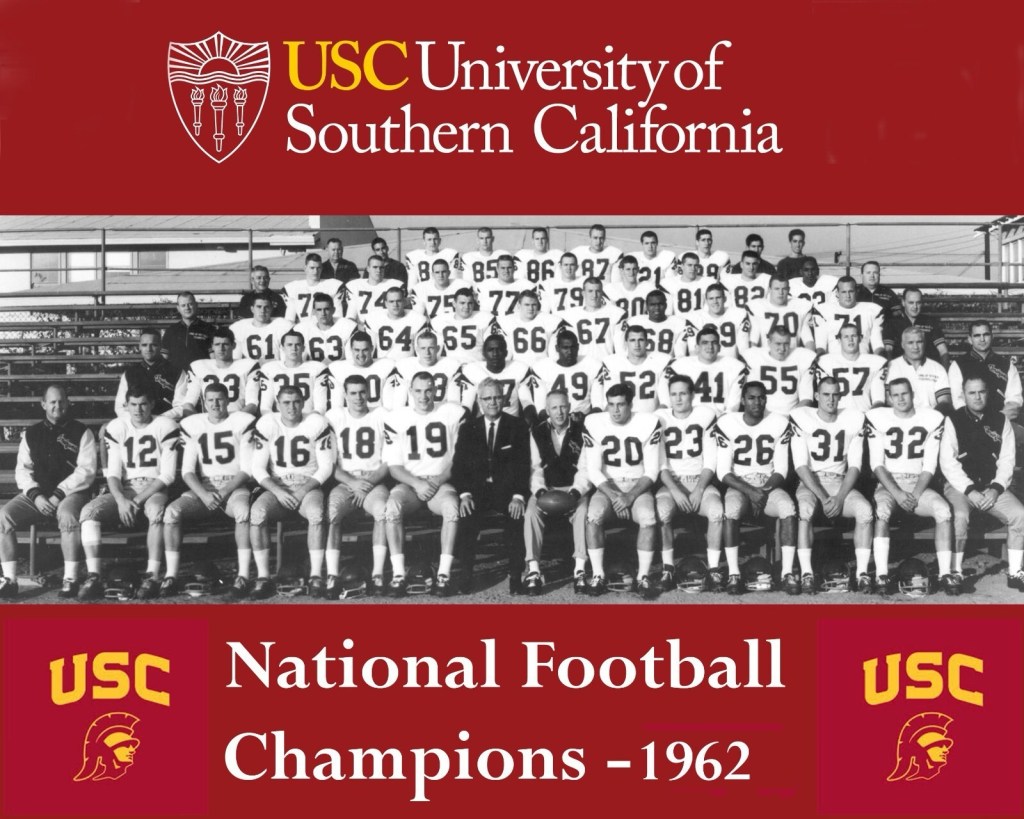
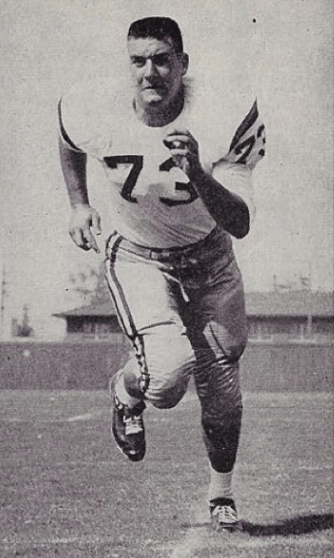
This is a photograph of the 1962 USC football team. That’s Mike in the upper right, No. 82 (His number had been 73) He played defensive end and was in large measure why that team held their opponents to single digit scores and went on to a perfect undefeated season. They beat the heavily favored and much vaunted University of Wisconsin Badgers in the Rose Bowl that year.
But Mike did not play in the Rose Bowl. He watched the game from the bench where he sat in a full body cast. You see… in the first quarter of the final game of the regular season against Notre Dame while rushing to tackle their quarterback, Daryl Lamonica, Mike was blindsided and suffered a fractured vertebrae. He would learn only days later that he played the next three quarters of that game, his last game, with a broken neck.
Most men, denied their boyhood dream in such an arbitrary and cosmically cruel way, might go on to live a life of bitterness and resentment telling tales of what might have been.Mike will tell you that his injury was the best thing that ever happened to him because it led to the Peace Corps and to Sally and to his three children and grandchildren, to the Chileno Valley Ranch, the Newt Brigade and the Throwers.
Some people, without ever seeking attention, and embarrassed should they happen to draw it, set quiet examples for us all. They don’t mean to; they just do.
Whenever I get to feeling sorry for myself with all this Parkinson’s stuff, I remind myself of my friend Mike: the adversity he has weathered and the adversity he still undertakes.
This past Sunday, I had a chance to stop by the Ranch, stretch my legs and watch the Throwers prepare for Korea. They are an inspiring bunch.
They laugh at longevity.
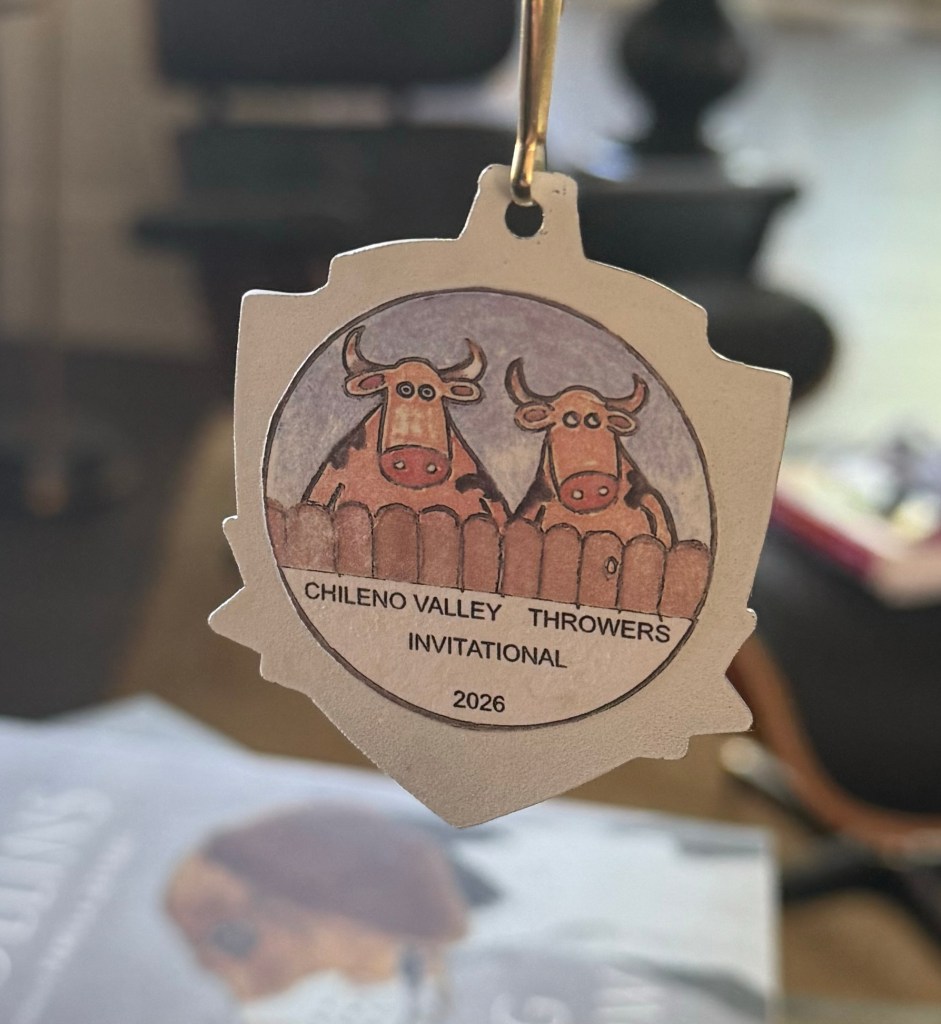
While I was there,Mike presented me with a medal. It was a kind gesture to encourage a friend through his own struggles of late. Typical Mike; always thinking of others.
I don’t pretend for a moment to have joined the ranks of the Chileno Throwers. I wouldn’t dare to step into throwing shoes in front of thousands of people. Hell, I’d get lightheaded just returning my ass to an upright position after bending over to pick up the damn thing I signed up to throw.
That said, I’m just shameless enough to slip my medal on beneath my hospital gown before the next surgery. The surgical team won’t allow it, I’m sure. But I like to imagine the puzzled look on my surgeon’s face were he to see two skeptical bulls staring back at him just as he’s about to plant the gizmo in my chest.
I tend to overdo it. Thinking, that is. It doesn’t yield any worthwhile results, but it does help kill the time.
Now especially …when me old noggin ain’t at its best… is probably not a good time to indulge the nasty habit, and it’s sure as hell not a good time to share the fruits of that belabored labor.
Still, no one ever mistook my thinking for wisdom so, what the hell; let’s share a few post surgical thoughts. In no particular order.
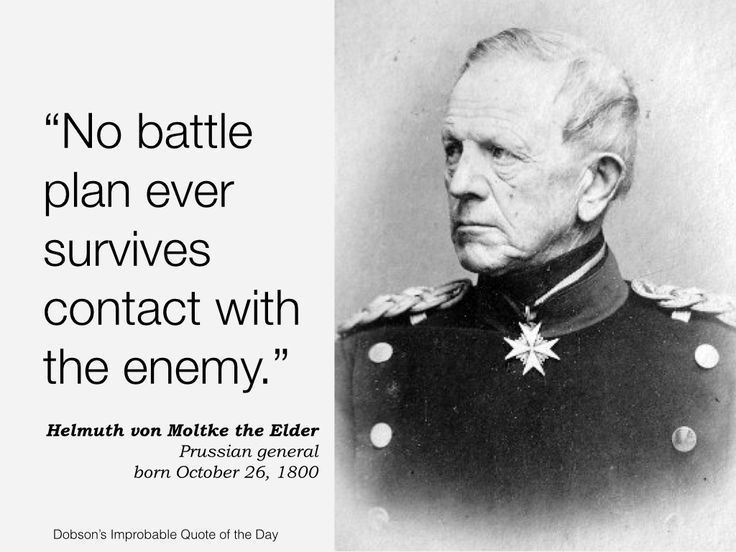
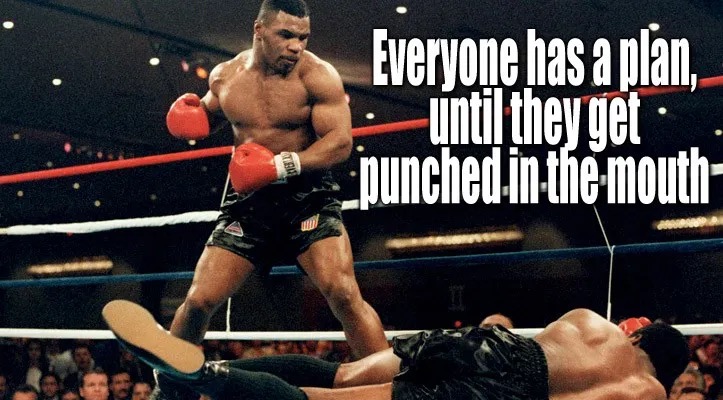
First…let’s talk about planning. I think it was the Prussian General Helmuth von Moltke the Elder…not to be confused with his lightweight son Helmuth the Junior… who said, “No battle plan ever survives contact with the enemy.” This notion was later stated far more eloquently by the famous American philosopher Mike Tyson, who said,
Well said, Mike.
My plan was simple.
Walk.
Walk some more.
Walk all night, the night before surgery. The only way to suppress my convulsing restless legs when off medication is to walk. So , I figured if you’re not going to sleep anyway Rob, you might as well be as comfortable as possible and walk into the hospital the next morning so exhausted sedation might not even be necessary.
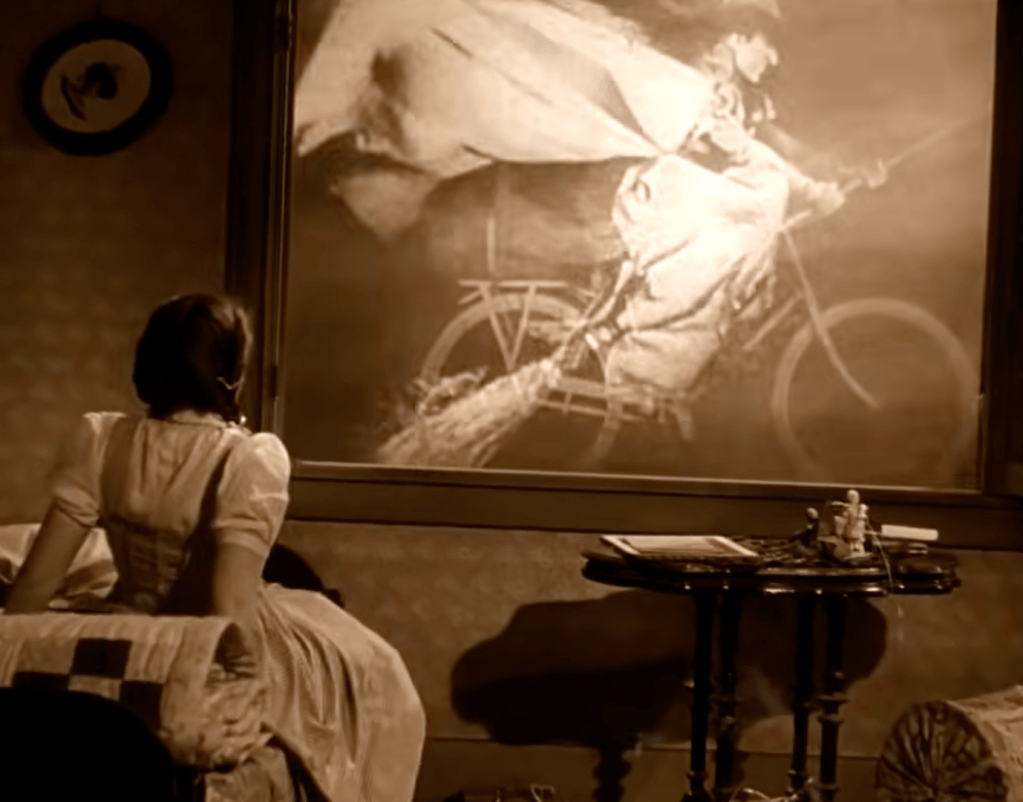
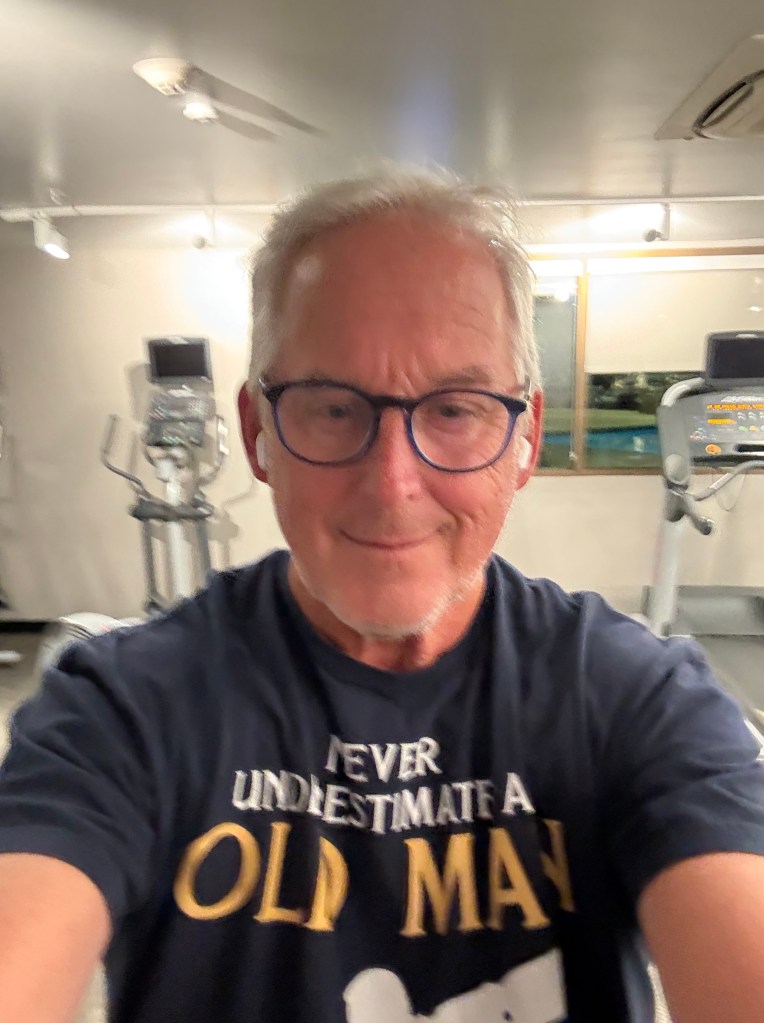
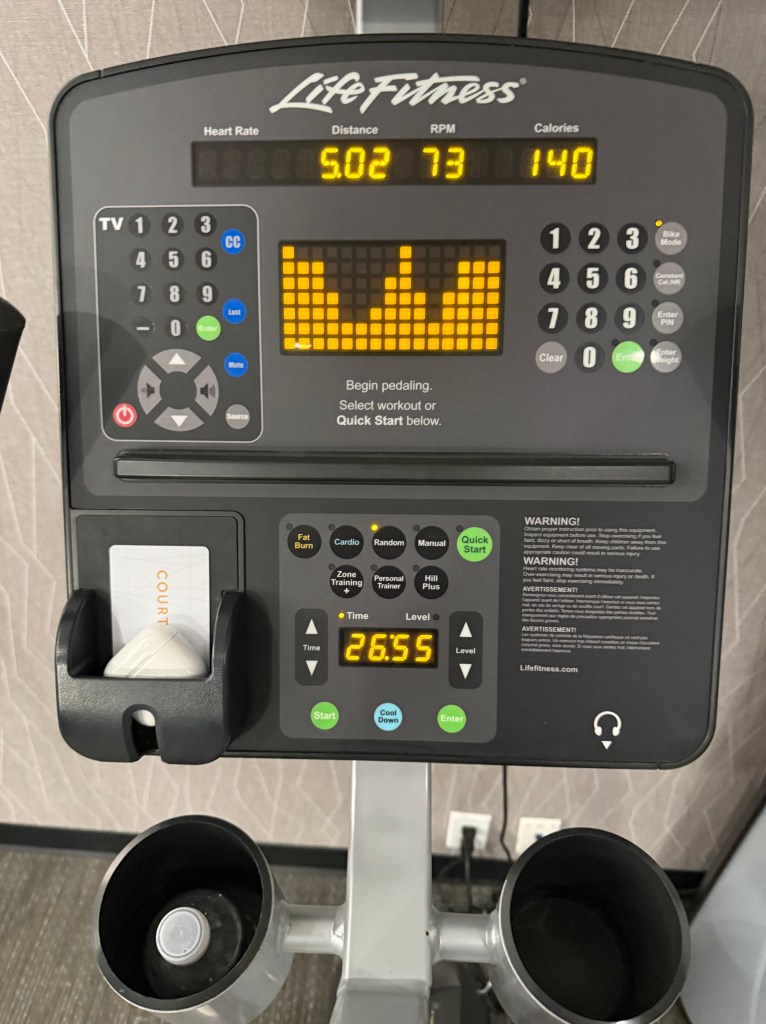
My surgery was planned for 10:00 Thursday. My doctor instructed us that I should eat no later than midnight on Wednesday, so at 10:40 I ate a miniature carton of Ben & Jerry’s chocolate ice cream from the hotel snack bar freezer (it seemed a good choice for a last meal if things went wrong) and set out for the fitness center one floor beneath our room. Since the fitness center is conveniently open 24/7 to hotel guests, I slipped in at 10:45 and between 11:00 and 2:00 I plugged in my earbuds, fired up my playlist, and peddled the hotel’s trusty Life Fitness stationary bike like I was flying through the Kansas sky with Todo in my basket about to transform into the Wicked Witch of the West.
My plan was to break it into half hour segments and figured if I could string six half hour sessions together, at a leisurely pace of 5 miles every half an hour, I could get a good three hour 30 mile start on a long night.
Around 2:00 I got off the bike and considered a similar regimen on a treadmill. But I was getting a little punchy and thought it best to stay off the treadmills where I might hit the wrong button and fly off the back like George Jetson walking Astro at the start of The Jetsons.
“Jane!”
At 2:15 I took the first of two showers in our room (a shower also helps when my restless legs act up), dressed and returned to the spacious lobby of the Marriot where I fired up Dune- Part Two on my iPad and walked while watching the movie.
I figured a movie that lasted 2 hours and 46 minutes, while too long to endure sitting in a theater, was just right for my early morning ambulatory needs in the Marriot lobby. It would distract me to just before 5:00 when I was to take another shower and wash my head with some pink antibacterial concoction. then wait another two hours before wiping down my body from head to toe with some creepy antibacterial wipes.
At 7:00 I fetched an Americano from the restaurant bar for Cathy and and she kindly administered the antibacterial swipe down. I had to stand motionless while the icky stuff dried leaving a sticky feeling all over.
About 8:00 I drank my last liquid, a strawberry flavored pre surgical Ensure. Cathy and I then went for a walk around the hotel until Kate and Sam arrived.
The kids distracted me with stories of my grandchildren and the four of us ventured off to the hospital just before 10:00.
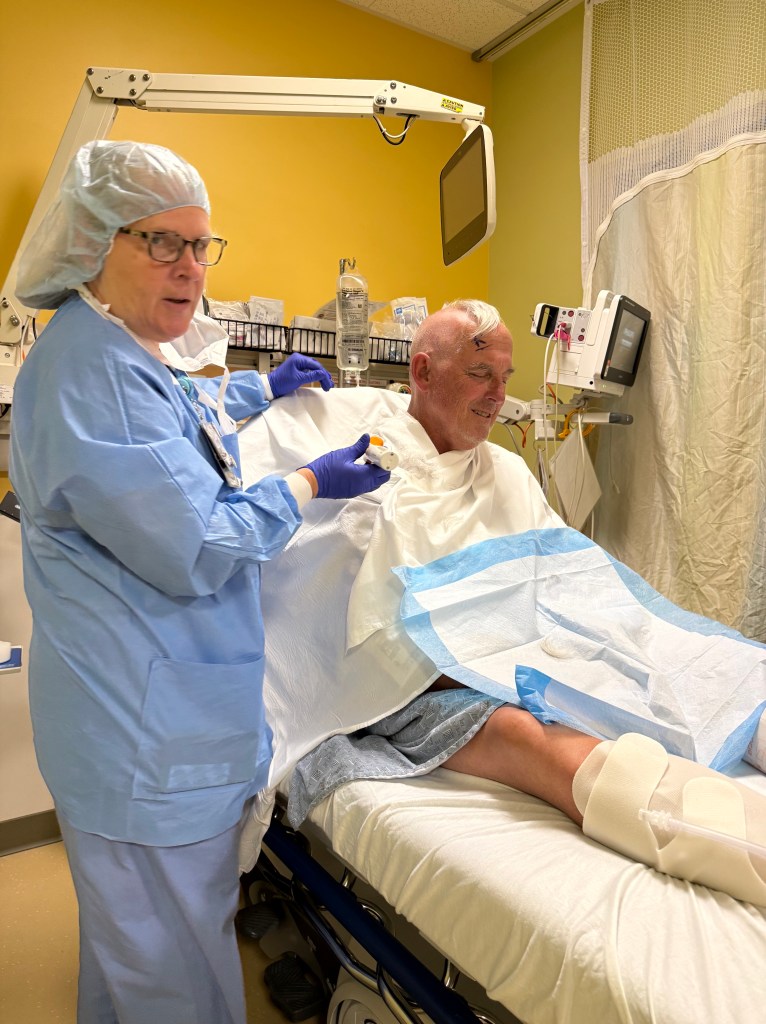
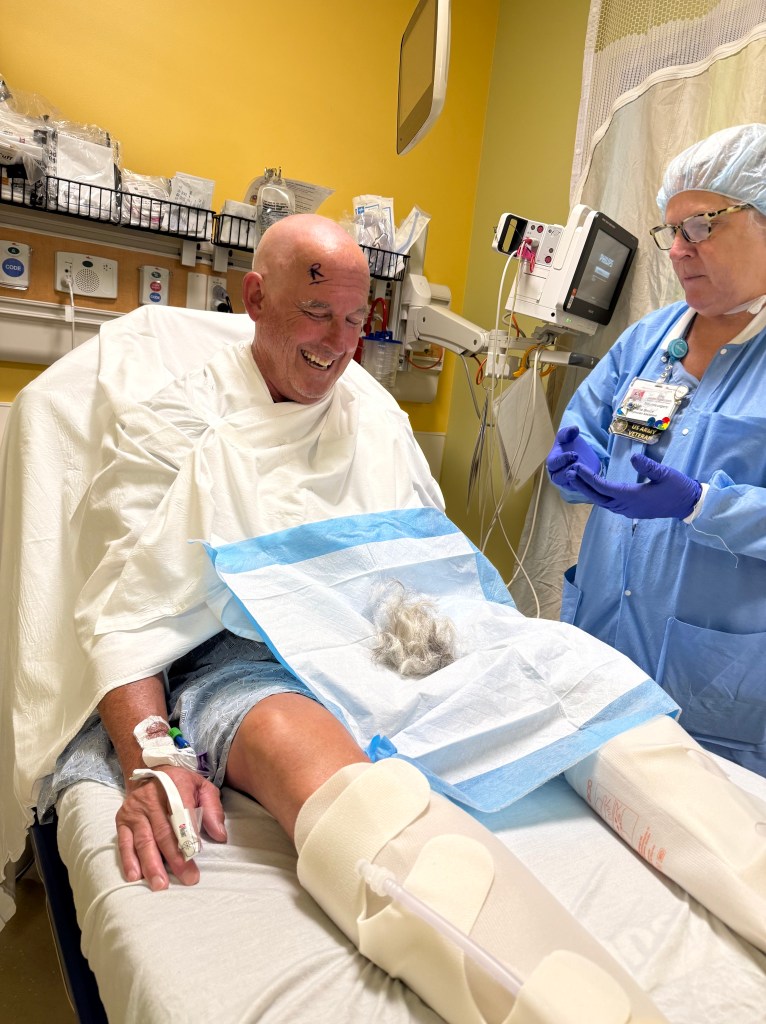
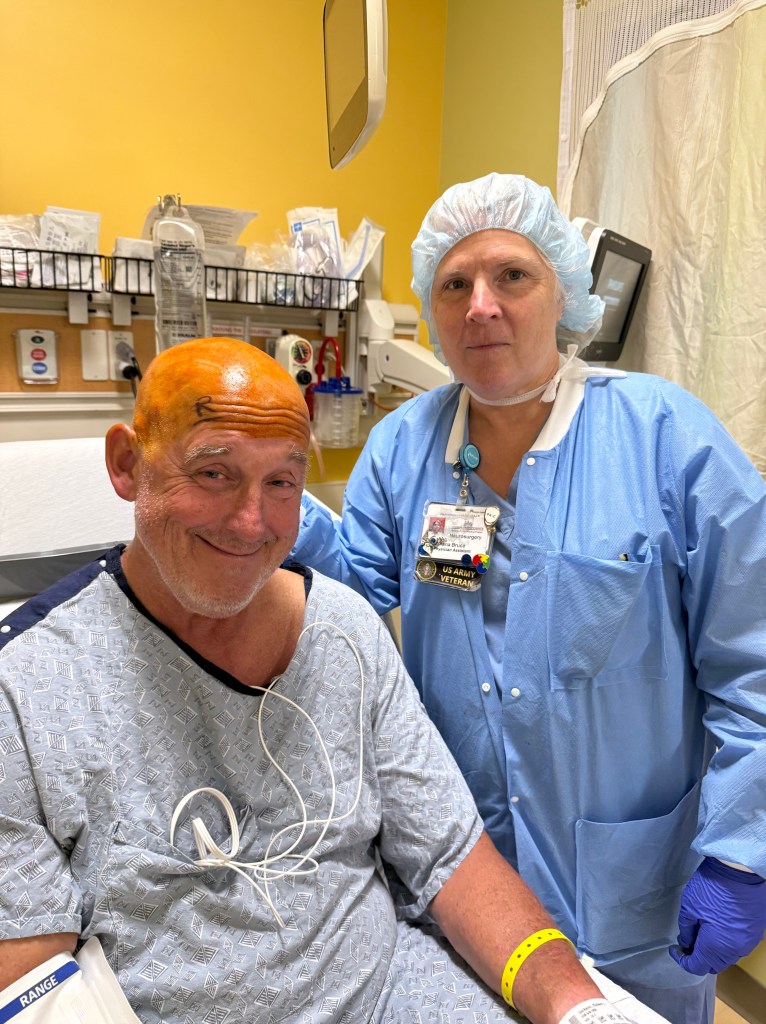
The haircut part went fine. Diana, my right hand throughout the process, a former Army Master Sgt. with a heart of gold and a quick wit, was wonderful. She first threatened to leave me with a new wave Mohawk and then teased me about the pet gerbil she left in my lap.
She then threatened to leave me with a Rudy Guliani dye job with a Trump inspired color choice.
So far so good.
My plan was working.
The flaw in my plan was assuming all I had to do was survive the haircut sitting up in bed and soon after they would plug in an IV that would give me some magic stuff that would quiet my legs’ crazy urge to move while sitting and lying down.
WRONG.
Interesting little physiological/anatomical/pharmacological teaching point for those of you interested in such things…
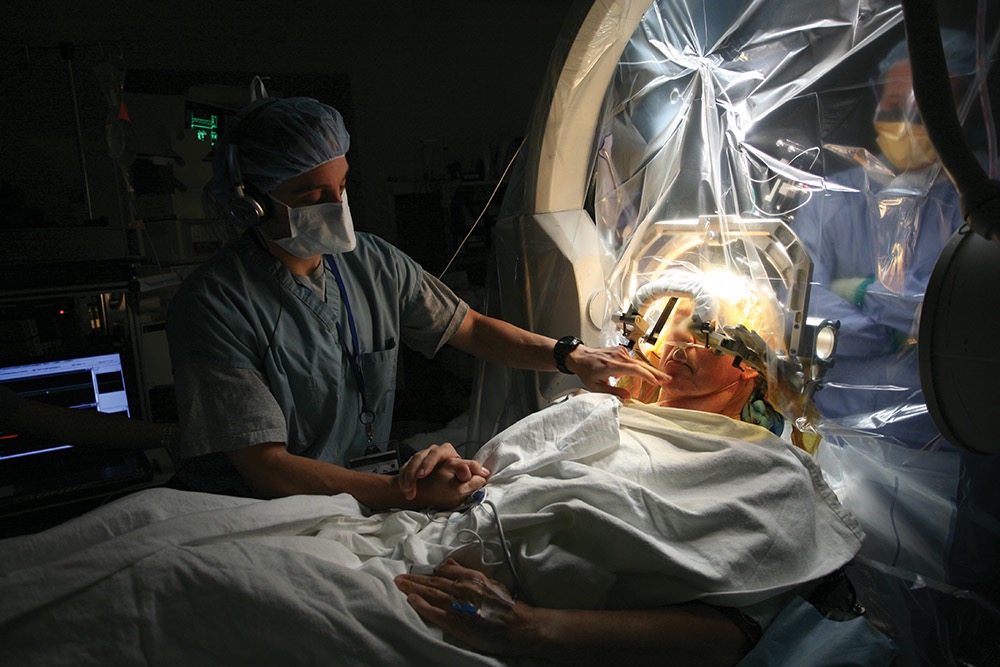
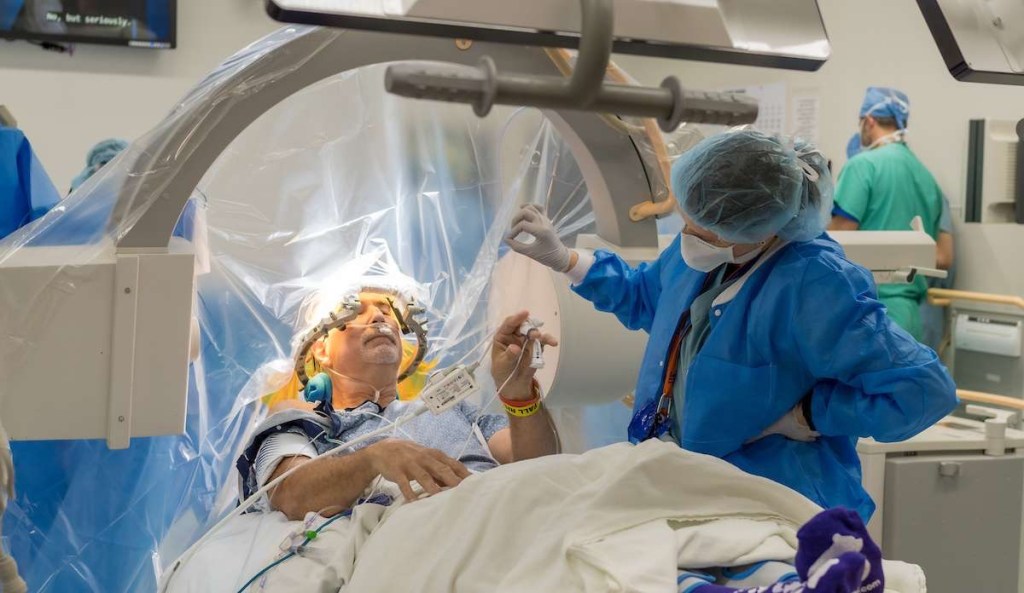
Deep brain stimulation surgery is generally done with you sedated but not under general anesthesia, because you need to be responsive enough to help— checking tremor suppression, side effects, speech, etc. That means they use light sedatives that do not fully knock out motor activity.
Sedatives that are good for calming anxiety and inducing drowsiness, don’t address dopamine deficiency. My leg movements, especially off meds, are substantially dopamine-driven. A sedative cocktail can make you drowsy while the dopaminergic circuitry underneath is still misfiring — so you can be “sedated” and still thrashing.
Withdrawal amplifies the thrashing. Going off my meds doesn’t just let my baseline PLMD/RLS return — it can produce something called “rebound akathisia” which is worse than your normal off-med state. That’s a different, more intense phenomenon than routine sedation is built to handle.
Periodic limb movements are generated at the spinal cord and brainstem level, not just cortically. Sedatives that work at the cortical/thalamic level to produce drowsiness don’t necessarily suppress movement generators sitting lower in the nervous system.
I know what you’re thinking, Probably the same thing I was thinking…
‘I WANT MY EPIDURAL”
Turns out, that’t not an option either.
Bottom line: I was…let’s just say… a challenge… for my anesthesia team. Finding the right mix that would enable me to be awake to participate, but quiet my thrashing legs apparently was a tall order.
I remember some parts.
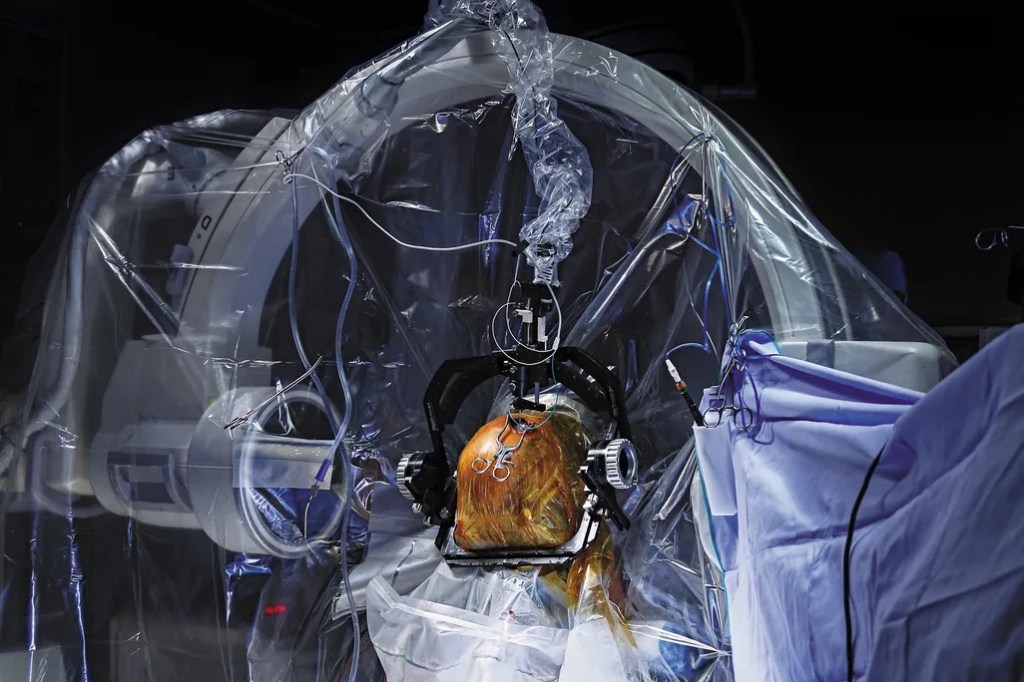
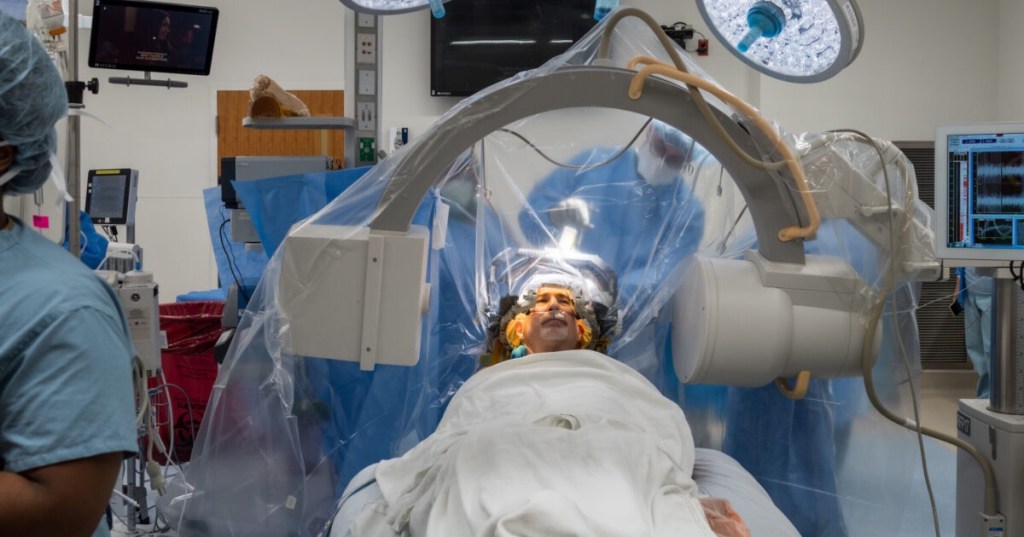
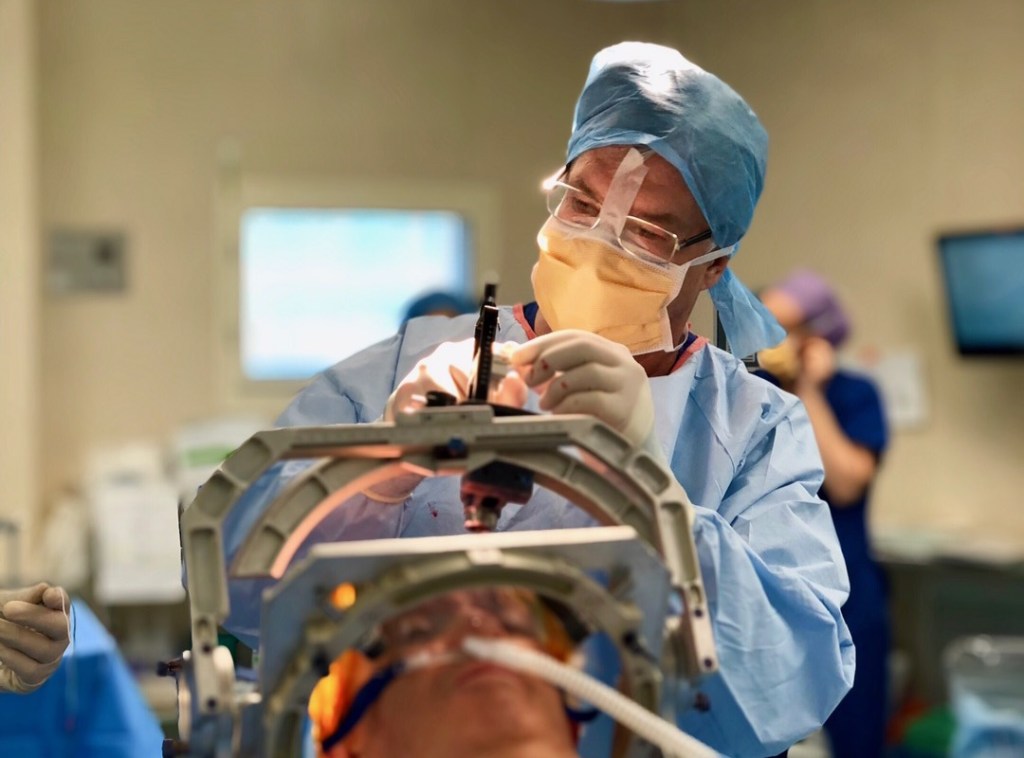
I remember the part where they screwed the tire rim to my head. And I remember my head being clamped in place, and I remember the drilling-the-hole part (that part actually wasn’t too bad), but most of all I remember my fucking legs convulsing like someone took one of those reflex hammers, only this time the size of a carpenter’s framing hammer and ball peened a periodic seismic twin legged convulsion from my waist to my feet while my head was clamped in place.
All I could think was, “Would someone please let me stand up? I just want to stand up and walk. I know how to stop this. Just let me walk.”
But my head was in a vice. My lower body was trying desperately to get away, but the clamp around my head wouldn’t let it. And no one was listening to what seemed to me a simple solution. “Just let me stand up.”
The last thing I remember thinking was “Rob, you’re pretty good at enduring discomfort. You ran cross country. You did four 200 mile solo bike rides in one year where you were in the saddle alone for 15 hours. You summitted long bike climbs above 12,000’ in the Rockies in Colorado. You rode the Obliteride, the Death Ride and climbed the worst part of Mt. Shasta up down and up again on Agony Hill in one day. You’re pretty tough old man, but I just don’t think you can do this anymore and I’m pretty sure no one else could. Then I thought, “What would Cathy tell me?” That’s when I remember mumbling to the surgical team “GET ME OUT OF HERE.”
Apparently, that was just about the same time my surgeon and anesthesiologist decided to change plans, go full general anesthesia on me and forego the audience participation portion of the program.
The outcome, we are assured, was excellent. The wires were placed where needed. My help proved unnecessary. Thanks to my surgeon’s experience, the anesthesiologist’s wizardry, and the skill and experience of the entire Kaiser Neuro team all of whom couldn’t have been kinder or more supportive, we did what we set out to do.
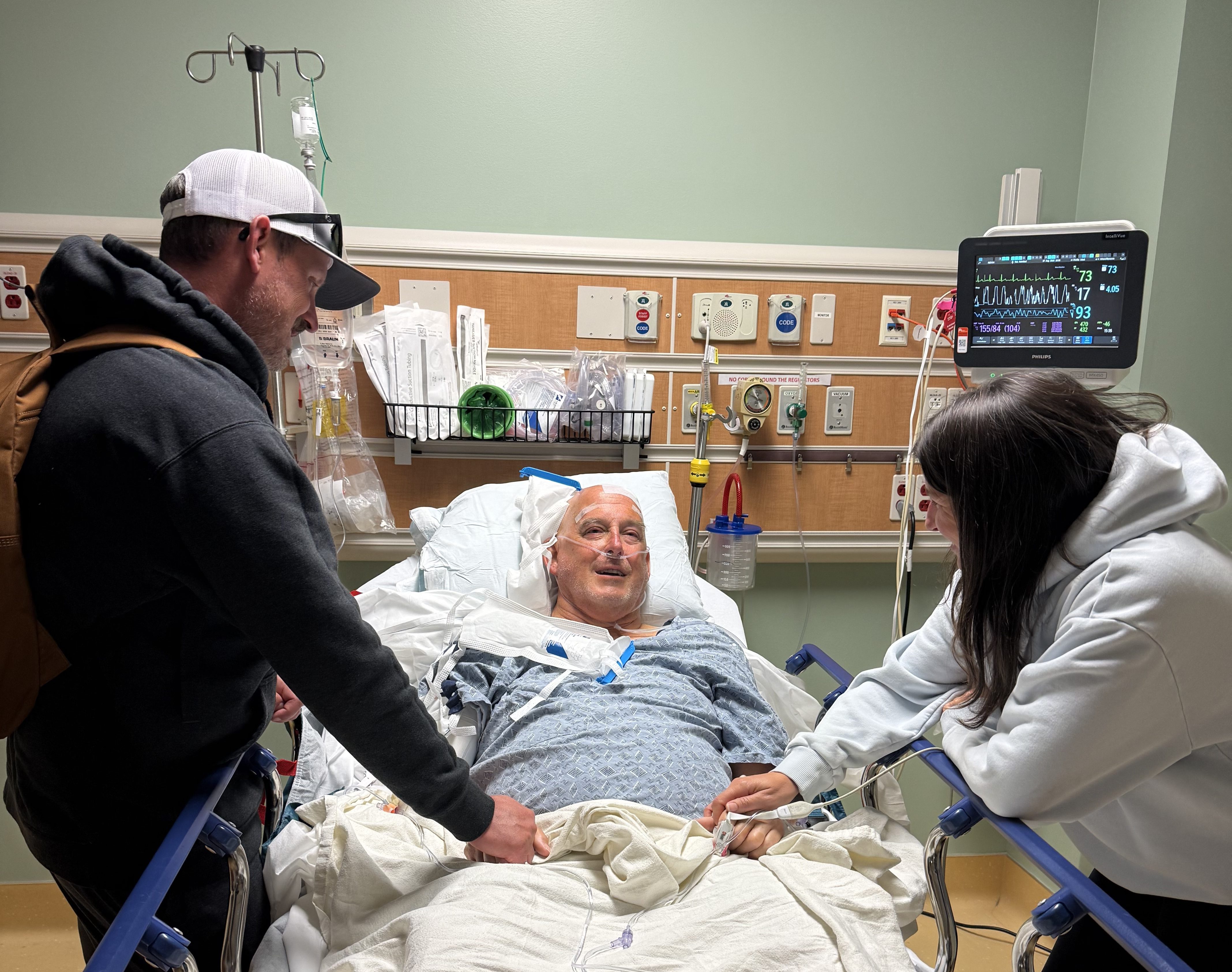
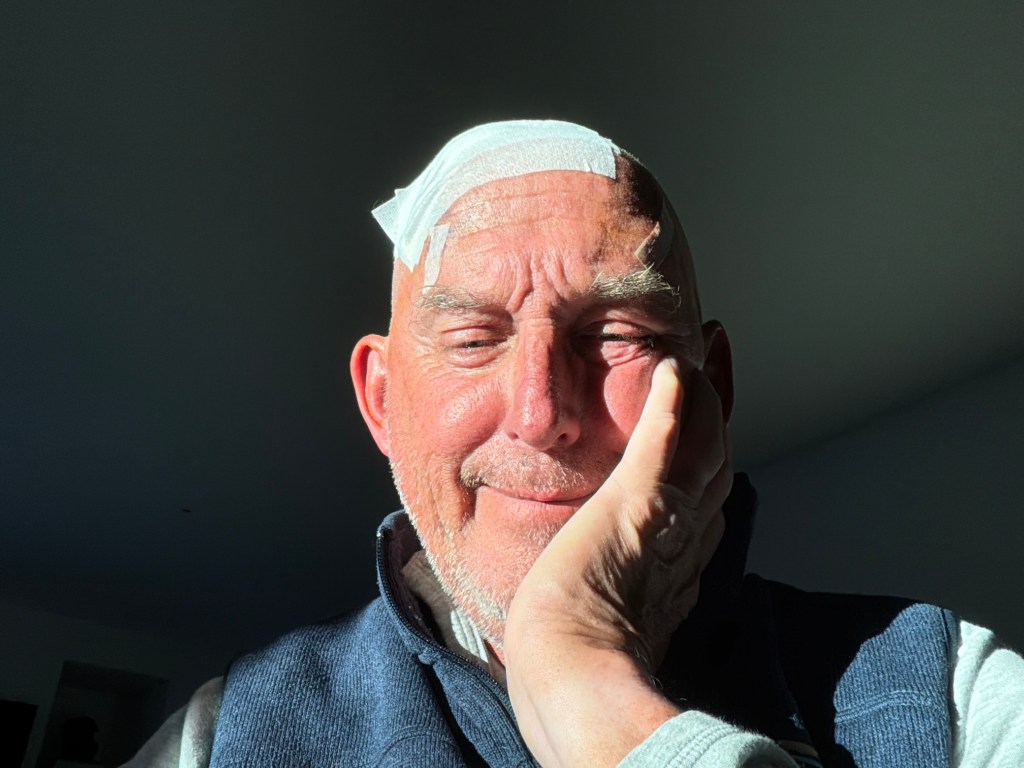
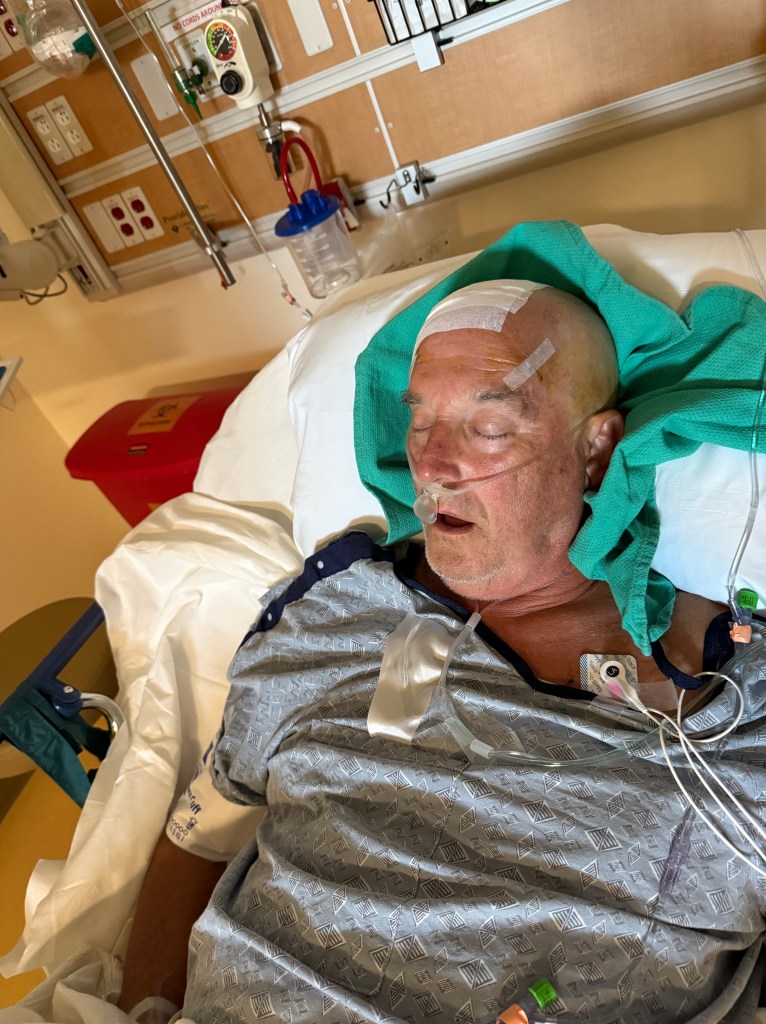
Here I was in recovery.
Nicelook, don’t you think?
It took me a long time to come out of it. Cathy, Kate and Sam reported my legs were still thrashing when they saw me. Damn things wouldn’t give up the fight.
No plan survives the first encounter with the enemy.
My enemy happened to be my own legs. The same ones I had relied on so many times before to get me through hard times.
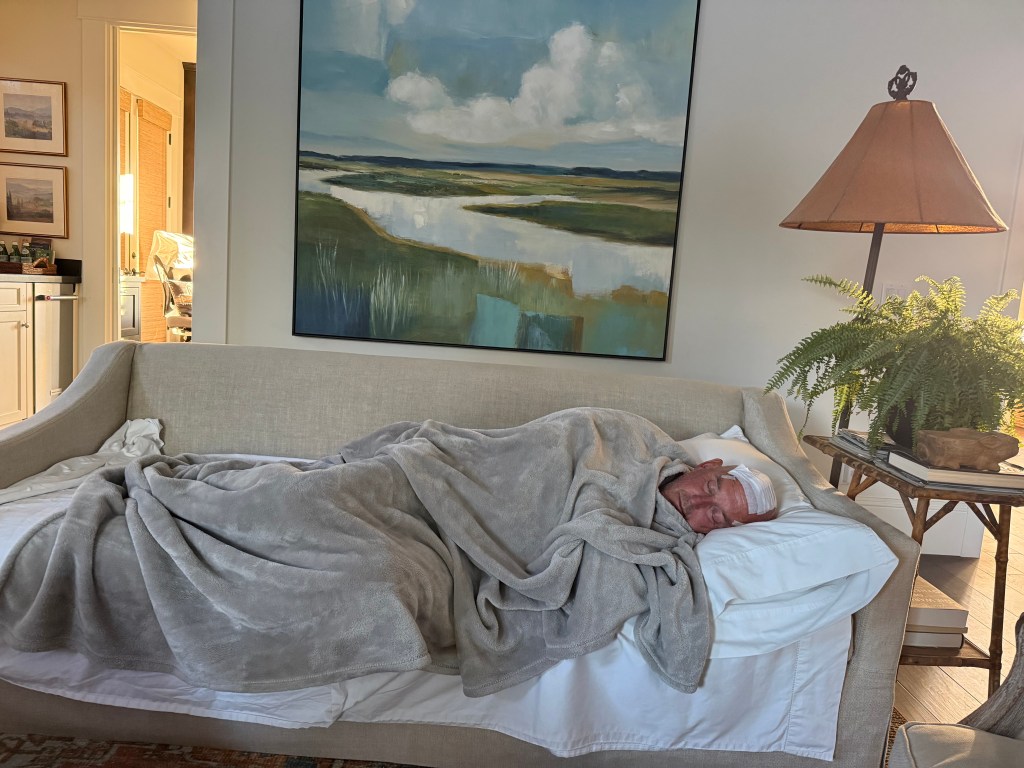
Here I am at home.
Now, three days later, it’s time to rest up for the next one. The good news is I won’t have to go off meds the next time. They’ll put me under from the start. No need for treadmills or long movies or early morning strolls in hotel lobbies.
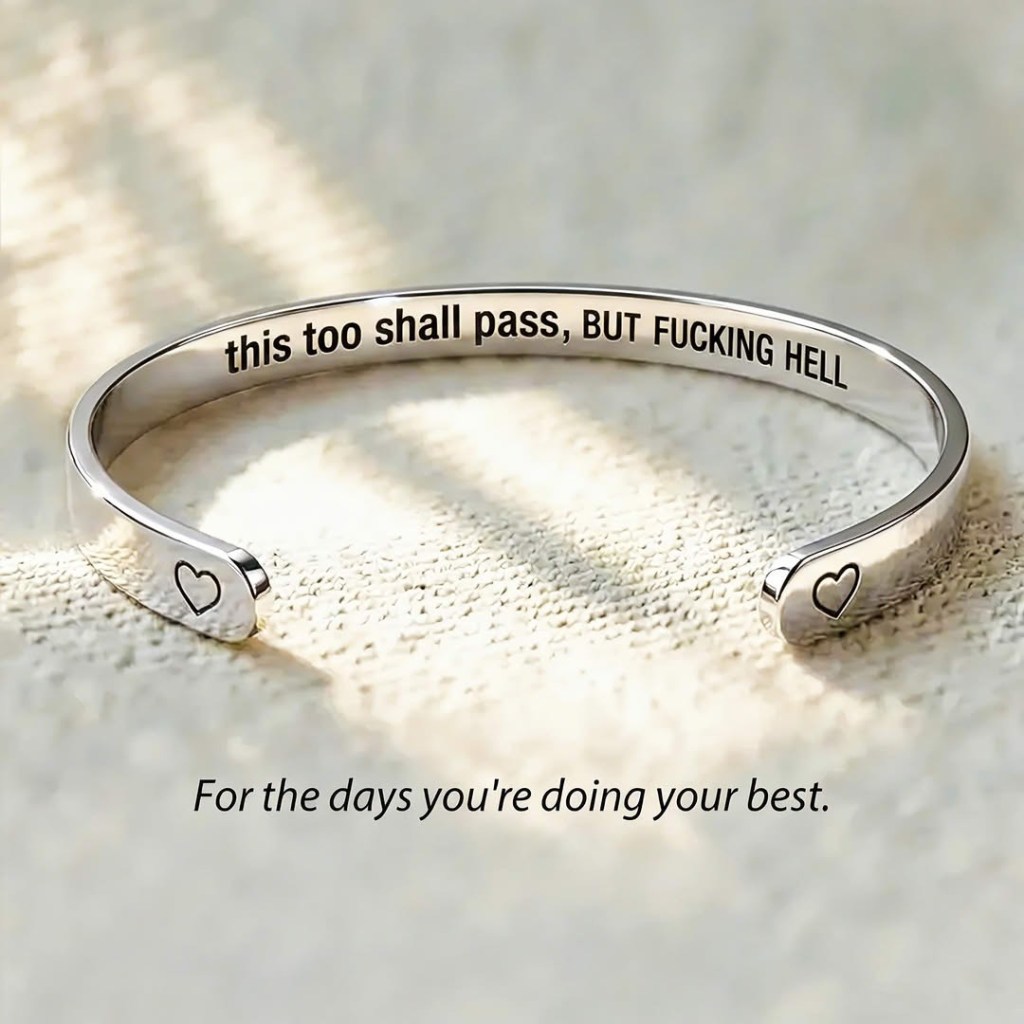
Cathy says she’s found just the right gift for me.
She says it goes with my new wannabe Stanley Tucci look.
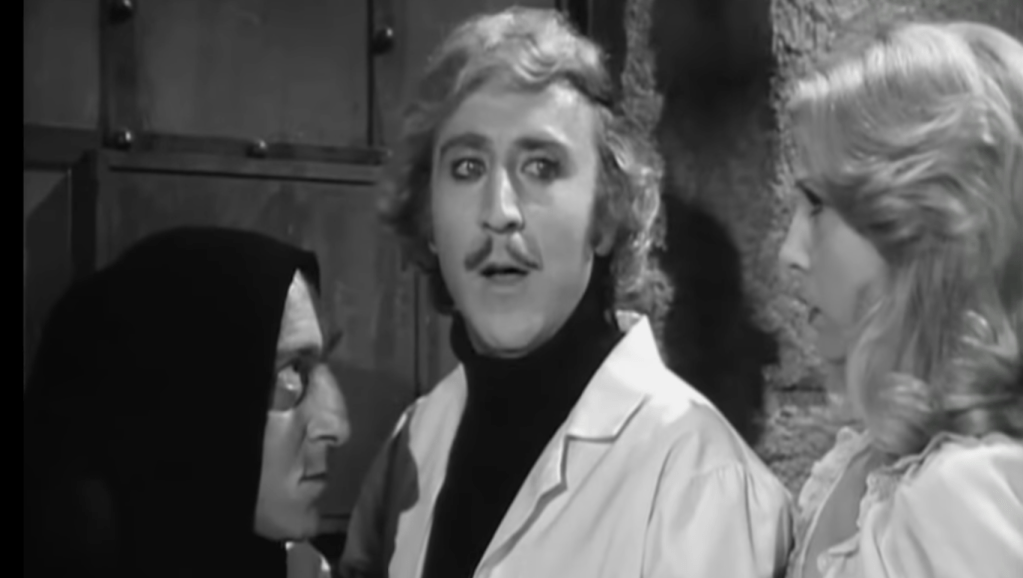
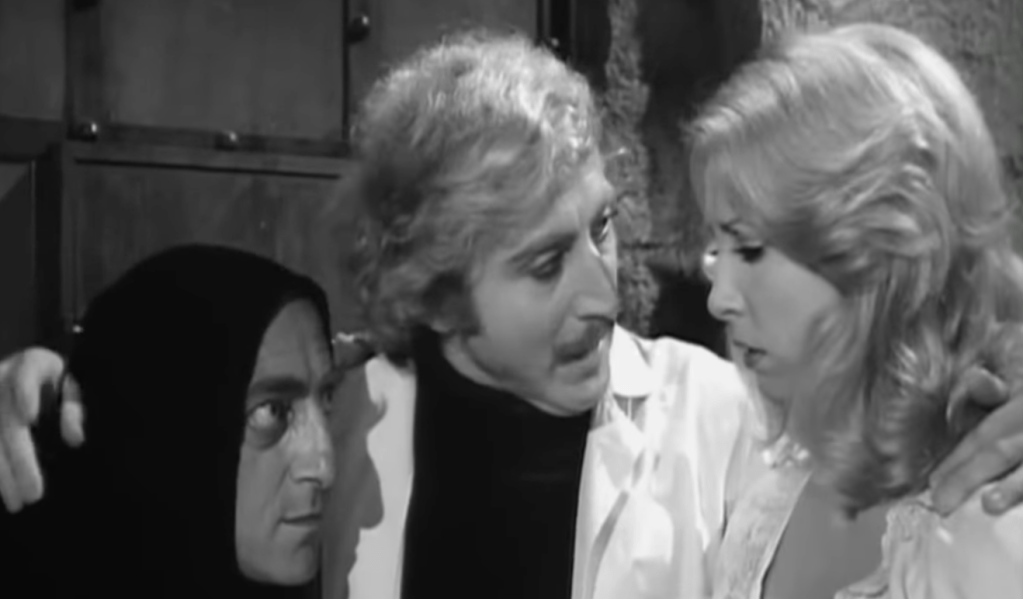
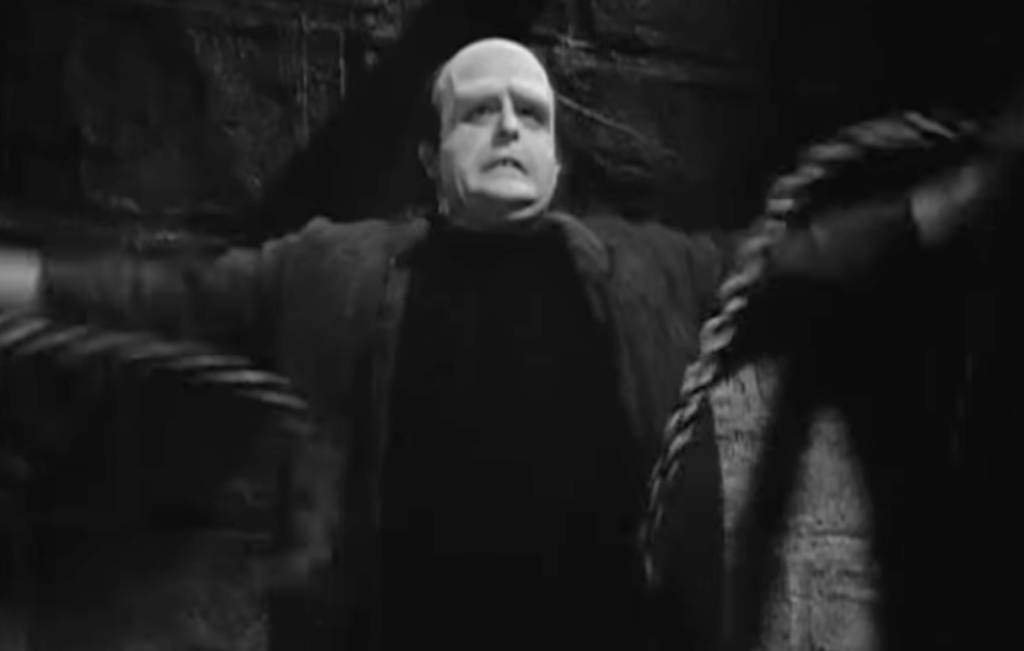
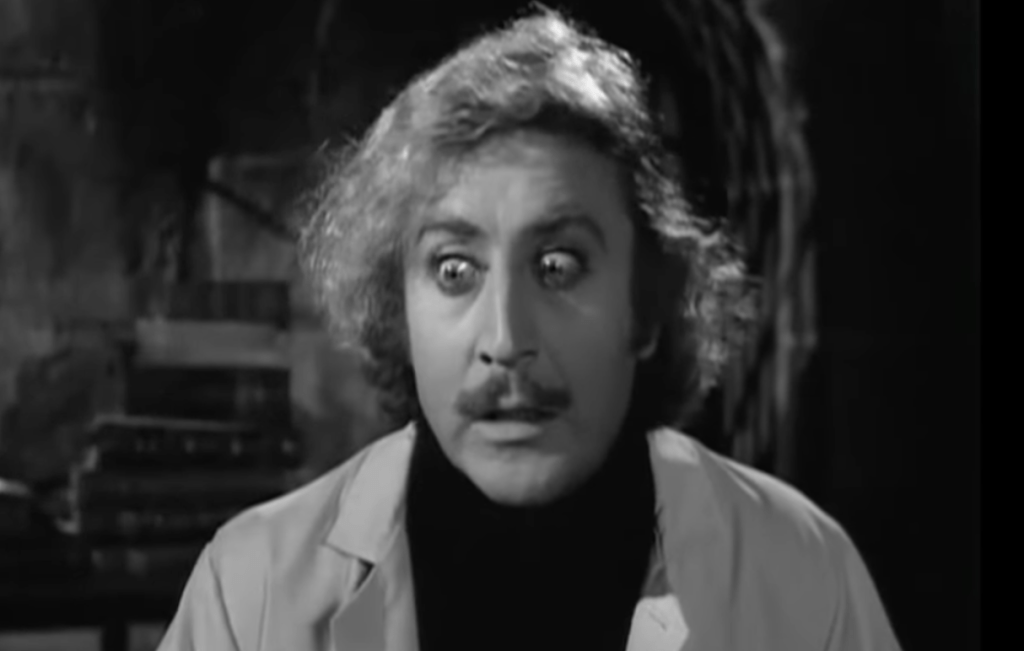
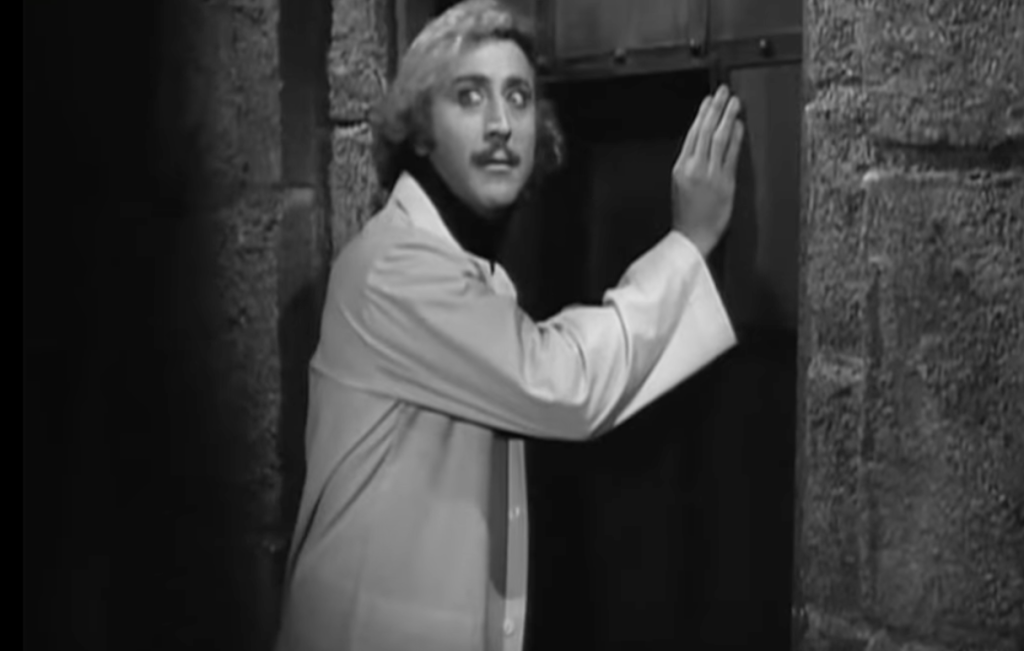
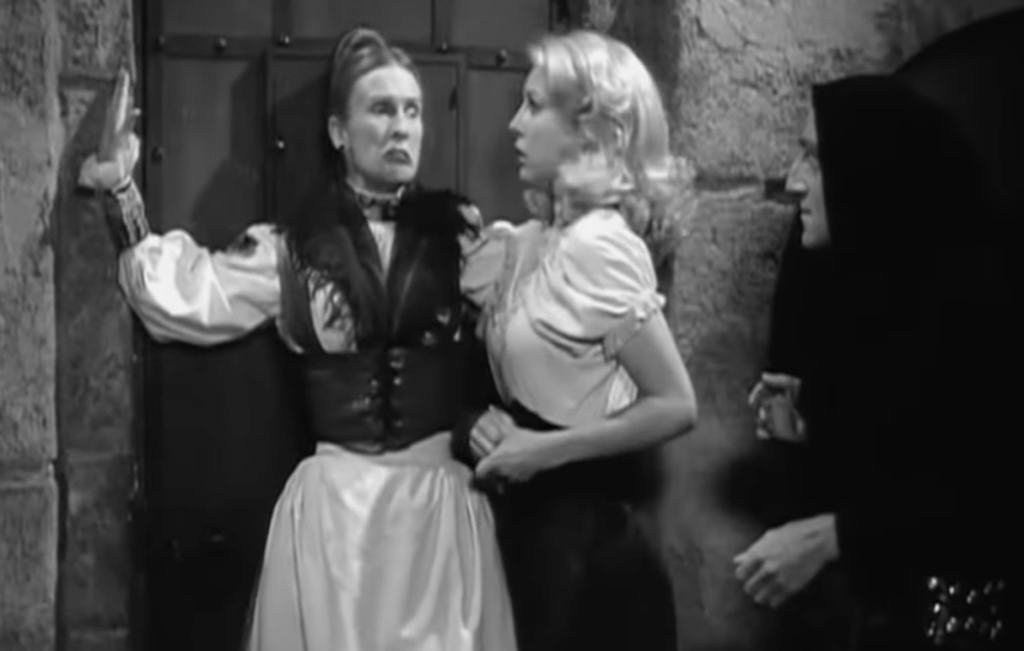
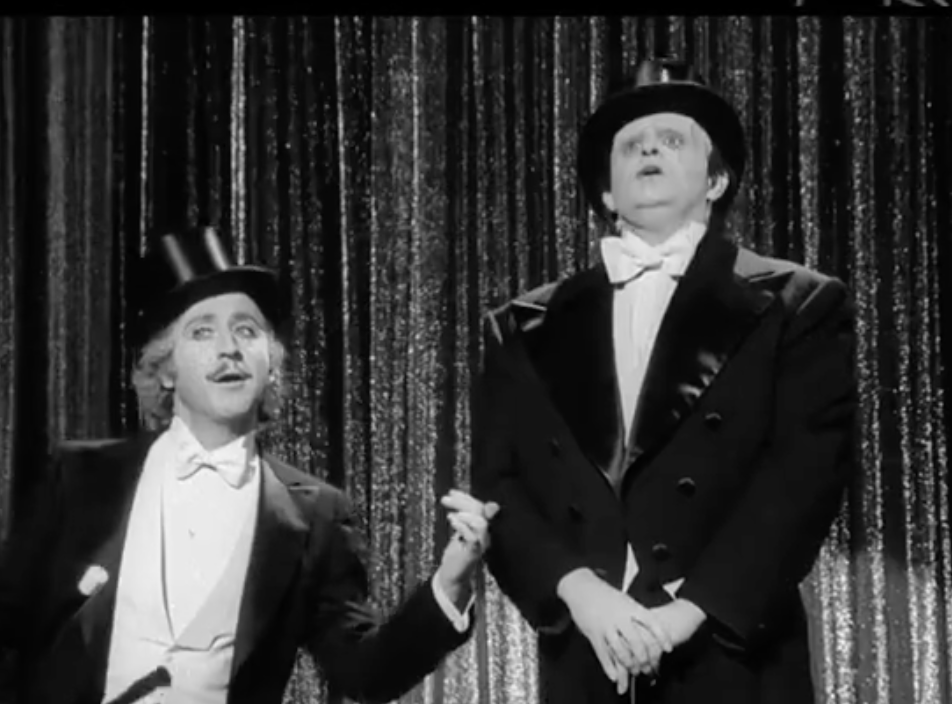
The one where, just before going into the cell where the monster is, Dr. Frankenstein (“It’s Frankensteen; not stine“) tells Igor (“that Eye-gore, not Eee=gore”), Inga and Frau Blucher,
“”Love is the only thing that can save this poor creature and I am going to convince him that he is loved even at the cost of my own life.”
No matter what you hear in there, no matter how cruelly I beg you, no matter how terribly I may scream, DO NOT OPEN THIS DOOR”
Cathy and I are off to Redwood City this afternoon. The plan is to check into the fully renovated Courtyard by Marriott, maybe have a light early bird “last supper” at their Bistro Cafe, don my nifty Tai Chi culottes and slippers, slip into the “complimentary fitness center”, have Cathy post guard at the door, set the timer on a treadmill to 12 hours and ride out…i mean walk out… a night without meds.
“Let me out. Let me out. GET ME THE HELL OUT OF HERE!”
“WHAT’S THE MATTER WITH YOU PEOPLE? I WAS JOKING! DON’T YOU KNOW A JOKE WHEN YOU HEAR ONE?”
Poor Cath. I know this is harder for her than it is for me. I can walk. She has to pace.
You know it’s bad when the idea that someone will screw a white-wall size tire rim to your head while you, in a panic, try to remember the 4-7-8 breathing technique to avoid panicking, and then drill a hole in your head…
Well, when that seems a welcome relief…
Ten o’clock tomorrow, Rob.
Just one more day. You can do this.
Why?
Because this monster knows he is loved.
Thank you all. Family, friends, kind strangers…
Thank you all for your kind wishes, prayers, good vibrations, and white light. This monster knows how lucky he is.
A Boomer’s Musical Guide to Getting Your Brain Rewired
July 17, 2026
In this day of streaming, tailored, on demand entertainment, it is hard to imagine a time…a time before Spotify and Apple Music, before Napster and iPods and Walkmen, a time before CDs, cassette tapes and 8-Track…when music came to you by way of
a transistor radio you held in your hand, pointing the antenna in the right direction hoping,
to catch an AM radio wave broadcast from a tall transmission tower out in the middle of a cornfield,
connected to a dingy studio in which a dingy little man named a disc jockey (AKA DJ) played 7” black vinyl records at the speed of 45 revolutions per minute,
hoping that, if he played a song often enough but not too often, you might hot foot it down to your local record store,
buy that same 45 record for yourself,
bring it home and
play it over and over until your father pounded on your bedroom door demanding “…that noise you called music”…stop.
Now, for you youngsters…that is, those of you the same age as my surgeon and younger…the disc jockeys or “DJ’s” would from time to time accept “requests.” A “request” occurred when a kid would call into the radio station, sometimes using what are now referred to as “land lines”, sometimes using what were once called “phone booths”,and ask the DJ if he would play a song. The DJ would ask who was calling and to whom the caller wished to “dedicate” the song.
There was no greater thrill than when you, on your transistor radio…and presumably all your friends on their transistor radios…heard “This one goes out to Betty from Bill.”
That Bill; he’s so dreamy.
Now, if the DJ was so plagued with requests that he refused to play your favorite song, or if the rate of repetition at which he was playing your song was less than the once every ten minutes your taste in music or need to assess popularity demanded, your only recourse was to ride your bike to the drug store, shell out 98 cents, return home and fire up your own 45.
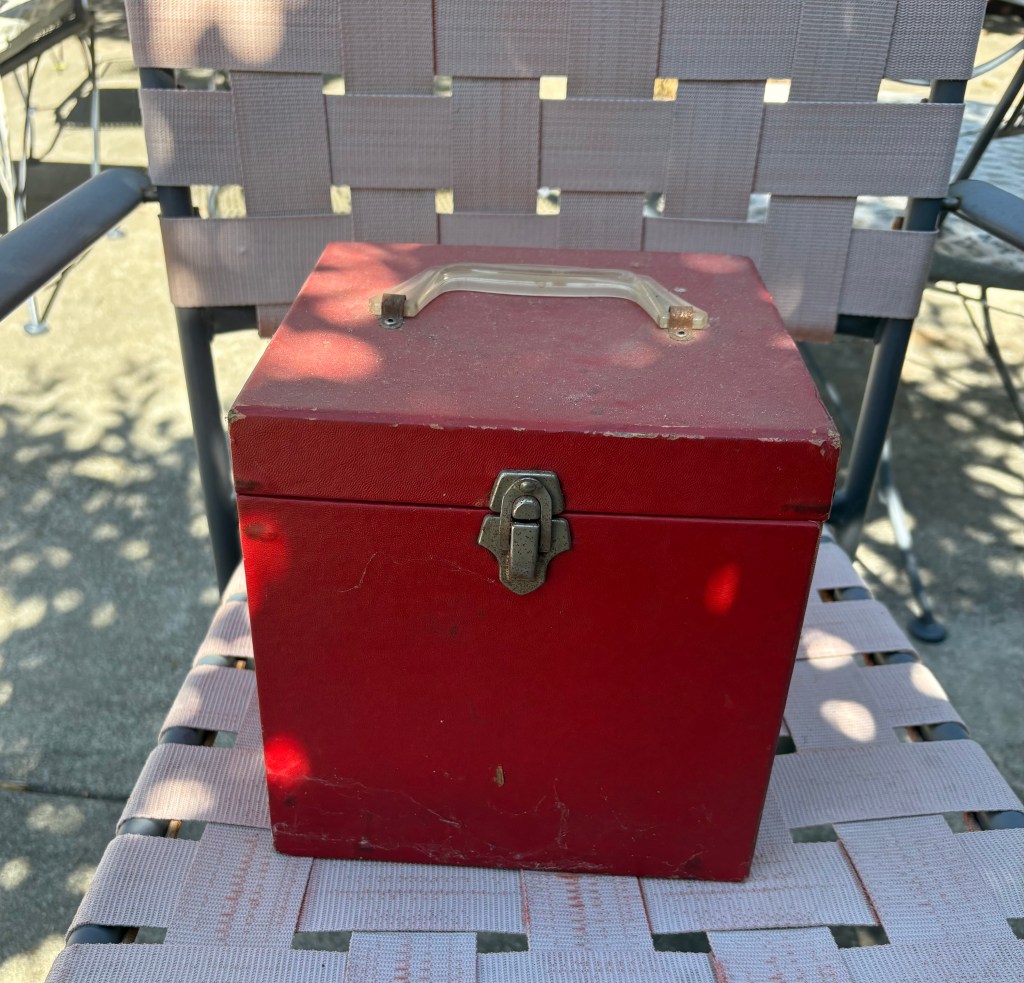
Do this often enough and mundane concerns arose. Things like, ease of storage, filing and retrieval. So much so that you bought a box.
A box in which to store your childhood.
A box like this.
When I told my brother and sister about my DBS surgery, I shared that the surgeon…you know, the fella younger than the box… encourages music in the OR and will, if you ask nicely, “play requests” while he is drilling a hole in your head.
Seems only fair, doesn’t it? I mean…just saying.
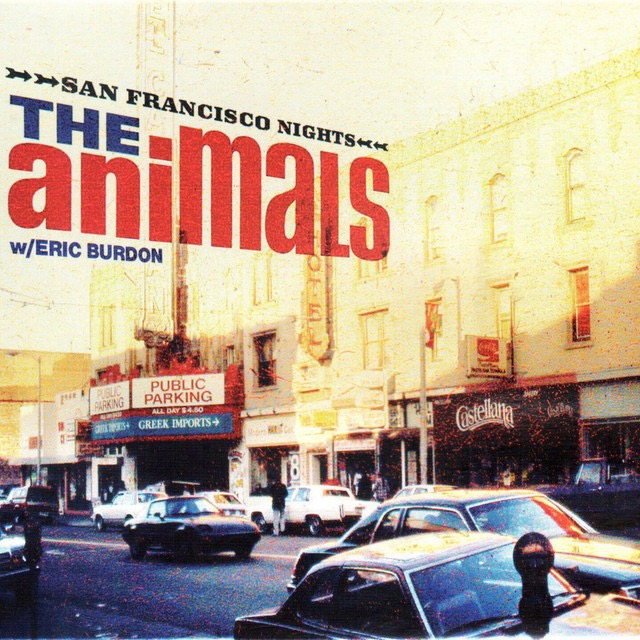
Quick aside…if you’re cresting 70 and ever need a quick “pick me up?” Fire up Spotify or Apple Music or ask Siri to play “The Greatest Hits of 1967.” The loud speaker introduction to The Animals’ San Franciscan Nights is guaranteed to lift any Bay Area Boomer’s spirits.
“The following program is dedicated to The city and people of San Francisco Who may not know it but They are beautiful and So is their city“
Try it…I’m telling you…it works.
Where was I?
Oh yeah…the red box.
When Linda heard I might have my own music in the OR, she rummaged through her garage and attic and found it.
The red box.
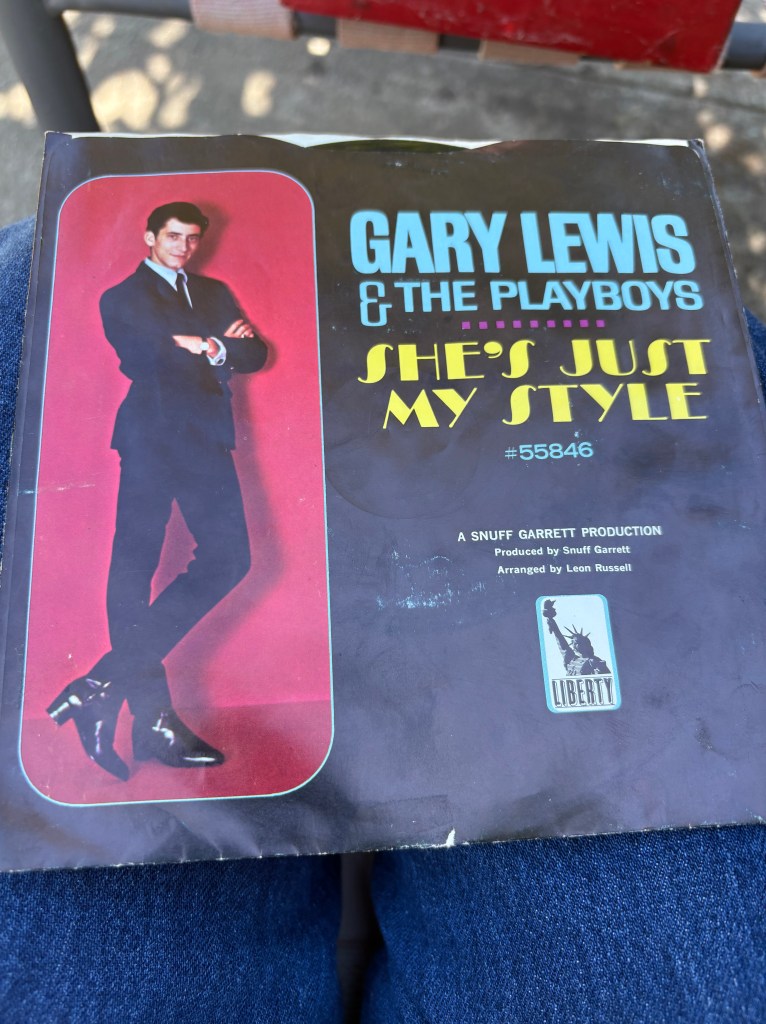
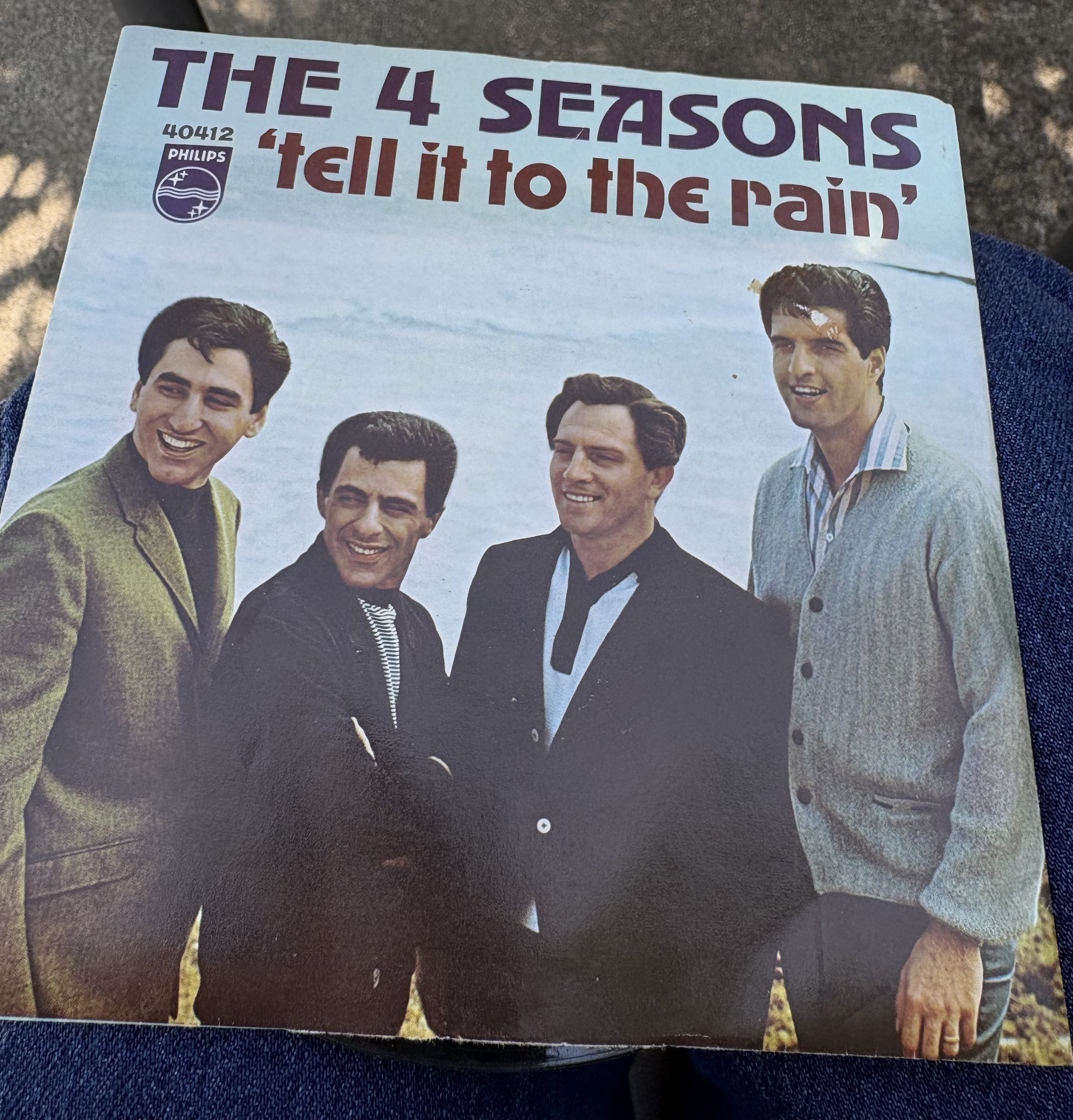
She blew the dust off, opened the lid, and found this…
And this…
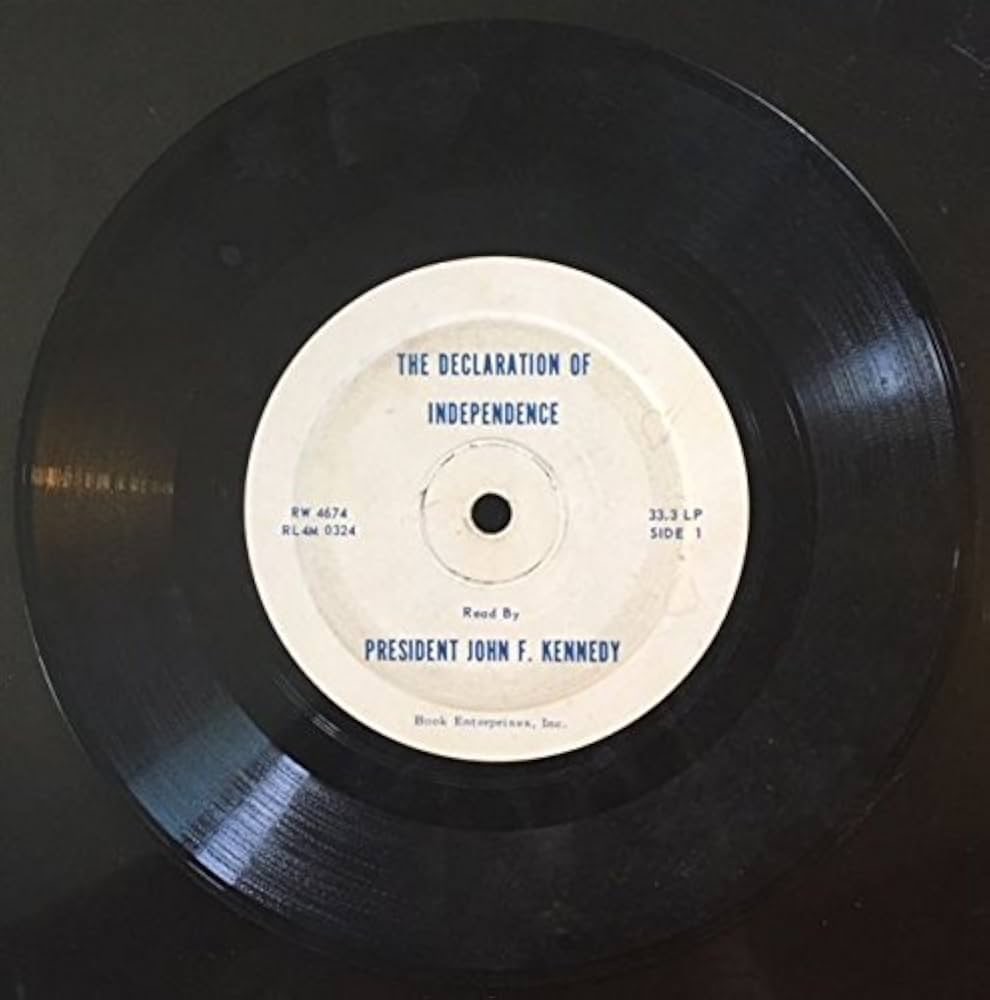
And even this…
Imagine.
Just imagine.
I know it’s a stretch, but imagine a time when our president was capable of reading.
And children would want to listen to him read…
The Declaration of Independence!
Yeah, I know…I know…but a boy can dream.
Anyway…
The red box prompted Linda …who was always more musically inclined than either John or I… to begin to curate what I’m calling “A Boomer’s Musical Guide to Getting Your Brain Rewired.”
Requests are encouraged. Anyone is invited to join with requests of your own. The rules are simple:
The tune must…like Linda’s red box…be older than my neurosurgeon, (I’m guessing he was born in 1983)
The title, the mood, or the lyrics must have a connection to a boomer’s youth; bonus points if word play involving Parkinson’s, double bonus if word play with brain surgery, and triple points if from an apt song playing in the Summer of Love, 1967.
Nominations will be accepted in the following categories
Pre-Op
During Surgery
Post-Op
Here are a sample of what Linda, with very little help from John or I, has come up with. If you have Spotify, the playlist is public and called “The Red Box.”
PRE-OP
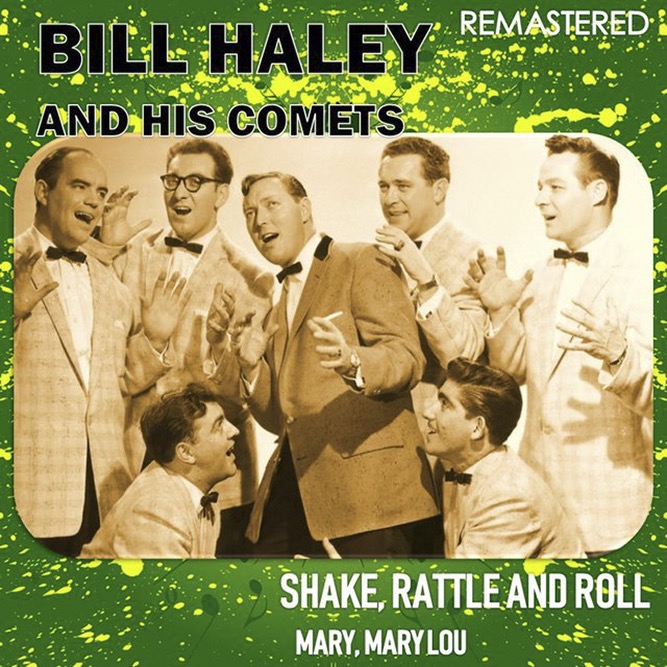
Shake, Rattle & Roll Bill Haley & his Comets (1954)
Jumpin’ Jack Flash The Rolling Stones (1968) “I’m Jumpin’ Jack Flash, it’s a gas, gas, gas”
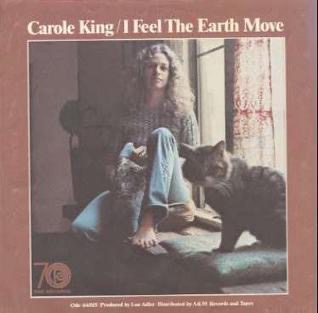
I Feel the Earth Move Under My Feet Carol King (1971) “I just lose control, Down to my very soul, I get hot and cold All over, all over, all over.”
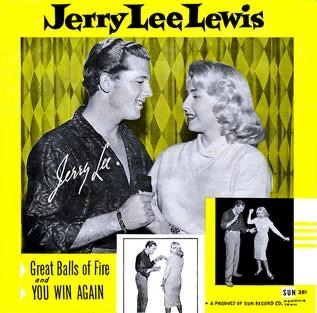
Great Balls of Fire Jerry Lee Lewis (1957) “You shake my nerves and you rattle my brain Too much love drives a man insane You broke my will, but what a thrill Goodness gracious, great balls of fire”
SURGERY
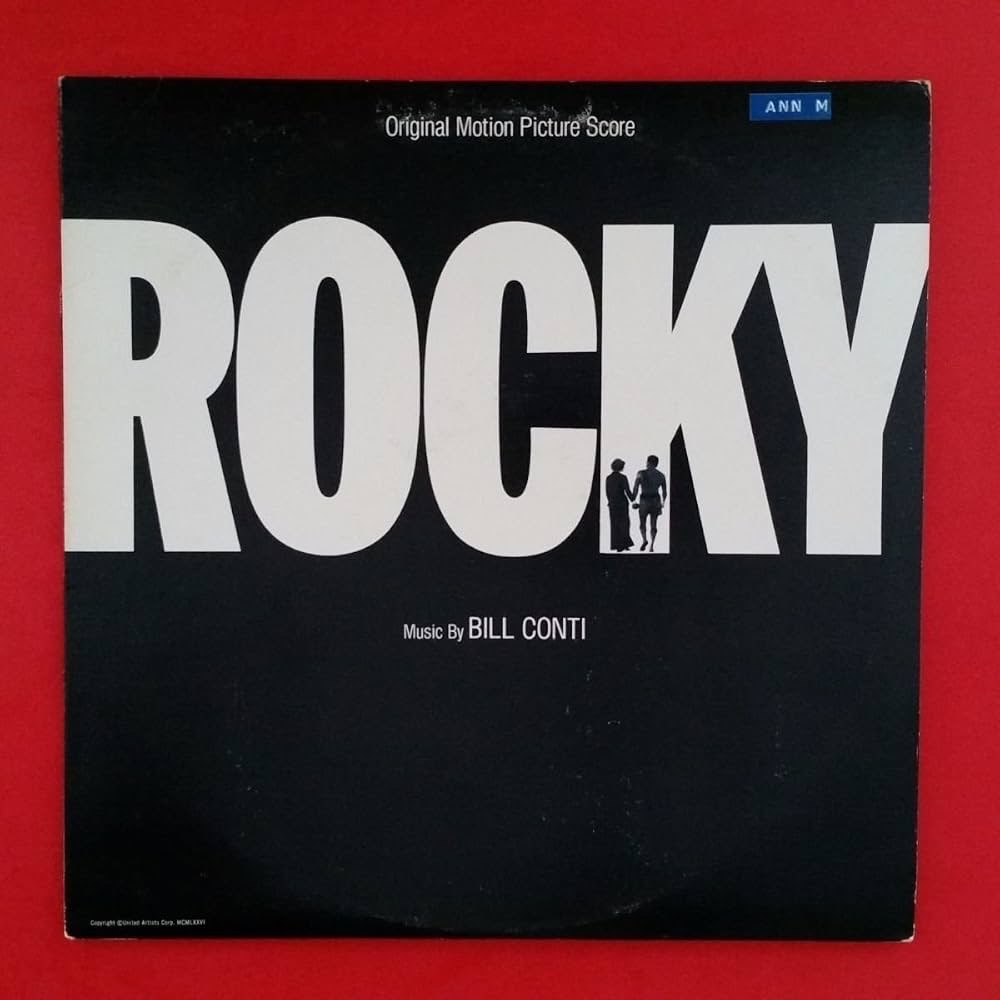
Gonna Fly Now Rocky (1976) Bill Conti
White Rabbit Jefferson Airplane (1967) “When logic and proportion Have fallen sloppy dead And the White Knight is talking backwards And the Red Queen is off with her head Remember what the Dormouse said, Feed your head. Feed your head.”
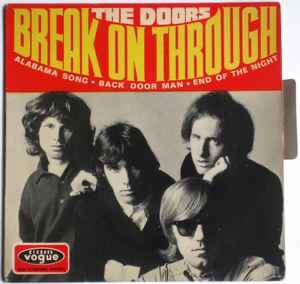
Break On Through (To the Other Side) The Doors (1967) “Tried to Run, Tried to Hide, Break on through to the other side”
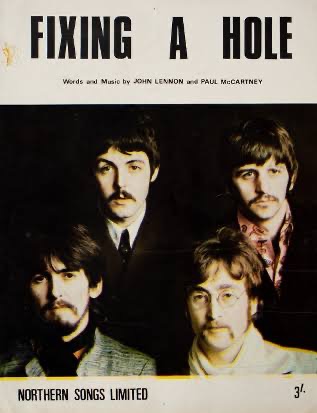
Fixing a Hole The Beatles (1967) “I’m fixing a hole where the rain gets in And stops my mind from wandering”
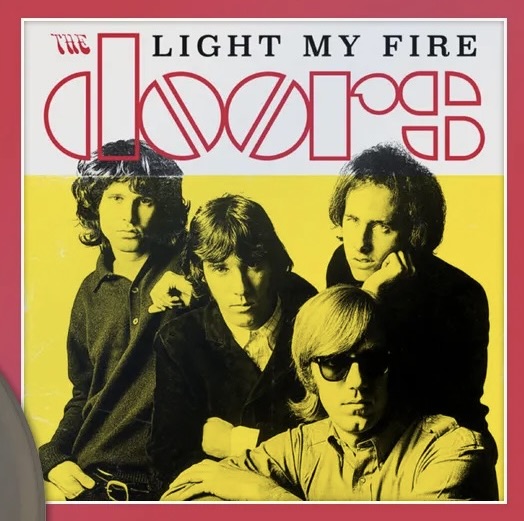
Light My Fire The Doors (1967) “The time to hesitate is through, No time to wallow in the mire“
Gentle on My Mind Glen Campbell (1967) “That keeps you in the backroads By the rivers of my memory That keeps you ever gentle on my mind”
Don’t Sleep in the Subway Darling Petula Clark (1967) “You wander around on your own little cloud when you don’t see the why or the wherefore.”
POST-OP
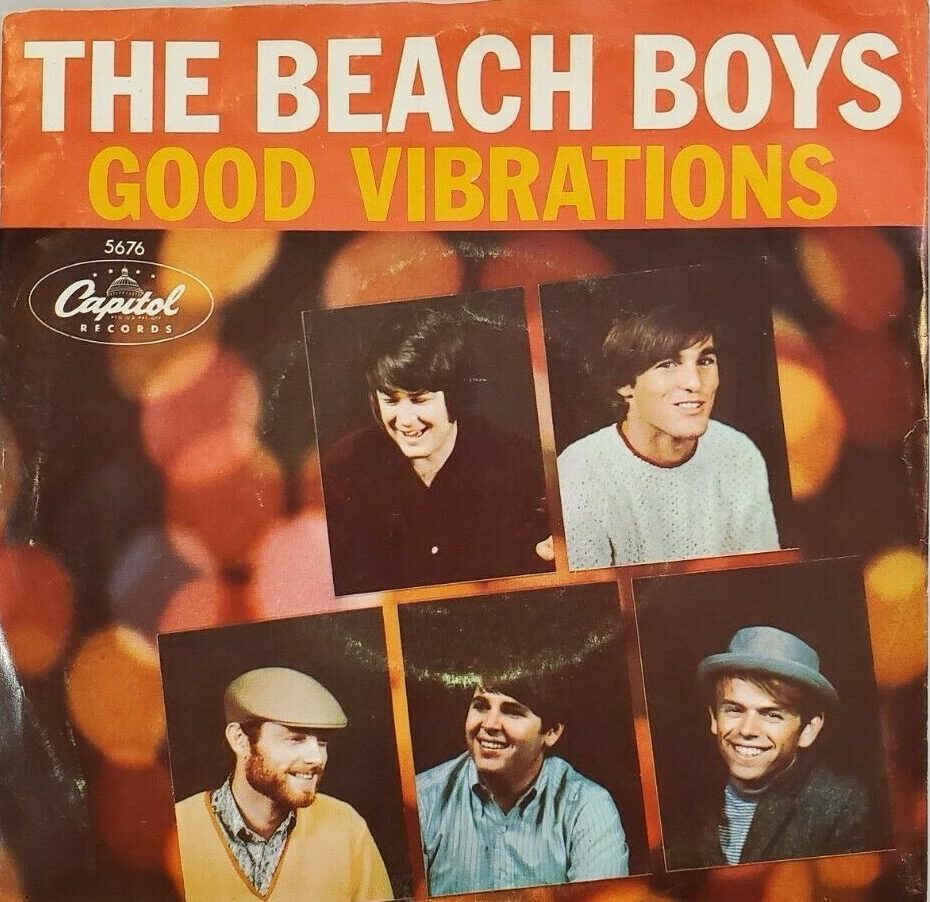
Good Vibrations The Beach Boys (1966) “I’m picking up good vibrations, She’s giving me excitations.”
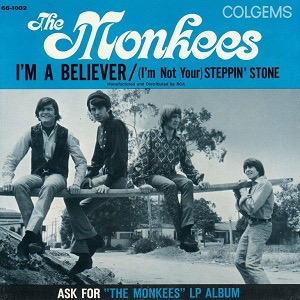
I’m a Believer The Monkees (1966) “What’s the used in trying, All you get is pain, When I needed sunshine, I got rain” Then I saw her face, now I’m a believer
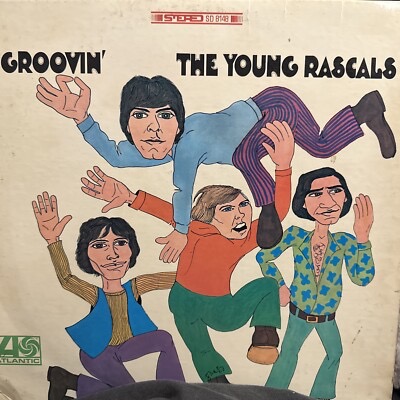
Groovin Young Rascals (1967) “Groovin’ on a Sunday afternoon Really couldn’t get away too soon I can’t imagine anything that’s better”
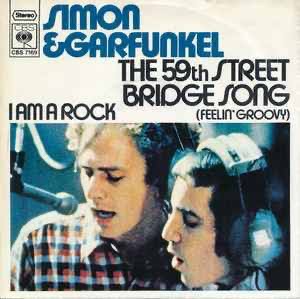
The 59th Street Bridge Song Simon and Garfunkel (1966) “I got no deeds to do, no promises to keep I’m dappled and drowsy and ready to sleep Let the morningtime drop all its petals on me Life, I love you, all is groovy”
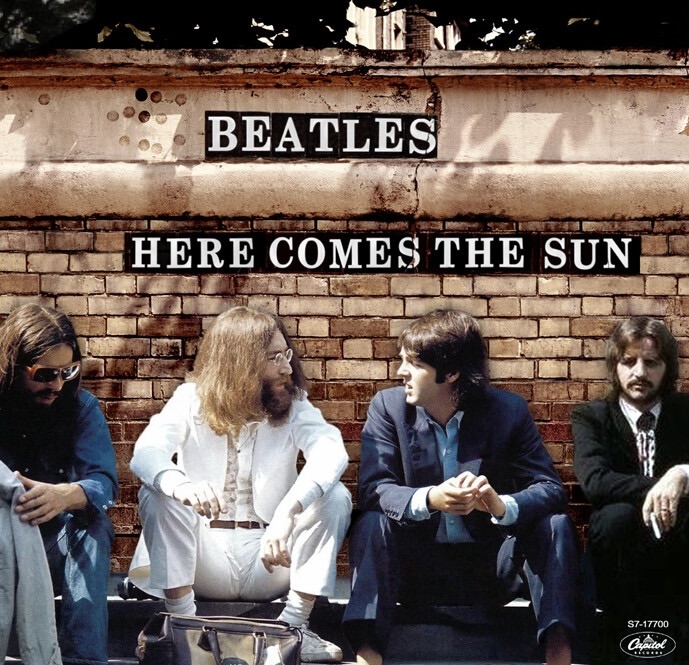
Here Comes the Sun The Beatles (1969) Little darlin’ I feel that ice is slowly melting Little darlin’ It seems like years since it’s been clear Here comes the sun, doo-doo-doo Here comes the sun And I say, “It’s all right”
San Franciscan Nights The Animals (1967) Strobe light beam, creates dreams Walls move, minds do too On a warm San Franciscan night
Old child, young child Feel all right On a warm San Franciscan night
The heavy mist off the Pacific makes the sidewalks along Castillo Street in downtown Santa Barbara glisten like obsidian. Cathy is asleep back at the hotel. At least I hope she is. I probably woke her despite my best ninja efforts to deftly lift the tumblers in the door lock and slip silently into the hallway.
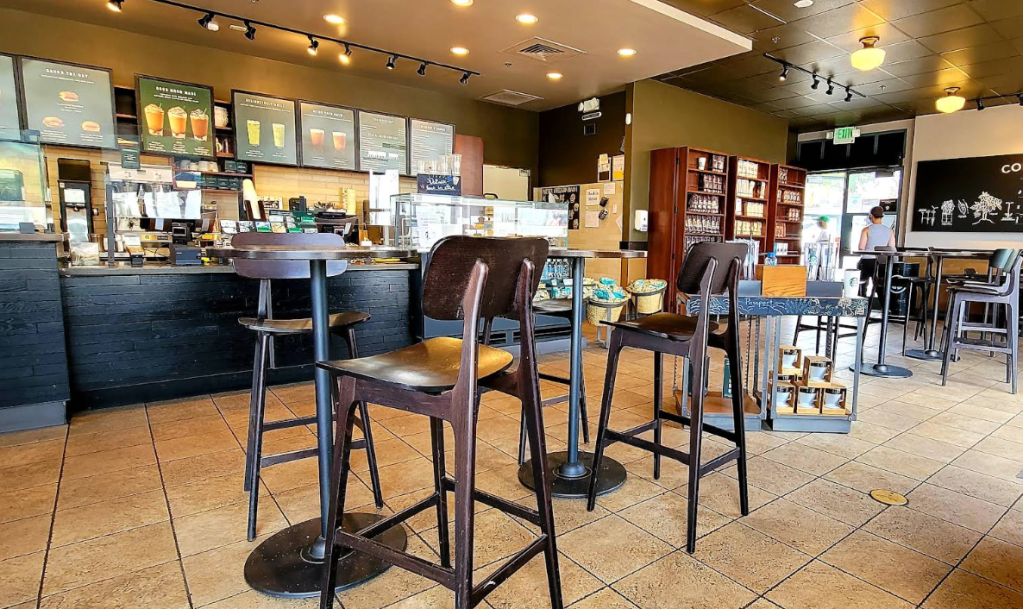
A middle-aged woman in gray sweatpants and a black hoody parks her wheeled walker in from of the Starbucks counter. The barrista calls her “Hon.” That, and the hour, suggest she’s a regular.
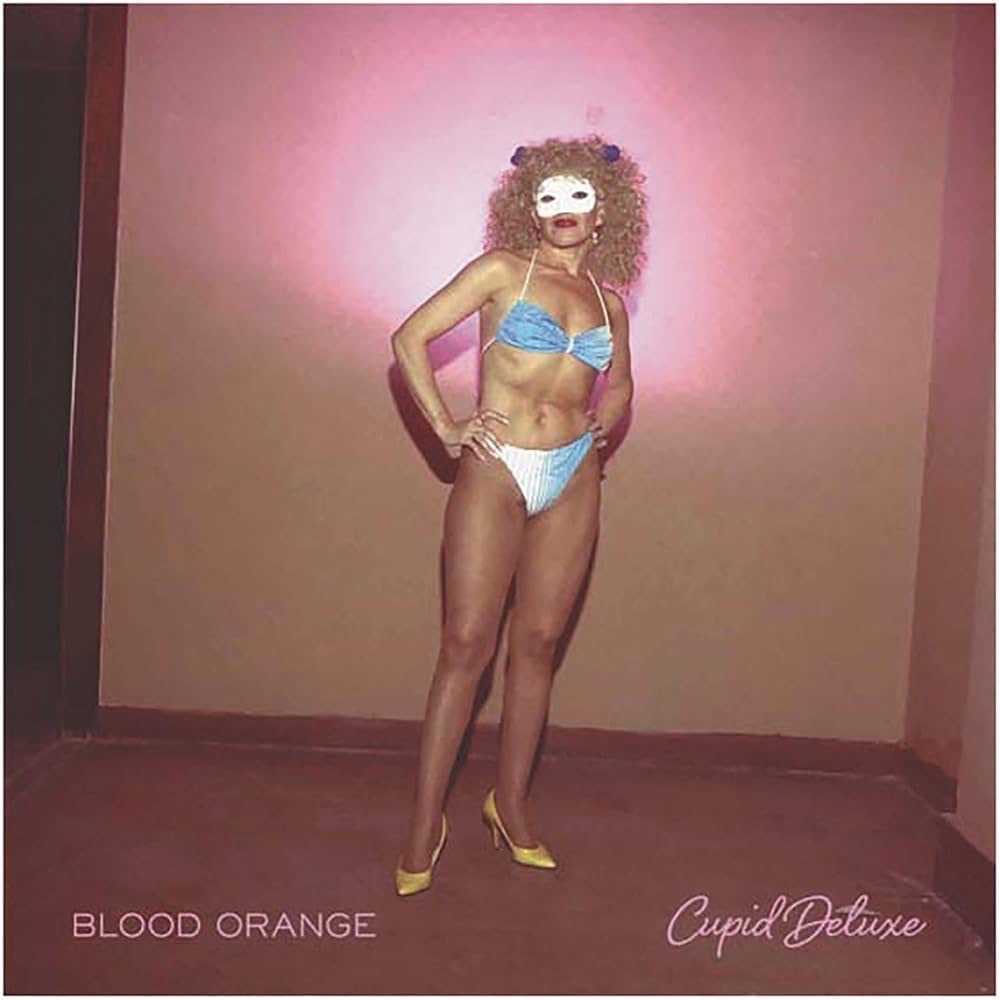
Barry Gibb and the Bee Gees are belting out “How Deep Is Your Love” on the speakers, straining to be heard over the industrial and incessant hummmm of the refrigeration motor keeping the yogurt parfaits chilled. Barry gives up and passes the Muzac mic to either Uncle ACE playing Blood Orange or Blood Orange playing Uncle ACE. I can’t tell which from my nifty Shazam app until the album cover comes up and I scramble to turn my phone off.
The album cover answers my question on the artist’s identity, but does nothing to ease my general feeling of unease this morning.
I steal glances over my laptop at the gal with the wheeled walker. “Nice wheels” I say. She looks miffed until I explain I’m shopping for a set. She still looks miffed when, apparently betraying my ignorance, I question the need for handbrakes. The tension breaks when a predawn jogger comes in and unwittingly provides a common target for shared resentment.
I glance again at the wheeled walker and my thoughts drift back to Wednesday.
Cathy and I met with the brain surgeon and his team in Redwood City and my neurologist in Terra Linda. All are very reassuring, very knowledgeable, very thorough. I endured another 40 minutes in the sinking one man submarine they call an MRI (that was worse than I expected) and they each gave a NASA launch team thumbs-up-all-systems-GO for the first brain boring on July 23.
Unfortunately, the team confirmed my worst fear that, yes Rob, you will have to suck it up and not once, but three times, endure dusk to dawn withdrawal hell. First, the night before my first surgery on July 23, the night before the second surgery on August 27, and the night before when Dr. Nandipati fires up and adjusts my gizmo in late September.
That’ s three more nights in withdrawal hell, two holes drilled in my head, and an eight-track planted in my chest before she can do the voodoo she doos and . . . god willing and the creek don’t rise . . .dial back my shakes.
For three months I am not to drive, not climb stairs alone, and never engage in exercise which might break a sweat on my pretty bald head. This is particularly distressing as breaking a sweat on my stationary bike and Peloton is the only way I’ve found to mask late afternoon seismic tremors that make a straightjacket sound inviting.
And if that weren’t bad enough, the doc told us I’m not to wear the cool blue tweed Donegal cap, forest green felt Stetson Indiana Jones hat, or the red, black, blue and white cotton paisley doo rags I ordered from Amazon to sweep Cathy off her feet and protect what I suspect will be a scalp just itching to be burnt to a Cool Ranch Dorito crisp.
Life goes on.
The young woman at the counter orders a Vente Caramel Macchiato with five shots. I’m not sure if five shots is normal or excessive or if that’s five shots of espresso or five shots of fast acting sucrose.
Life goes on.
The coffee machine is signaling it’s about to blow with a klaxon that sounds like a submarine about to dive but the baristas do not seem concerned.
Life goes on.
The lady with the sporty walker finishes her drink, smiles and leaves. I sip the last of my iced tea.
Life goes on, doesn’t it?
All about us life goes on.
Taking little notice, offering little solace, asking none in return . . .
My brother John won’t like that I write about him.
He doesn’t like to talk about himself. Hell, he doesn’t much like to talk.
He is a man of few words and the few that he shares seldom, if ever, center on himself. A mathematician by education and a physician by profession, he views language wth suspicion, accepts it as an unfortunate necessity to impart information but enjoys it so long as it is used well and sparingly so as to demonstrate what he believes the highest virtue of man.
A quick wit.
At this, the latter, he is very good.
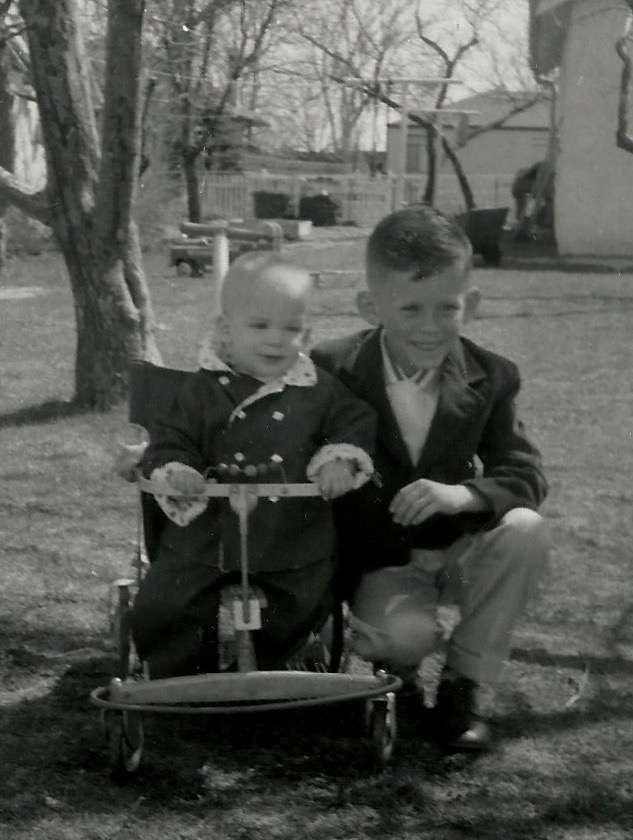
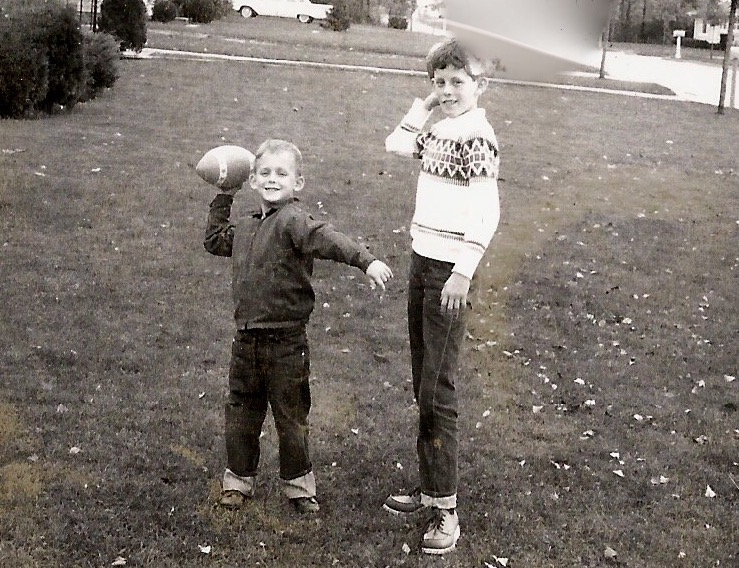
I have always looked up to my brother, literally and figuratively. John is five years older and 5 inches taller than me. (I’m not bitter.) He was born John Calvin Jackson, IV. Our father was John Calvin Jackson III. John’s son is John Calvin Jackson V and his grandson is John Calvin Jackson VI.
They call him “Six.”
III taught IV and, I suspect, V will teach VI that the best way to avoid conversation is to get the person to whom you are speaking to talk about himself. This has four desired effects. First, it is a subject near and dear to the speaker’s heart. Second, fascinated by the subject, the speaker will gladly overlook and unknowingly make up for your lack of participation. Third, when you part ways, the speaker will, on reflection, know little or nothing about you, but curiously like you for reasons he can’t explain. And fourth, if you listen…truly listen…you will learn a lot more than if you speak and find, as dad did, that most people …surprisingly…have a good story to tell.
Given his tendency to say little, it’s ironic that my earliest memories of John are of his voice. Often speaking up when I was too frightened to speak for myself.
We shared a bedroom throughout our childhood. John slept in the top bunk: I slept below. His bedtime was later than mine, but most nights he would crawl into the top bunk and listen patiently as I prattled on. Occasionally, he would answer a question, but it was his quiet presence that conveyed…more than words might…that I need not fear and all would be well.
When you are the younger brother, there is a comfort that comes with knowing, if tongue tied, your big brother will speak up for you. Take, for example, the obligatory Christmas morning phone call when, prompted by our mother, John, Linda and I would each thank our grandparents for a sweater we were likely never to wear again. On those occasions, John would do all the talking and my role, third in line to take the phone receiver, was merely to parrot what he said and quickly pass it back to Linda.
As a little boy, I was nervous around my dad. He traveled a great deal for his work and, although he was a kind and gentle man, he was often not home. I never felt entirely at ease when it was just he and I, one on one. Thankfully, that seldom happened as I was typically at John’s side and John could do the talking for me.
Usually, if the “three men” were off on our own, John would, as the oldest, be summoned to the front seat of the station wagon, and I, thankfully, would watch and listen from the warm and dark comfort of the back seat.
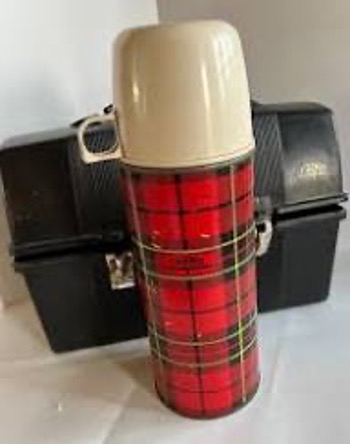
Once, on a fishing trip, John suffered a migraine, and dad called me to the front seat so John might lie down in the back. I will never forget what came to be known as the “Plaid Thermos Affair.”
You see, Dad had a plaid thermos for his coffee and typically John would pour when asked. When John fell asleep in the back, the job fell to me. This was a responsibility for which I was not prepared and should have been assessed as hopelessly unqualified
Uhhh, dad?
You do realize I’ve never done this before. Right?
“Nothing to it?” you say.
Unscrew the cap? Hold the cup with my left? Pour with my right?
While we’re moving?
John!!!!
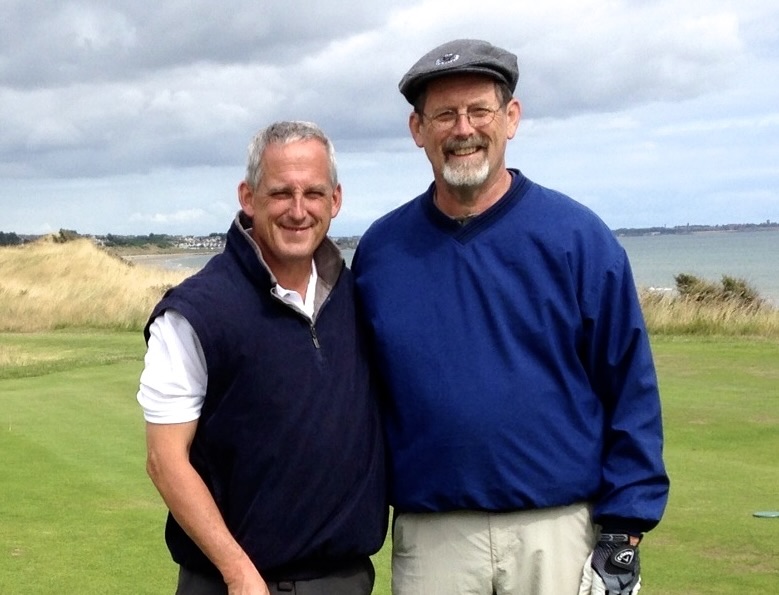
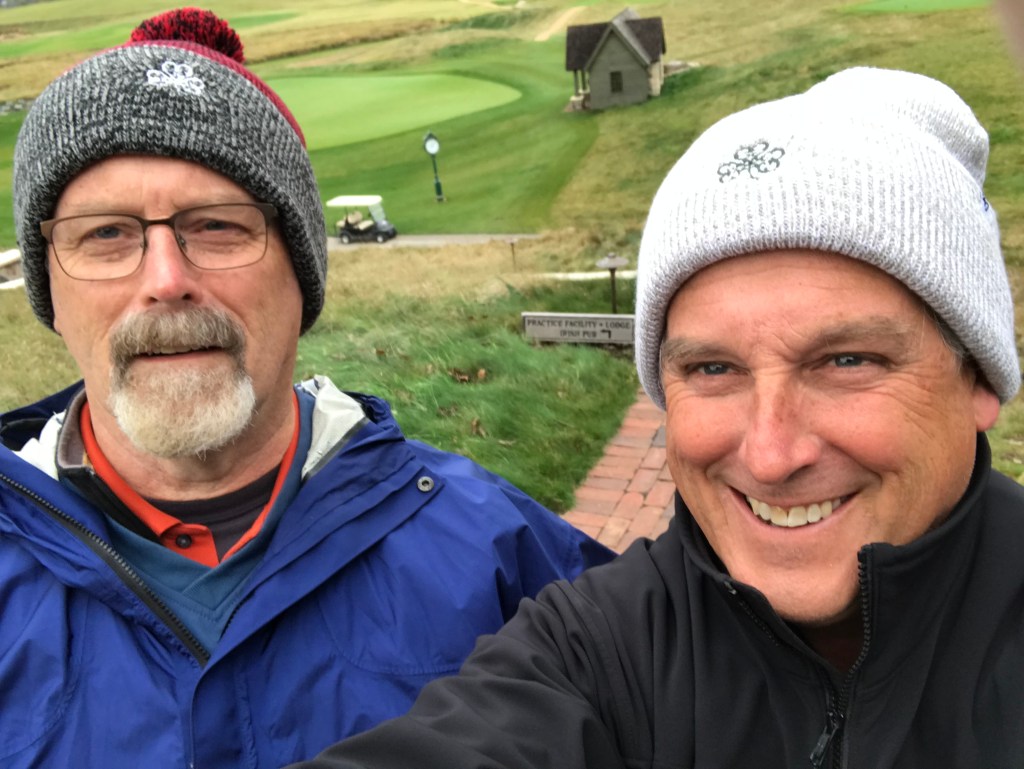
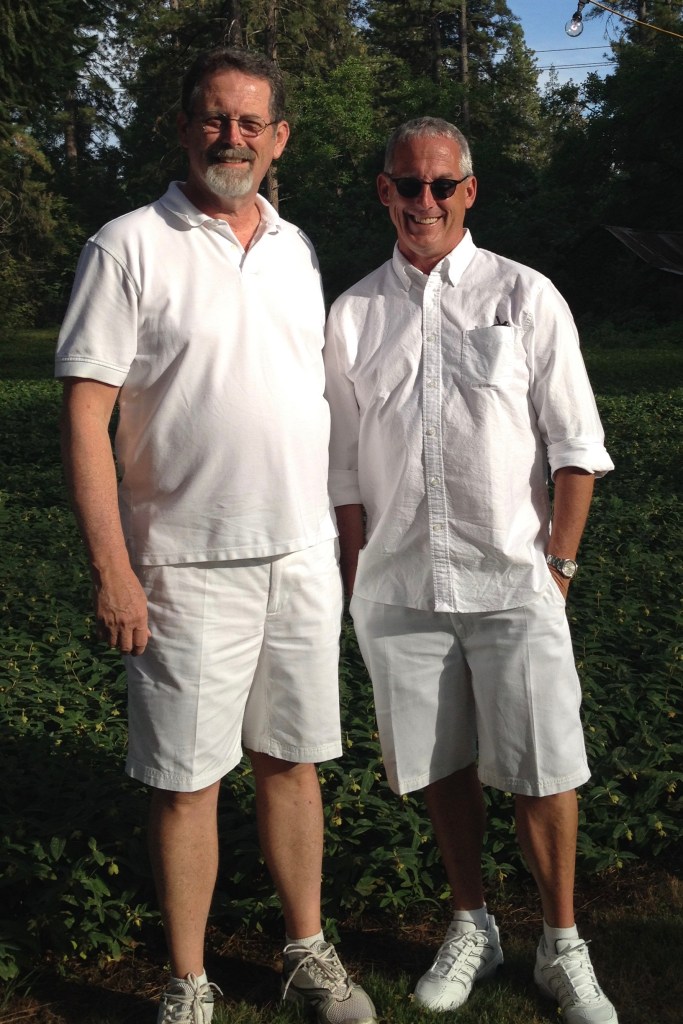
John lives in Nevada City. I live in Petaluma. Before my Parkinson’s, John and I would occasionally get away, just the two of us on a golf junket. Once to Ireland. Once to Wisconsin. Often, on the road, in the hotel, on the course, we would not say much, and I sometimes wonder if an observer might have thought it odd that two brothers, as close as we are, were so quiet.
That’s just our way. We have grown accustomed to shared silence. Though alone in our thoughts we are not alone in our fears. We can listen to the other without either of us saying a word.
And so it was odd last week when I felt my phone vibrate and looked to see that it was not John, but his wife Sue calling. While visiting his kids and grandchildren in Seattle John had suffered a stroke. Not life threatening. Not permanently incapacitating. No facial droop. No speech impairment.
But the stroke was more than mild. (He had diagnosed himself, correctly, on the ambulance ride to the hospital.) John could not walk unassisted, and his left arm would, without warning, levitate, rising from the bedside to float above his head.
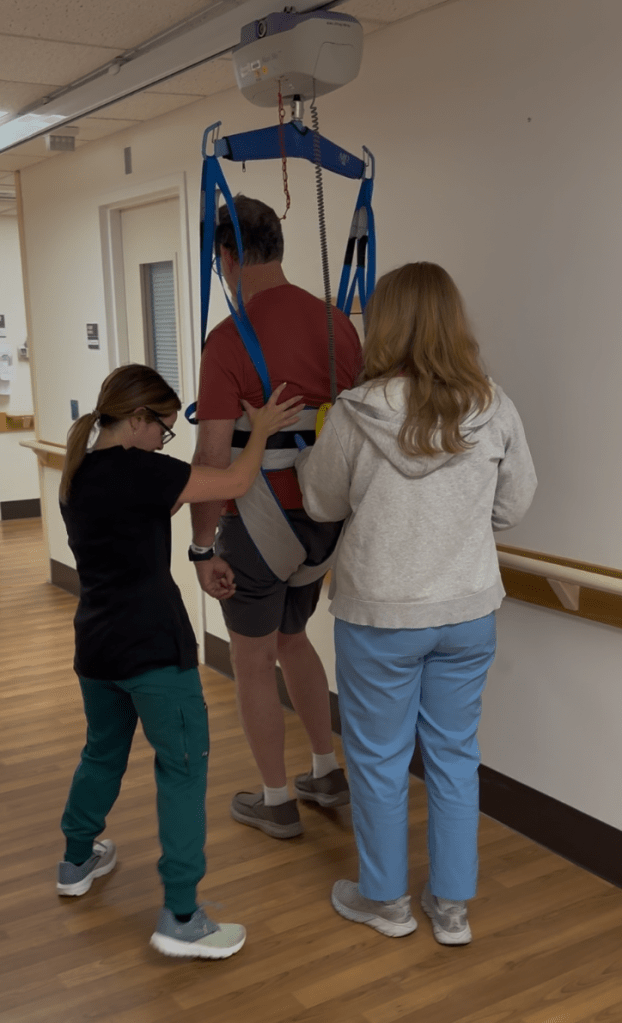
Linda and I flew to Seattle and found our big brother, as we knew we would, surrounded by his wife, three children, and his newest grandson, Lachlan, age 4 months. The hospital is first rate. The doctors and staff are excellent. They have John in intense rehab several hours a day and already he has progressed to where he can walk with a cane a short distance on his own.
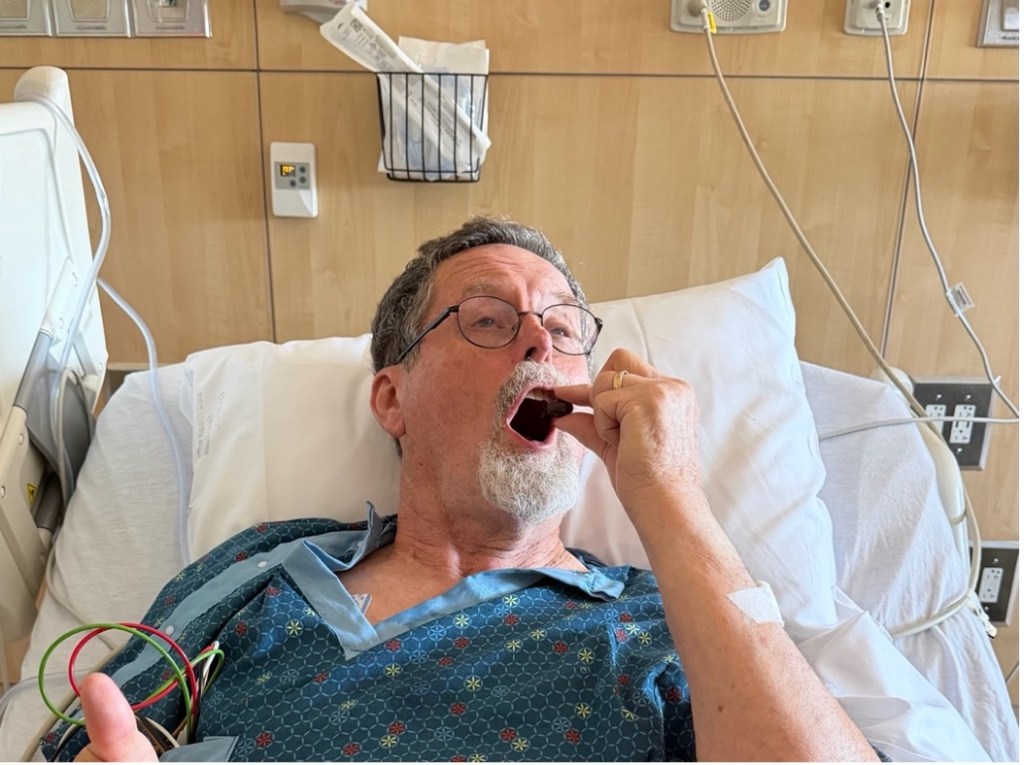
He entertains the hospital staff like Bob Wiley in What About Bob?, makes fun of himself as he tackles rehab, and will gladly demonstrate for anyone who might assist, how he can intercept with his open mouth a levitating left hand holding a chocolate covered almond.
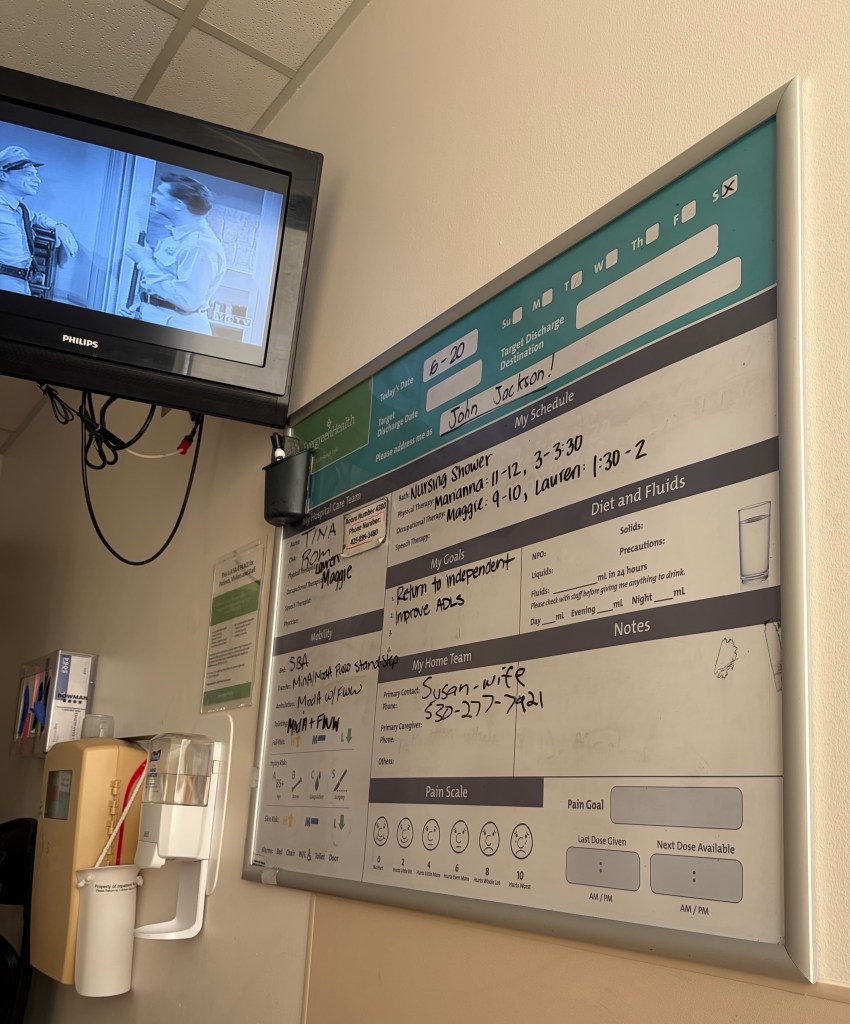
I asked him to take a photo of his bedside white board so that we might visit or call during a break in his rehab schedule. If you look closely, you will see his daily grind, but it is more telling to look at what John is watching on the TV…
Andy Griffith and Barney Fife.
John will tell you Andy and Barney have more important information to impart than anyone on CNN.
The problem with being a physician is that you make a lousy patient. You know too much. You know the right things to ask and the wrong things to learn.
And the problem with having John Jackson as your brother is that you don’t know if what he’s not saying is John just being taciturn John or John not wanting to frighten those he loves with stuff he knows. Both are his nature.
I like to think I can read John’s silence. We have shared silence for so long I like to think I can hear what he won’t say.
He is not one to be dramatic; he tends more toward the pragmatic. And I think that while he is disappointed, he is not daunted. I think he knows that as minor as this setback will prove to be in the grand scheme of things, it may be just enough to prevent him from doing the little things he hoped to do. Like walking the dogs. Shooting hoops with Six. Playing shitty golf. Driving from Nevada City to Davis to shoot the shit with his brother and sister and talk about the old days over a pastry or two.
I don’t know for sure, but I suspect one of the little things he planned to do and now, living in Seattle, may not, is to drive to Redwood City to give his brother shit after brain surgery and talk about the weak minds that seem to run wild in the Jackson men.
Although he will not say it, and I suspect he never will, I think John fears this setback may hamper him from helping those he loves. He is not afraid of dying; he’s afraid of not showing up before he dies.
That’s what a husband, a dad, a granddad, and a big brother are supposed to do. Look after the little ones.
Speaking for myself, he needn’t worry.
It doesn’t matter if it’s Seattle or Redwood City, I already know he’s there and looking after me.
I mean this will be me in…oh…42 days. Just 42 days until they drill not one but two holes in my head, run wires to the center of my brain and connect them to a battery the size of an old ABBA cassette tape they plan to plant in my chest.
“Knowing me knowing you, it’s the best that I can do”
Have to admit…this has got my attention.
But, as my dad always said, “the more you know the less there is to fear.”
So, talk to me doc. One surgery on July 23? The second one on August 20? What do I need to know? What do you need me to do? Just say the word and I’ll do my part.
“COME IN GOOD HEALTH.”
Okaaaay…sounds simple enough. Hmmm…let’s hit the “Play” button on this nifty Kaiser “DBS Surgery Video” and find out more.
Uh huh… uh huh…I see…
Let me break it down.
Apparently folks who undergo this, what the Brits might call “under-the-bonnet” work, have been known to pack on pounds…I’m guessing while pounding down celebratory chocolate shakes during “recovery.”
Experience teaches us it’s best not to be riding high on the ol’ bathroom scale before you experience the post-surgical “freshman 15.”
Makes sense.
I mean, if I’m going to do this, I don’t want to be a lardo after the re-do.
So…how best to approach this?
Claude?
We need a plan.
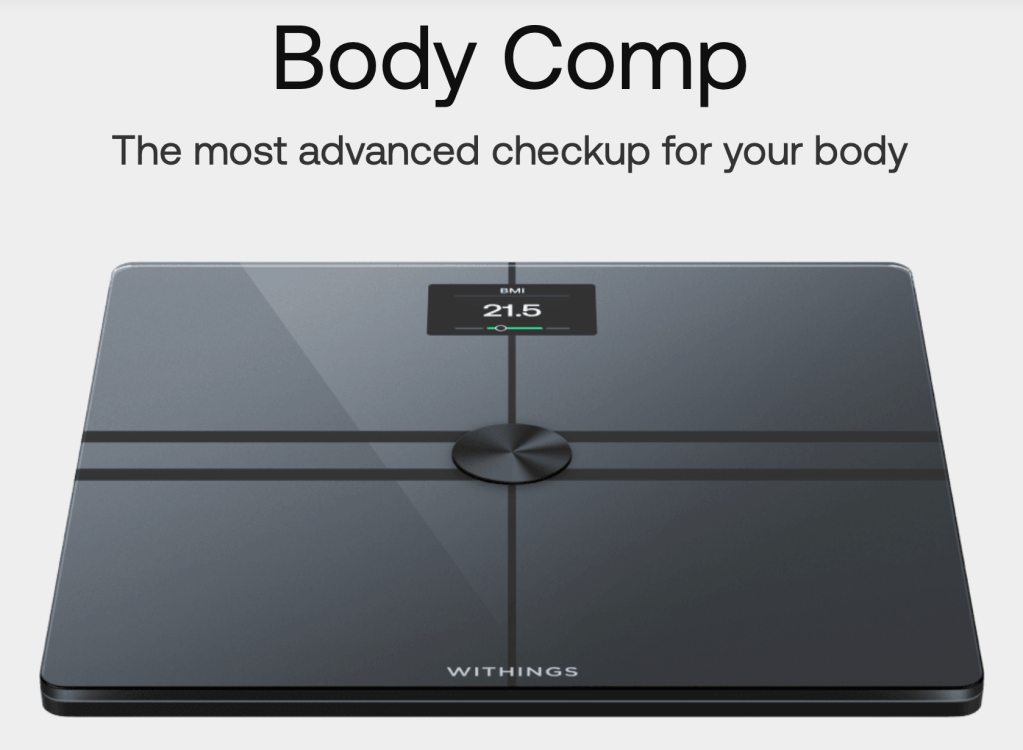
First, a new scale. But not just any scale.
No siree Roberto.
Claude…my wingman, my new AI BFF, my very own virtual Jack LaLanne…Claude says I need the new Withings Body Comp 2000. Hop on this puppy each morning and a technicolor screen between my big toes tells me…and anyone else in the greater Petaluma area not blinded by the LEDS… things like my weight, the trend line on my weight, my vascular age, my heart rate, my nerve response score, my muscle, fat and water mass. All of this is then sent magically to my cell phone and Apple Watch.
Cool.
Next up?
Sleep.
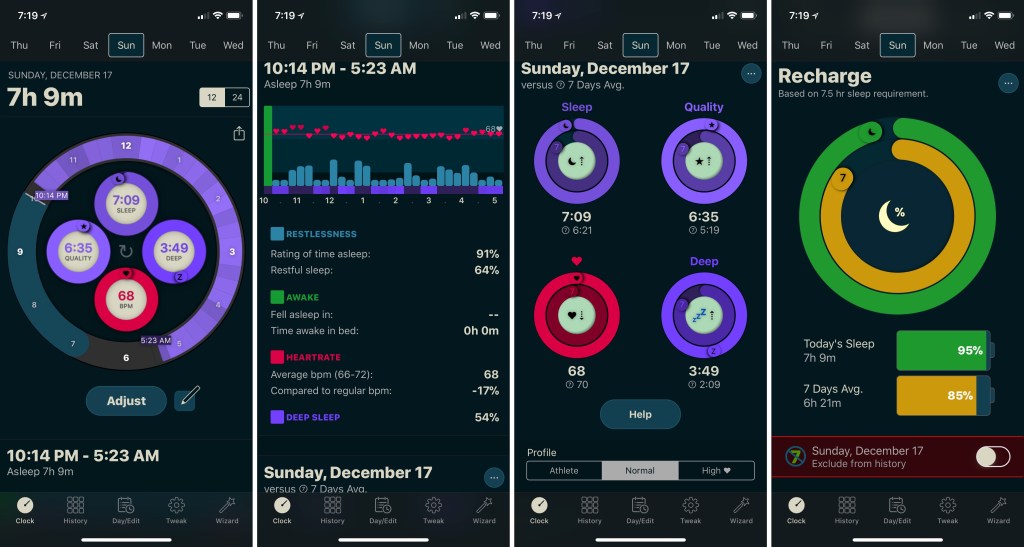
Claude says I need to better monitor my sleep and the best app for that is the AutoSleep 2000 also linked to my Apple Watch.
Hop off the ol’ Withings Weigh-O-Matic, grab a cup of tea, scroll through AutoSleep and I can tell you the hours I slept, the hours I didn’t, my sleep quality, my REM and deep sleep time, and my heart rate. Hell, I can tell you the times I got up to pee or jumped out of bed to work out a leg cramp.
“Okaaaay?” you might ask, “Where are you going with this, Rob?”
Why silly, where all great endeavors begin and culminate…
A spreadsheet.
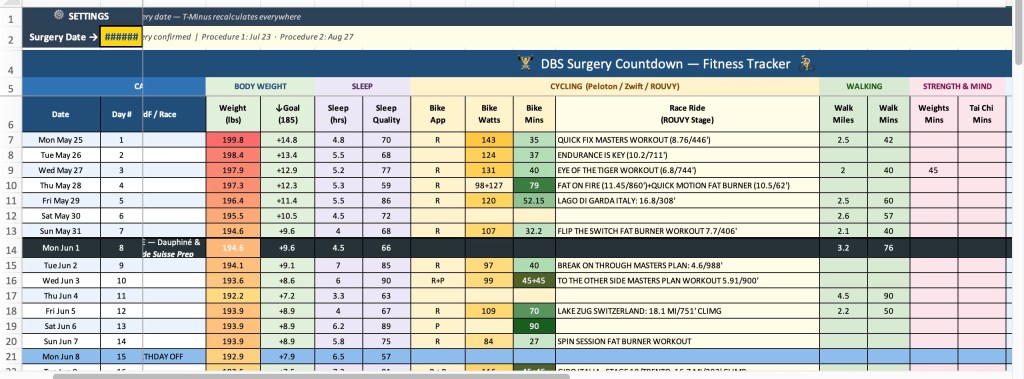
This, my friends, is the “DBS Surgery Countdown Fitness and Diet Tracker.” The most sophisticated spreadsheet I’ve yet to devise in a lifetime of long and fruitless self-improvement spreadsheets.
I walk…I record time and distance. I lift weights…I record reps. I ride…
Boy howdy do I ride. I don’t go anywhere, but I ride.
How, you ask? How does a balance-challenged Parky log cycling miles?
By never leaving the comfort of the garage, my friend.
I have two ride options:
Option A: I can perch on the roomy saddle of my trusty Peloton stationary bike and follow along with Christian Vande Velde as he puts me through simulated pro rides over the Roubaix cobblestones.
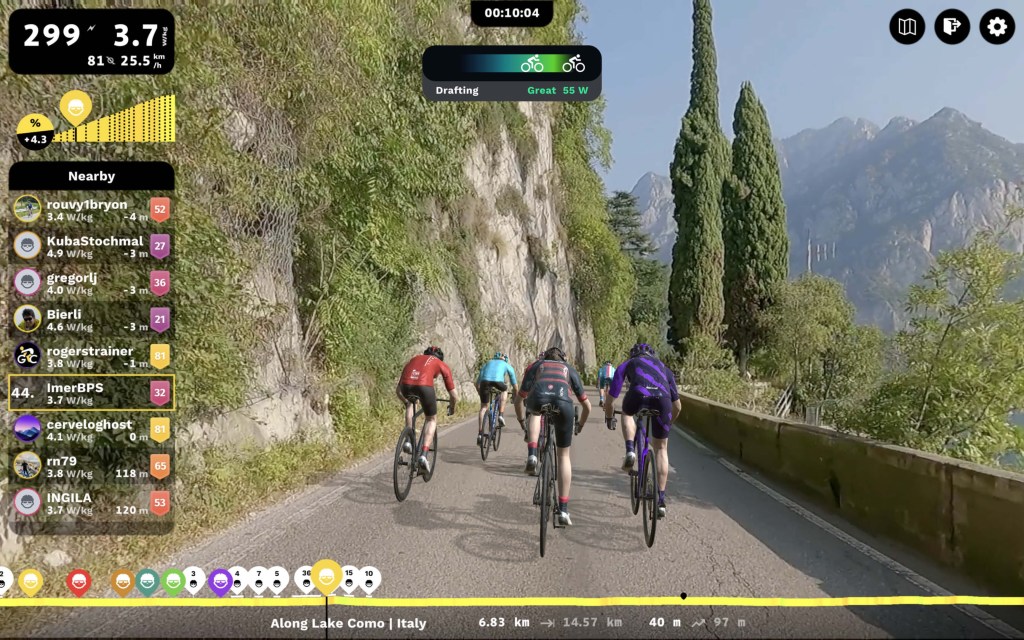
Option B: thanks to my KIKR Core stationary bike trainer attached to my old reliable 2009 Specialized Roubaix road bike and my groovy 2025 ROUVY virtual reality cycling app which automatically adjusts the resistance on my pedals so as to simulate the climbs and descents depicted on my big screen, I can monitor my time, distance, speed, wattage, total joules and heart rate while “racing” against other garage bound geriatric road warriors, and watch on a big screen as the Alps pass by.
Why just yesterday I drafted a group of friendly Italian boys along Lake Como.
Ciao, bambinos!
I’ve even plugged into my spreadsheet the five stages of the Tour de Suisse and the first 20 days of the Tour de France so I can ride the same roads Tadej Pocagar and Jonas Vingegaard will.
Well, not all the roads. The flat ones, mostly.
On the calorie intake side, I track the time and nature of my meals. I’ve even included color-coded cells showing “the weight loss remaining to reach my goal” and a cell showing just “how short of my 15-hour daily fasting goal” I fall each morning. The colors grow brighter the closer I get to the objective.
Cool, huh?
I’m guessing that’s not the word you were searching for.
I bet your word starts with an “A”?
I thought so.
I thought about including anal output, put that seemed a metric too far. A bit too anal. Even for me.
Don’t get me wrong. I’m no purist. I indulge myself plenty.
At lunch I mainline Diet Pepsis and free base Jello Zero-Sugar Pudding cups like a heroin junkie on methadone. I know they’re poison packed with some nasty toxic chemicals from which I’ll sooner die than learn to pronounce, but if I can’t chase lunch without at least the illusion of sugar, my spreadsheet “Grumpy Meter” will red line and Cathy will be fitting me for a third hole in my noggin.
Okay, it all goes on my DBS Surgery Fitness and Diet Tracker spreadsheet. What’s next, Doc?
“MANY INDIVIDUALS FIND IT HELPFUL TO LEARN RELAXATION TECHNIQUES TO GREATLY REDUCE ANXIETY AND STRESS DURING SURGERY”
Uhhh…a couple of questions? Yeah…me…here in the back.
First, maybe it’s me…it probably is…not sure why…but anytime someone yells, ‘PRACTICE RELAXATION”, I have a hard time…mmmm…relaxing.
Second, what’s this “stress during surgery” stuff? I thought the plan was that, while sometimes awake, I’ll be pretty loupy throughout each surgery.
No? Not entirely? Hmmm…yeah…okay…good point.
Let me break it down. Seems each day will start at Oh-dark-thirty and I won’t be allowed to take my anti-shake-rattle-and-roll pills after bedtime the night before.
Uhhh doc…two quick thoughts?
About this notion of bedtime?. Who are we kidding. The notion of a “bedtime” or any “bed time” the night before the surgery is a stretch. And I’m not talking horizontal. I’m guessing no amount of “Magic Fingers Massage” in the bed of our Redwood City Best Western is going to get me to sleep.
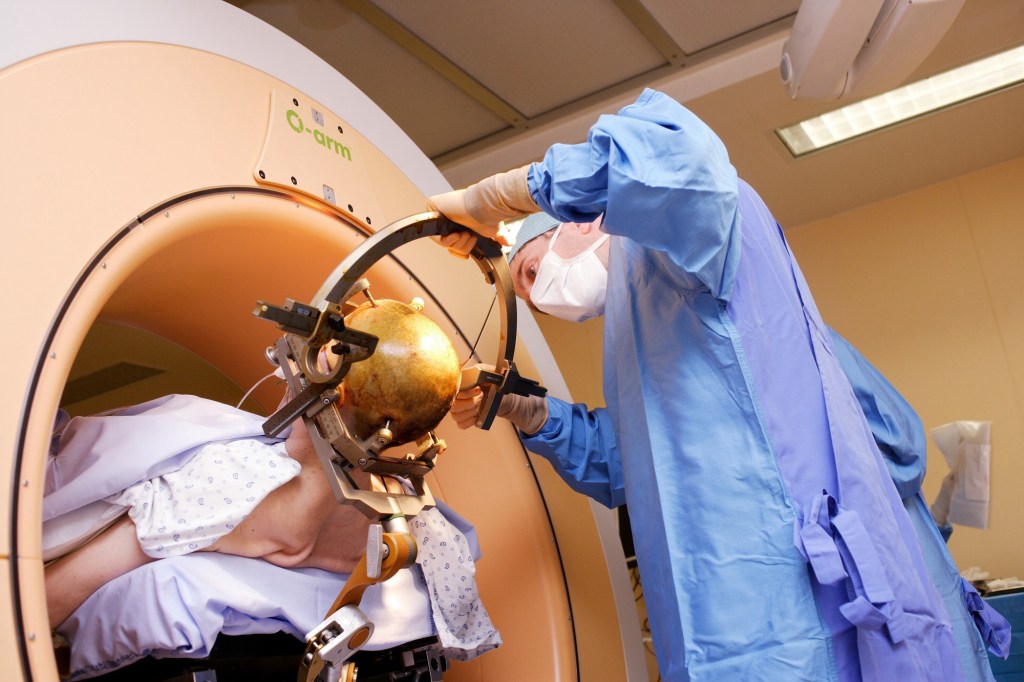
Second, as I understand it, I’ll arrive before dawn having skipped my morning meds. My head gets shaved and bolted into a frame. Me and my bald-bolted-in-place-head are wheeled into and out of an MRI machine. And then I sit there…increasingly more shaky, increasingly more stiff, and increasingly more aware that I’m about to have a hole the size of a nickel drilled into my skull.
Between pre-op and post-op, I’ll be in my coach size recliner, meds withheld, skull drilled, and wires stuck into my brain for the same time it takes to fly from New York to London, but without a window, a movie, headphones, snack, or those little sox they give you.
Okaaaaay…
Maybe some deep breathing techniques might be a good idea?
Maybe some of those Lamaze things I learned when the kids were born. Shallow breaths. Focus on one spot.
Or maybe that thing where you first focus on your toes, command them to relax, then move onto your knees, command them to stop shaking, and work your way up consciously relaxing every stop along the way.
That miiiiiiiight work…don’t you think?
What do they give you in spas? Lavender? Burn some sage?
How about one of the posters dentists plaster to the ceiling showing some “happy place” like a puppy farm or a bubbling brook?
Headphones?
I didn’t think so.
Can I bring my own play list for the OR? Maybe some…what’s her name…Anya?…Enya? The woman who sounds like you’re drifting off with the elves along a stream somewhere in Middle Earth.
Before the orcs show up.
“THE SURGERY STAFF WILL MAKE YOU AS COMFORTABLE AS POSSIBLE”
Okay, now, that’s not helping. I know it’s supposed to. And I’m sure the staff will do their best. But…
“THE DRILL SOUND IS LOUD AND CAN RATTLE YOUR TEETH…THE RELAXATION TECHNIQUES YOU HAVE LEARNED CAN BE VERY HELPFUL.”
What?????
Drill sound?
Rattle my teeth?
CLAUDE!!!!
Mayday, mayday. Pilot to tower, pilot to tower…
Don’t give me that, “Don’t worry, Rob.” I don’t care if the surgeon does use a pneumatic high-speed handheld drill made by Medtronic called the Midas Rex?
Handheld?
You mean like a dentist?
No afront to my DDS buddies, but that’s not comforting, Claude. Drill too far down on a cavity and you get pulp. Drill too far down on my skull and you get the good stuff.
What?
The Midas Rex is engineered for “smooth and precise” bone cutting? Especially when mounted with the new and improved 14mm “cranial perforator”?
First off, I don’t like the sound of a “perforator” and I haven’t even heard it yet. Second, the fact that the cranial perforator is guaranteed to, in all but 1 in 200 times, stop rotating before it reaches my gray matter is not the reassurance you think.
How does the doc know when to stop?
He doesn’t?
Well then, who does?
The drill does?
How does the drill know? Some kind of whizzy wig AI magic?
No? It’s mechanical? A clutch of sorts?
A clutch?
A CLUTCH?
What if the guy pops the clutch?
Okaaay, so after the perforator, we’re in? Right?
Not quite?
The surgeon still has to make an incision with a good old-fashioned scalpel through my dura.
What’s the dura?
Like thin leather? Its name comes from “dura mater” which means “tough mother.”
I’ll show you tough mother, Claude.
My surgeon will be holding this gizmo… this high end Dremel Tool… which will turn off on its own before it hits paydirt. Then he switches from the handheld perforator, which I’m guessing, giving the resistance my skull has put up, has been shaking a good bit, to a scalpel to cut through some mother of-a- dura tough membrane without going too deep, and then he threads a wire the width of an uncooked spaghetti noodle three inches deep into an area the size of a pea, and parks the tip of that noodle within a millimeter of just the right spot to zap me. And during all of this I’ll be wide awake and expected to answer questions, do finger puppets, and snap my fingers to help him find that spot?
Let’s get back to the teeth rattling part, Claude. Give it to me straight.
This is what Claude said…
“Rob, let’s be honest about what’s actually happening: you are awake, your head is bolted into a stereotactic frame, and someone is drilling through your skull from the outside. The vibration doesn’t travel through air to your ears — it travels through your bones directly to your cochlea. It’s not a sound so much as a full-cranial event. Patients have described it as feeling like the world’s worst dentist drill, except the dentist is working from the outside and the tooth in question is your entire head.
The “teeth rattling” description is literal. The skull is a resonating structure. When that Midas Rex perforator bites into bone, the vibration propagates through the mandible, the maxilla, the orbital ridges — your whole facial skeleton becomes a tuning fork. Some patients say their vision blurs momentarily from the vibration. It’s fairly common for awake DBS cases to be altered or aborted due to the patient’s extreme anxiety and inability to cooperate.
The good news is it only lasts two to three minutes.
Okaaaay,
I’m going to let you in on a little lawyer trick, Claude.
I had a lot of car accident cases in my day. I took a lot of depositions of drivers. Invariably, whether it was a pedestrian hit in a crosswalk, or a left turn into cross traffic, or a rear ender on the freeway, the question always came up: “How much time passed between when you first saw, let’s say the oncoming car or pedestrian, and you began to accelerate or brake?”
I must have done a hundred auto accidents and taken over 500 depositions and the witness would always testify,