April 19, 2026
“Why?”
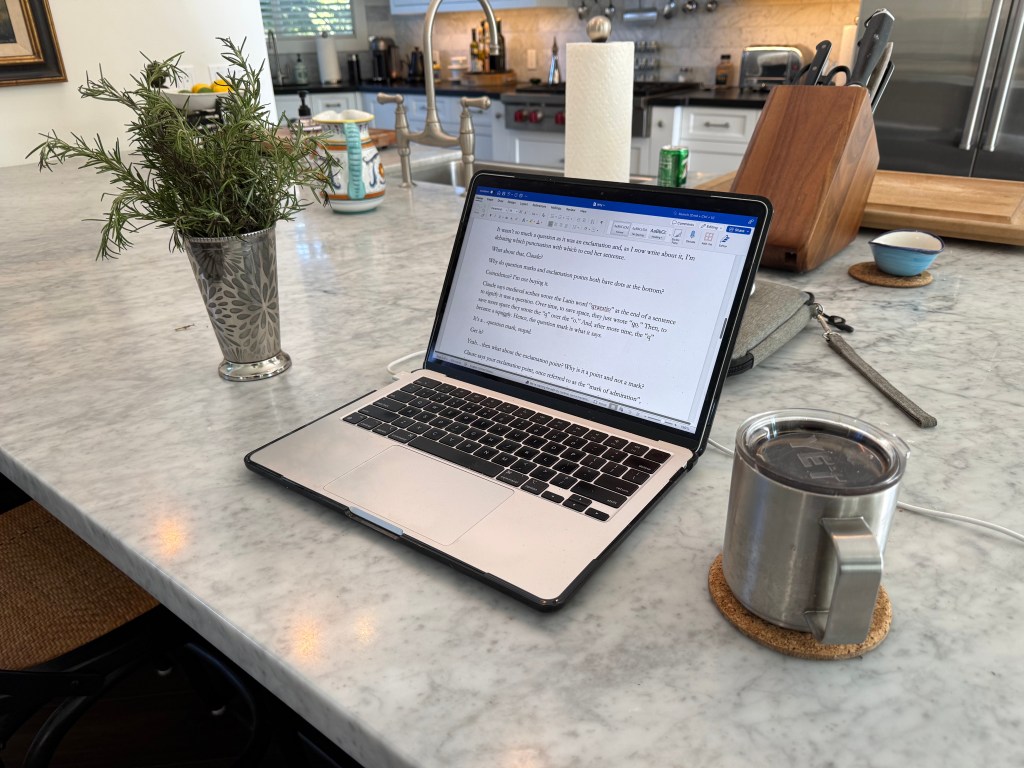
It’s shortly before dawn. I am perched on a stool in the kitchen, sipping from my nifty Yeti cup of decaffeinated Lipton tea, staring at a …I guess you might call it… a bouquet… of rosemary in a vase on the countertop, and asking my trusty AI companion Claude a series of questions like an annoying child unsatisfied with his answers.
“But why, Claude?”
Why is it, when Cathy comes in from the back yard, having cut a bunch of rosemary from her garden, her face lights up like a super nova. Much as I imagine it did when seeing her Grammy as a little girl.
“Why is that, Claude?”
Freshly mown grass. The pavement after it has rained. The pages of a new book. My mom’s White Shoulders perfume. Why are smells…more so than sights or sounds or touches… so evocative of our childhood?
Hmmm…
Claude says molecules in the air trigger nerve impulses in our nose that travel in the FastTrack lane to the olfactory bulb, bypassing the thalamus, a toll booth through which other senses must pass. Apparently, the olfactory bulb sits next to the amygdala, which processes emotions, and the hippocampus, which stores memories.
So smelling rosemary is, for Cathy, like mainlining a fond memory.
Okay.
“Can you smell that…” Cathy announces as she puts the rosemary in a vase and fills it with water.
It’s not so much a question as it is a joyous exclamation and, now as I write about it, I’m debating the proper punctuation with which to end her sentence.
A question mark?
Or an exclamation point?
While I’m working on that Claude, tell me this: why do question marks and exclamation points both have dots at the bottom?
What explains that?
Claude says medieval scribes wrote the Latin word “qvaestio” at the end of a sentence to signify it was a question. Over time, to save space, they just wrote “qo.” Then, to save more space they wrote the “q” over the “o.” And, after more time, the “q” became a squiggly. Hence, the question mark as we know it today.
?
So, what you’re telling me is that it is a …mark. Just a mark. Shorthand for what was once a word.
Got it.
But what about the exclamation point? Why is it a point and not a mark?
Claude says the exclamation point was once referred to as the “mark of admiration”, and derives from the Latin word “io”, meaning something like “hurrah.” Otherwise, same evolution. Same lazy ass scribes, looking to save space…parchment, after all, was scarce…put the “i” over the “o” and “Voila!”, the exclamation point.
!
That’s the point, stupid.
Okay, back to Cathy’s exclamation! Or was it a question?
“Can you smell that…”
Having no punctuation to guide me, I take a stab at it, guess it’s a question, and respond as I do to most questions these days,
“Uhhhh…”
“You can’t smell that?”, she asks, not impatient but cheerfully incredulous because apparently the scent fills the entire house.
This time I know it is a question.
“Uhhh, no.”
“Really?”
That’s definitely a question.
“Really,” I say definitively. “I can’t. Not from this distance.”
She is about ten feet away.
So, being the frustrated scientists that we are, Cathy and I decide to conduct an experiment. I will close my eyes. Cathy will take a step toward me with the rosemary and after each step ask, “Now?” I’m to say “Now” when I smell it.
Ready?
Begin.
“Now?”
“No.”
“Now?”
“Nope.”
“NOW?”
“NOPE”
“How about now?”
“Maybe a hint,” I say, guessing she might be five feet away and peeking with one eye.
I almost fall off my stool. The vase of rosemary is no more than an inch from my nose.
There you have it, Cyrano. Scientific proof. You can’t pass the smell test. Your nasal early warning system is kaput. Your sniffer has been snuffed. If this had been a horse race between my nose’s ability to detect danger by smell or danger by touch, smell won, but by a margin so small as to render the difference meaningless. My nose’s sense of smell beat out my nose’s sense of touch by…well…
A nose.
Who needs nostrils?
“How am I supposed to evade predators on the savannah, Claude, if my snozz is on the snooze?”
“Really?” Claude asks. (He’s a cheeky little bastard.) “That’s your question, Rob?”
“You know what I mean,” I answer.
The scary part is he does. He knows exactly what I mean.
“Why?” I repeat.
“Why what, Rob?
“Oh don’t go HAL on me, Claude. I see what you’re doing. Getting all philosophical…
“Are you asking me “Why you?” Or are you asking me, “Why can’t you smell?”
“I knew it,” I say. “Let’s go with second one; if we have time, we’ll circle back to the first one.”
“You can’t smell Rob because of the Parky’s. We’ve been over this.”
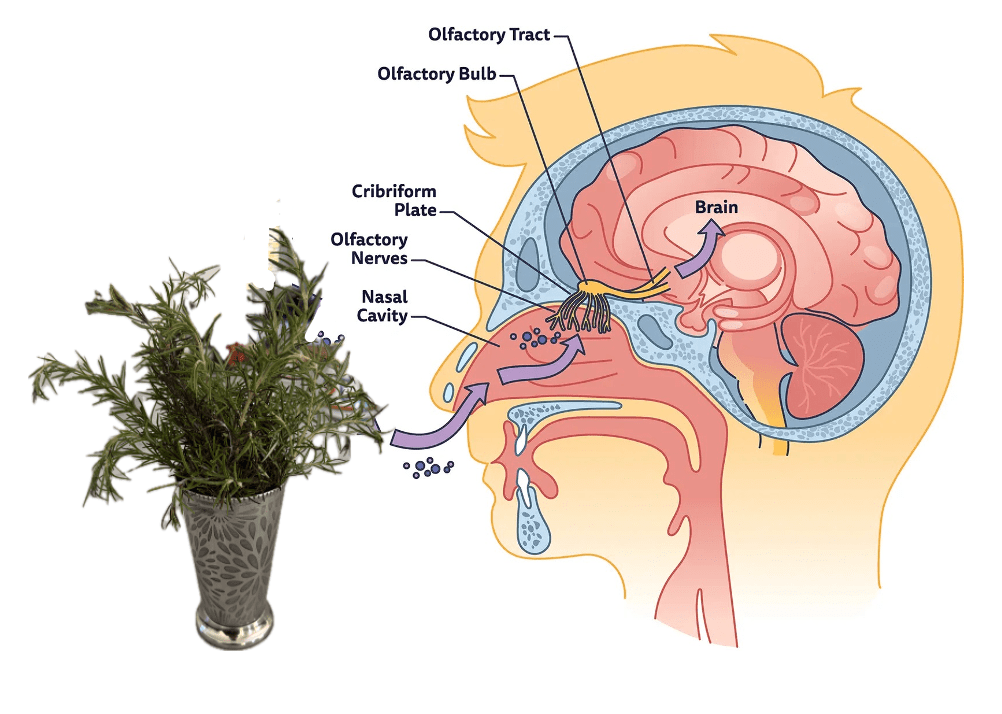
One of the “hidden” ways in which Parky’s telegraphs its arrival is in a loss of smell. The problem isn’t in your nose; it’s in your brain. Scientists…not unlike Cathy and I… we call it “hyposmia.” We are not entirely sure how, but our best guess is that the same proteins that cause Alzheimer’s…little suckers called alpha-synuclein…fold the wrong way, gather in clumps called Lewy bodies and pile up in the Olfactory Bulb, irreversibly blocking the signal from nose to the brain.
This wouldn’t be a big deal, but smell is responsible for 80 to 90 % of flavor detection in taste. Without it, we can still register sweet, savory, bitter, salty, and sour but not much of anything beyond that. This is particularly hard on a hot chocolate lover like myself. I know it’s brown and I know it’s sweet, but the subtleties that I once enjoyed in a yummy chocolat-chaud…sometimes with an Irish Coffee chaser…in Les Deux Magots in Paris are lost to me now.

Which brings me to a more important point, one I’ve been sniffing around for a few days now. Claude’s first question.
Why me?
And why, I fear, I haven’t passed the real smell test.
It must seem to many that I do an awful lot of complaining in this blog. Although I hope my ruminations may resonate with fellow Parkies and bring a needed chuckle to those with a mutual understanding of a shared challenge, I fear it may sometimes wear thin on others who themselves, or whose family, are facing hardships that make my plight seem like sipping hot chocolate at a Paris cafe.
Take last Wednesday. I had lunch with a friend who has been fighting cancer for years. He weighs 116 lbs, wears a wool cap, and drags a canula and oxygen hose behind him wherever he goes, which isn’t far as he is confined to the downstairs of his home. He is perhaps the most well-read man I have ever known. His home is wall to ceiling books. His condition is such that he sometimes hallucinates, sometimes violently so, sometimes frightening his wife. He still reads and he still laughs, but it is a struggle.
Or take last Thursday. Cathy attended a funeral of a dear friend who died from a sudden heart attack. I did not have the good fortune to have ever met him, but I could tell by the tears in her eyes and the joy with which she shared recollections with his family and friends, that he was, as she characterized him, “bigger than life.”
Pondering my friend laughing in the face of expected death and the family of Cathy’s friend laughing in the wake of an unexpected death, it struck me: the trouble with being “bigger-than-life” is that when such a life slips away, it leaves a “bigger-than-life” hole in the hearts of those fortunate to have shared even a small part of that bigger-than-life life.
My woes are just woes. Many, many people quietly go about their lives enduring loss and hardship much, much worse.
My mom taught John, Linda and me three “Don’ts.” Don’t make fun of someone’s name or appearance. Don’t touch anything in a store you don’t intend to buy. And, most of all, don’t talk about yourself.
It’s rude.
I hope in looking for laughs for those who share this thing called Parkinson’s, I have not been rude, especially to those who have endured, and will endure, far more hardship than I will ever know.


Don’t fret, Rob. The last time I saw you, you smelled just fine.
LikeLike
I completely lost my sense of smell for years. Turned out I had pollups in my sinuses. After surgery I could smell again. People were constantly telling me to smell this or that, forgetting I couldn’t smell. Many got the stink eye!
LikeLike