May 21, 2026

In December of 1978 when I was a first-year law student at the University of California, Davis, I had a peculiar habit to prepare for fall semester final exams. Although it was cold and the tule fog was thick, I would throw on my North Face parka and a Navy watch cap, load 3×5 cards into my backpack, and walk.
Walk and talk.
Walk and talk.
For hours, I would walk country roads, glancing at my cards, quizzing myself, repeating, drilling, trying to find a way to absorb and retain all the legal nonsense necessary to pass a silly exam.
Take for example, burglary. Burglary, for those of you who somehow wisely managed to avoid walking the backroads of Yolo County prepping for the Crim Law final, has three elements. It is (1) the unauthorized entry, (2) into a structure, (3) with the intent to commit a crime therein. All three elements must be satisfied to rise to the level of the crime of burglary.
So, for example, if your roommate gave you permission to go into his room before you took his television set, it might be larceny, but because the entry was authorized, there is no burglary. Or if the TV was in the backseat of your roommate’s Datsun B-210 when you lifted it . . well . . . no structure; ergo, no burglary. And if you didn’t intend to take his TV when you broke the window into his apartment, but formed the idea only after you saw it once inside, no premeditated intent, no burglary.
Are you with me? Good.
Unfortunately, the burglary I was planning as I walked those backroads had all the necessary elements to land me in the slammer. We’re talking Leavenworth.
Let’s run through the elements of burglary again:
A Structure? I planned to break into the LERHR. This was a supersecret Federal compound on Old Davis Road, about a mile south of the law school. Actually, it wasn’t too secret. It was hard to miss; you could see it from the road. It had a guard tower, barbed wire fences, and uniformed guards. Not exactly clandestine.
Authorization to enter? Hellllll, no. You see the LERHR or “Lab for Energy Related Health Research” was strictly off limits. As in, “STAY OUT. THIS MEANS YOU” off limits. It wasn’t exactly a stop on the Picnic Day Campus Tour and the folks at UCD and the Department of Energy weren’t about to let me in.
Felonious Intent? Helllll yeah! What I had in mind was a federal offense. I’m talking 120 counts, probably five to ten at Lompoc.
I planned to let the beagles out.

In the fifties, radiation was all the rage. Yer Ruuskies were threatening to blow us Amerikanskis to smithereens. So, the crack scientists in the Atomic Energy Commission or AEC were curious what would happen to those of us dimwits who were not lucky enough to be vaporized. Basically, what was the longterm fallout of short-term fallout? So, they teamed up with UC Davis to find out.
From 1956 when I was born until 1986, five years after graduating from law school less than a mile away, researchers at UC Davis were part of what was called the “Beagle Club”, a set of experiments in six states to study the effects of nuclear contamination. At the LERHR, scientists fed beagles strontium 90, injected some with radium, and irradiated others with cobalt to see how nuclear fallout might affect people.
We’re talking a shitload of radioactive material. Hell, they even built a special septic system to treat and contain radioactive dog poop. It didn’t always work, as overflow radioactive sewage was sometimes released into Putah Creek. To this day, radioactive strontium and radium used in the beagle experiments remains in the soil, the laboratories, and the kennels.
Little did I know, as I repeatedly walked by the kennels in 1978, that I was next to a spot so radioactive that it would later be considered a candidate for a superfund site.
Why beagles, you might ask? The AEC and UCD boys claimed beagles were chosen because they are long-lived, have greater genetic diversity than other dog species and their skeleton and bonemarrow resemble that of humans. These purported reasons may well have been the motivation in 1956, but what I am sure the researchers found by 1993 when 1200 beagles were released—and as any beagle owner would tell you–the real reason beagles were perfect for their daffy study is that beagles are too damn stubborn to die.
I know. I had one.
His name was Homer.
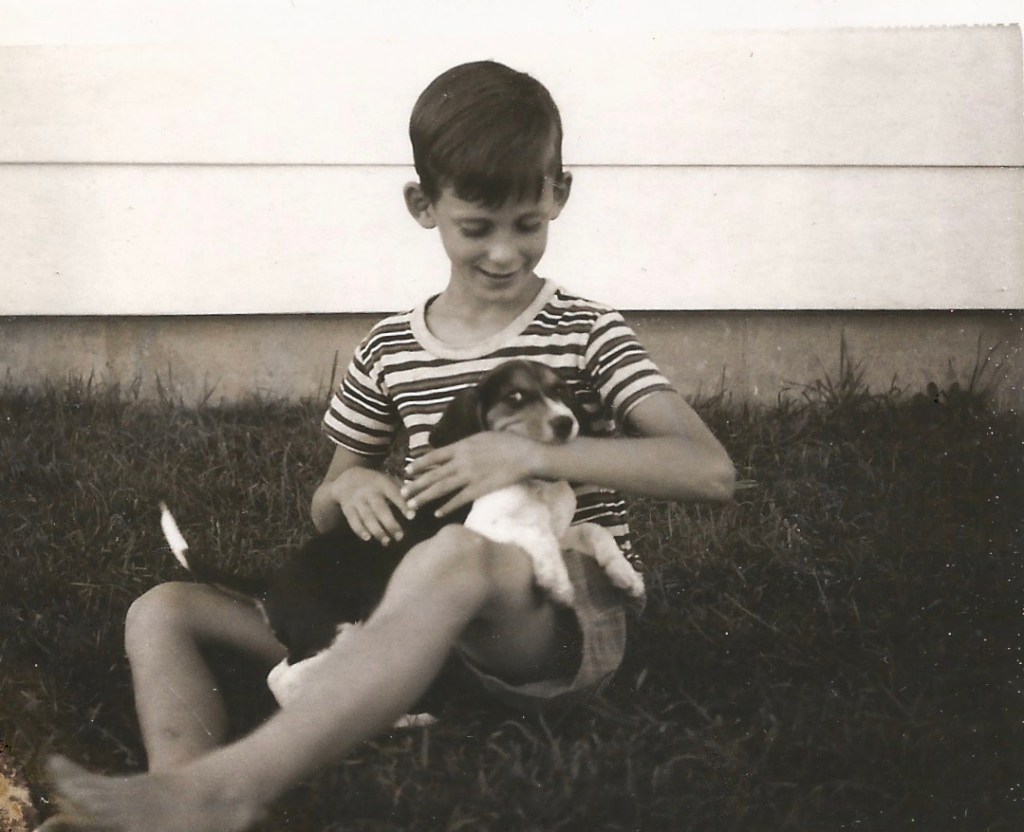
On my eighth birthday in 1964, the family drove to a farm near Marshall, the small town in Michigan where I grew up. I was invited to pick a pup from a recent litter and I chose the smallest. I recall my dad paid twenty dollars, which at the time, seemed an extravagance for a birthday present.
As I played with the little guy on my lap, my first impulse was to name him “Henry.” In this I was quicky overruled, as the consensus in the family was that this was a singularly dumb name for a dog.
How Homer came to be Homer is the subject of some conjecture. There was a beagle named Hector in the neighborhood and it might have been something as simple as searching for another “H” name. My dad often used a phrase to connote a long span of time: “. . . since Hector was a pup.” That might have entered the formulation. I would like to say that his name was pulled from the ancient Greeks, but more likely it was pulled from Homer and Jethro, a musical comedy duo who were famous at the time for Kellogg’s Corn Flakes TV ads in which the breakfast cereal, made just down the road in Battle Creek, was hawked with the catchy phrase, “Oooh, that’s corny.”
Get it?
The good folks at the American Kennel Club will tell you that your beagle is an “excellent hunting dog”, a “loyal companion”, “happy-go-lucky, funny, and (thanks to its pleading expression) cute.” All true but a would-be beagle owner had best keep a few other things in mind:
- A beagle is a hound. He wants to hunt. In particular, he wants to hunt rabbits (“beagling”). His one objective in life is to bolt through any open door presented to him and high tail it for the hills, from where, once he as arrived, he will disregard all calls to return.
- Says right here on the AKC website that beagles are intelligent, but “because they were bred for the long chase”, they are “single minded” and “determined.” This sanitized characterization is kind of the AKC, but what they are really trying to tell you is that beagles are so damn stubborn and so easily distracted that they are virtually impossible to train.
- A beagle will not heel. A leash is an impediment; it stands between him and where he wants to be. The concept of “restraint”, in walking or any other endeavor, is not in the beagle brain.
Homer was my boyhood pal. Though seldom at my heel, we were inseparable. At night, he would jump up onto the lower bunk, curl up in that curious fashion that dogs do, turning three times in a circle, before settling down between my legs, bowed wide to accommodate him.
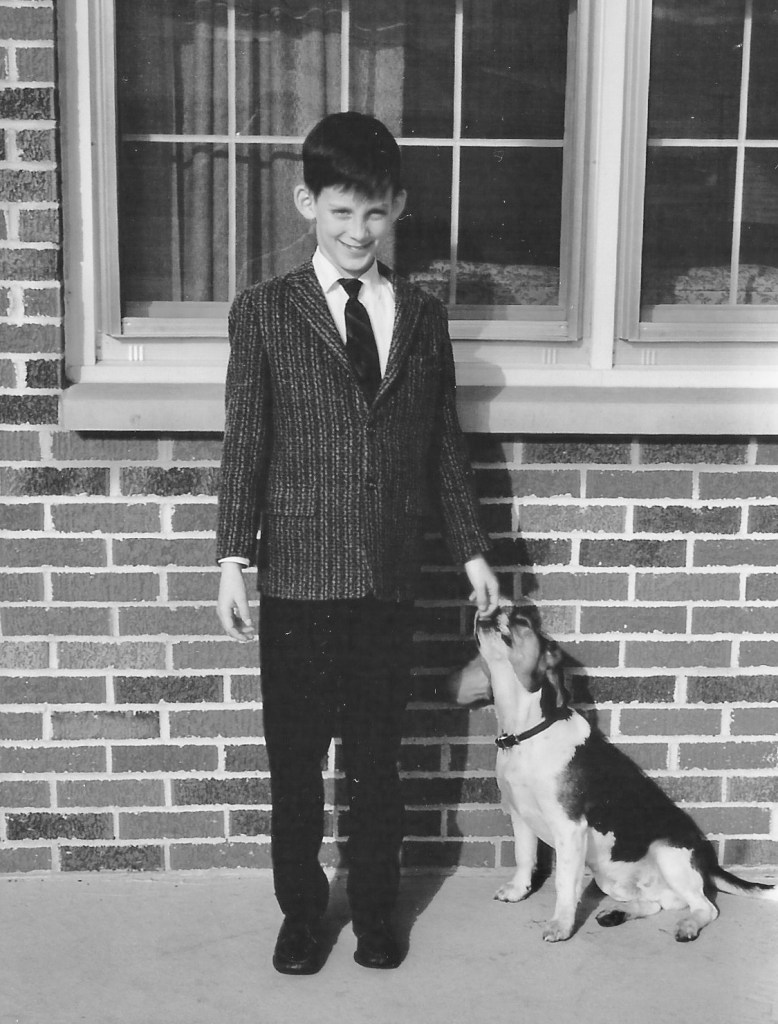
In the fall he would bound through the leaves; in the winter you could detect his whereabouts by the tip of his tail emerging like a periscope from beneath the drifts, darting this way and that as, even in the dead of winter, that nose searched for the scent of a rabbit.
He was the unofficial mayor of Marshall. Known to everyone in town by his name, he would wander down Michigan Avenue, lord of all he surveyed. Folks would call out to Homer as if he were their own. When at night, we went to bed worried that he hadn’t come home, strangers—to the extent there was such a thing in Marshall– would call my folks to reassure us and say, “don’t worry; Homer is here.”
It may sound apocryphal in this age of leash laws, but Homer would roam far and wide, never on a leash. As such, he was the elusive and wily antagonist of the town’s much maligned dog catcher. Their moves and counter moves, their match of wits, their mutual disdain for what they saw as the other’s inferior intellect and primitive tactics, became the talk of the town.
Since he was inclined to follow me wherever I went, mom would keep him in the house as we set out each day to school. In the Spring, when the weather turned warm, the school doors were left open to allow for an occasional breath of fresh air. After waiting an hour, mom would let Homer out and he would bolt straight for the school, wander the halls until he found my room, mosey in, and curl up beneath my desk.
Once, while chasing a garbage truck, Homer managed to break a leg. The vet put a cast on it and I can still recall the “clunk…pat . . . pat . . . clunk . . . pat . . . pat . . . clunk” as Homer roamed the halls of my grade school, his cast thudding on the linoleum, as he looked for me.
Once, unbeknownst to me, Homer jumped through a glass window, slicing his belly down the middle like a surgical incision. I was horrified when he came home and rolled over onto his back to present his belly for the customary scratching, and I received a much too graphic insight into beagle anatomy.
He must have cost my folks a fortune in vet bills.
When we moved to Philadelphia, we stayed for a month in a Holiday Inn paid for by State Farm as we waited to get into our new house. Homer would bark and bey from the motel room when we went out to eat. His beagle bark so resembled the sound of a seal, that hotel management once admonished dad that, while pets were allowed, marine mammals might be pushing it.
When I wad eleven-years-old our family lived in a split-level house on a white-bread middle class street of a suburb called Springfield on the southside of Philly. It was the Sixties’ version of the neighborhood to which Tony Soprano returned home in each episode of The Sopranos.
Our next-door neighbor was a shadowy and mysterious character whom we suspected to be Mafioso himself. He was always impeccably dressed and emerged each morning, at the exact same time, in his wool topcoat and Fedora hat, and walked to the curb where a driver would open the door to a black Caddy and whisk him away behind tinted windows.

As luck would have it, this was the same time of day in which I would take Homer for a walk. (Springfield was not as enlightened on leash laws as Marshall.) I would usually set off hoping to avoid an encounter with the black Caddy and, when that plan proved unsuccessful and our paths would cross, I would walk head down, tugging on Homer, careful not to draw the attention of the driver or his sinister passenger in the back seat.
It was on just such a morning that a nasty old lady emerged from her house at the end of the block and, suspecting I had given Homer license to “do his business” on her lawn, gave me an earful, basically threatening me and my dog that were we to ever visit her lawn again she would call the police.
I was terrified and turned to run home. As I did, the black Caddy pulled up. The tinted window slowly lowered and, although I could not hear the conversation, I could tell that the nasty old gal was a bit shaken.
I continued down the street, my pace quickening, still tugging on Homer to stop sniffing and get the hell out of there. To my horror, the black Caddy, instead of speeding away, now in reverse, slowly and ominously pulled alongside me. I stopped, convinced I would soon be swimming with da fishes, as the tinted window on the back passenger side slowly descended. Afraid to make eye contact, I never saw the man, but to this day I can recall a very kindly voice with a thick Philly accent emerge from the back and assure me I could walk my dog anywhere I wanted for as long as I wanted. And I needn’t worry about the police.
Hey! Sometimes the protection racket is a good thing. Capiche?
Mind you, Homer was not above joining in a bit of criminal mischief. It must have been . . . oh . . . I wanna say . . . 1971 when my best friend Mark Andrews would call late at night and suggest it might be a good time—wink, wink, nod, nod–to “take Homer for a walk.”
While I was throwing a leash on Homer and reassuring mom and dad I would be back in a bit, Mark, who lived a mile away, would kindly offer to his mom Helen to pull the family’s 64 Chevy BelAir station wagon into the driveway from where she parked it on the street. We were too young to drive, but Helen thought allowing Mark to drive 50 feet from the street to the driveway did not qualify as a Vehicle Code violation nor present a mortal danger. So, she would gratefully hand Mark the keys as she dozed off.
Mark would slip past the driveway down Grove Avenue quietly so as not to wake up Helen, then accelerate east on Dupont, and come to a screeching stop at the corner of St. Francis and Escalero Drives; just long enough for me to throw Homer in the back seat of the BelAir and jump in the front. Mark would then drive throughout the neighborhood, taking corners far faster than was safe, far louder than the neighbors appreciated, but just right for an aging beagle that slid happily, ears flapping, from one side to the other of the back vinyl rear seat. Helen never knew.
Years passed. When I went off to college, I left Homer behind.
I always wondered if he felt I had abandoned him. You know . . . Puff the Magic Dragon . . . Jackie Paper. . . “A dragon lives forever, but not so little boys …Painted wings and giant’s rings make way for other toys.”
More years passed. His age began to catch up with him. His legs would lock up so that he couldn’t walk. The vet told my folks to put him down, but mom and dad refused. Dad built a redwood tub of sorts, the size of a horse trough, and each night he and mom would heat water on the stove, fill the trough, and hold Homer in the warm water, prompting him to work his legs to avoid drowning. It worked and Homer enjoyed his last days upright and roaming in the backyard as was his nature.
Mom and dad later recounted to me that they knew Homer’s end was near when he began to look for something to crawl under. Apparently, this is not uncommon. A dog’s instinct is to isolate himself for protection. He knows he is dying, and by hiding he is doing the only thing he can to stay safe and protect himself.
I should have been there with him.
The last of the Davis Beagles died at the age of 18, not long after I stopped walking down Old Davis Road, a few years after I became an attorney. I think of them often. I think of the lives they might have lived.
I was a lawyer for over 40 years. Somehow, I managed to remember—without 3×5 cards—all the nonsense necessary to practice law.
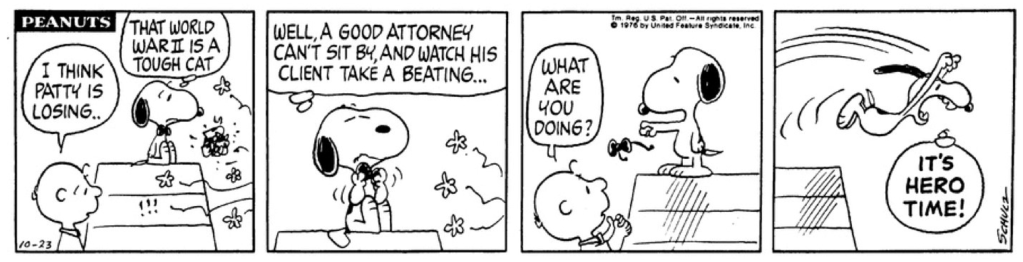
But, as is so often the case, the important lessons in life aren’t in the damn 3×5 cards. They’re not found by memorization or drill or mindless repetition. The elements of burglary are seldom relevant except when contemplating burglary or explaining to a federal judge why what you did was not burglary. The important lessons are right in front of us if we would only look up from the damn cards long enough to see.
My best teacher was a beagle. He taught me to roam, to tug at the leash, to think “Squirrel” when someone wanted me to “stay.” He taught me never to heel, the importance of friendship, and to stretch my legs for as long as I can before I curl up to die.
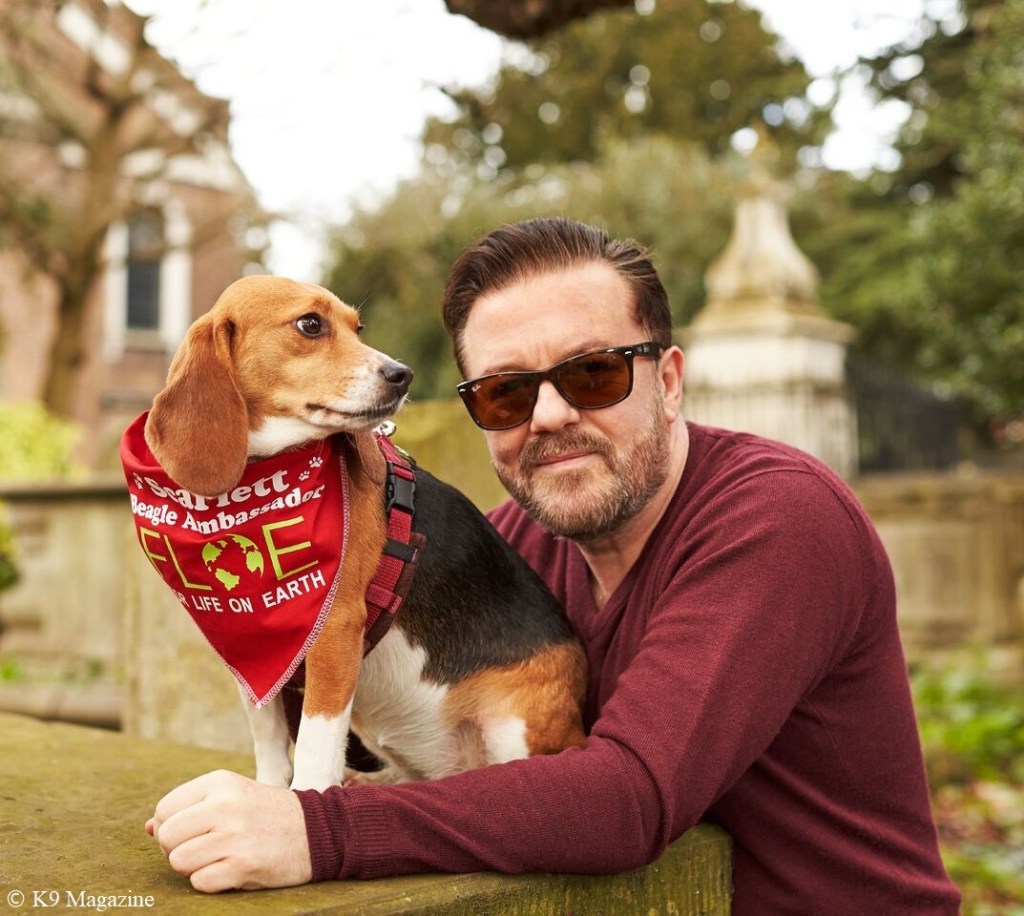
Some folks admire Ricky Gervais; some folks don’t. Some find him crass and detest his atheist ideology.
I get it.
Me? I like the guy. While I often wince at his humor, I admire his eloquence in speaking on behalf of those of us “non-believers” and I especially enjoy the way he ridicules the Hollywood self-important.
He seems a wise and kind man and I suspect that is, at least in part, owing to lessons he has learned from his dog.
A beagle can teach you much. Mine did.

